 SUNSET:

 0
0Some daily events in the changing sky for May 23 – 31.
The bright International Space Station continues to have many good flyovers this week. Amaze your friends! Show them one of its passes above your hometown using our custom prediction generator.
Comet Boattini, about 6th magnitude, is visible this week from the southernmost US, the tropics, and the Southern Hemisphere, now that the Moon is out of the early-evening sky. The comet is crossing northern Pyxis and Puppis: low in the southwest right after dusk for the latitudes of the southern US. See our article and finder charts. It's been seen naked-eye from Australia.
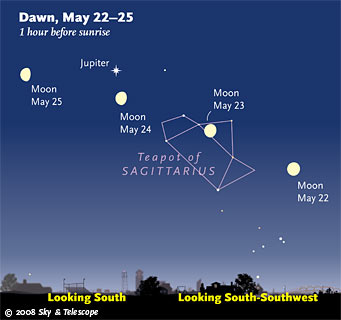
In early dawn later this week, the waning Moon marches past the Sagittarius Teapot and Jupiter. The scene is plotted for the middle of North America. European observers: move each Moon symbol a quarter of the way to the one for the previous date.
Sky & Telescope diagram
Friday, May 23
See article and chart.
Saturday, May 24
Sunday, May 25
Monday, May 26
Tuesday, May 27
Wednesday, May 28
Thursday, May 29
Friday, May 30
Saturday, May 31
Don't know where it is? Get out your Sky & Telescope and turn to the monthly fold-out constellation chart. Porrima is the brightest star a little more than a fist-width to the upper right of Spica in the south after dark.
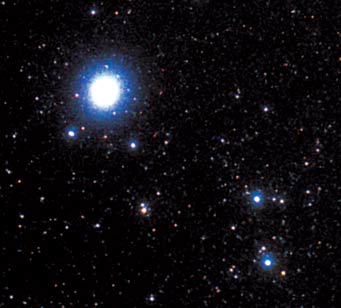
Bright Vega dominates the little thumb-sized constellation Lyra, currently dangling to Vega's lower right.
Akira Fujii
Want to become a better amateur astronomer? Learn your way around the constellations. They're the key to locating everything fainter and deeper to hunt with binoculars or a telescope. For an easy-to-use constellation guide covering the whole evening sky, use the big monthly foldout map in each issue of Sky & Telescope, the essential magazine of astronomy. Or download our free Getting Started in Astronomy booklet (which only has bimonthly maps).
Once you get a telescope, to put it to good use you'll need a detailed, large-scale sky atlas (set of maps; the standards are Sky Atlas 2000.0 or the smaller Pocket Sky Atlas) and good deep-sky guidebooks (such as Sky Atlas 2000.0 Companion by Strong and Sinnott, the even more detailed Night Sky Observer's Guide by Kepple and Sanner, or the classic Burnham's Celestial Handbook). Read how to use them effectively.
More beginners' tips: "How to Start Right in Astronomy".
This Week's Planet Roundup
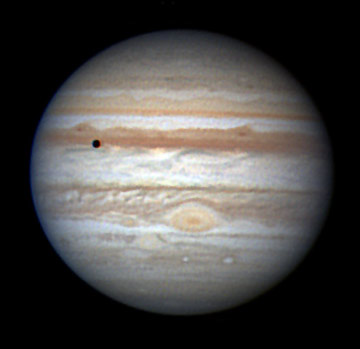
Jupiter on May 24th. The North Equatorial Belt, above center, "is getting lighter in color from the deep dark red a few weeks ago," writes photographer Christopher Go. The black dot on it is the shadow of Io. Visible below center are not just one red spot but three; see picture below. The Great Red Spot remains near System II longitude 121°. North is up (though many telescopes show south up).
Mercury and Venus are hidden in the glare of the Sun.
Mars (magnitude +1.5, in Cancer) shines high in the west after dark, off to the upper left of the Castor-and-Pollux couple. Each week Mars is moving farther away from them and closer to the Saturn-and-Regulus couple to Mars's upper left. Mars, Saturn, and Regulus will have close get-together in early July.
In a telescope, Mars is a minuscule 5.1 arcseconds wide — a very tiny blob.
Jupiter (magnitude –2.6, in eastern Sagittarius) rises around 11 or midnight daylight saving time, left of the Sagittarius Teapot. It's highest in the south, and therefore sharpest in a telescope, shortly before dawn. (The table of Jupiter's satellite phenomena in the May Sky & Telescope is incorrect; use this corrected version.)
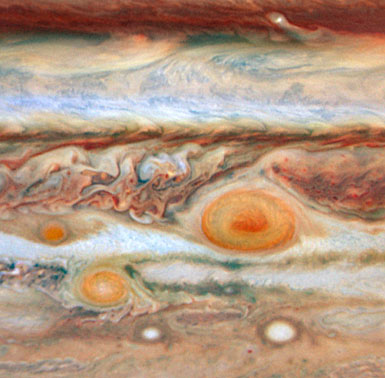
The Hubble Space Telescope caught Jupiter's three red spots on May 10, 2008. They're closing in toward each other daily. The Great Red Spot is at right, Oval BA ("Red Spot Junior") is the lowest, and 2008 Oval 2 is at left. Color contrast is exaggerated. North is up. Read more.
Even today, the cause of the coloring is not known for sure. The leading theory is that when a storm grows strong enough, it dredges up some compound from deep below the clouds and lofts it to unusually high altitude, where ultraviolet sunlight causes a chemical reaction that produces the red stuff. See full coverage of the recent Jupiter campaign by Hubble and Keck.
Alan MacRobert
In the last few weeks, planetary scientists have been using the Hubble and Keck telescopes for a coordinated, multi-wavelength observing campaign to track Jupiter's current upsurge of activity and to tackle its chemical mysteries. Start here.
Saturn (magnitude +0.7, in Leo) glows high in the southwest after dark, 2½° above fainter Regulus (magnitude +1.4). They're quite the eye-catching couple, though they're gradually getting wider apart now.
Telescope users: there's more to Saturn than you may realize! See our Saturn observing guide in the April Sky & Telescope, page 66.
Uranus and Neptune (magnitudes 6 and 8, respectively, in Aquarius and Capricornus) are in the east and southeast just before dawn. Use our article and finder charts.
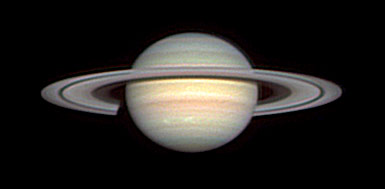
In a large amateur scope during excellent seeing, a pair of white storms is visible in Saturn's South Temperate Zone. This stacked-video image was taken at 11:15 UT on May 1, 2008, when the System II longitude on the central meridian was 70°. North is up.
To find when the white spots are back in view the same way as seen here: For your date (in Universal Time), look up Saturn's System II central-meridian longitude in this table (it's the "CMII" column). That's the value for 0:00 UT that date. To this value, add 33.8° for each whole hour since 0:00 UT, and 0.56° for each minute, for the time you plan to observe. See what you get. Find a good Saturn-observing date and time for you that results in something around 70°, and plan to be out then with your scope.
P.S.: Here's an incredible closeup shot of the storm by Cassini taken on March 4th. And Cassini's radio instruments find that the storm is full of lightning.
Christopher Go
Pluto (magnitude 14.0, in northwestern Sagittarius) is well up in the southeast after midnight. If you've got a big scope and ambition to match, use our article and finder chart.
All descriptions that relate to your horizon or zenith — including the words up, down, right, and left — are written for the world's mid-northern latitudes. Descriptions that also depend on longitude (mainly Moon positions) are for North America. Eastern Daylight Time (EDT) equals Universal Time (UT, UTC, or GMT) minus 4 hours.
"Rational and innocent entertainment of the highest kind."
— John Mills, 19th century Scottish manufacturer and founder of Mills Observatory, on amateur astronomy.
----------------------
To be sure to get the current Sky at a Glance, bookmark this URL:
http://SkyandTelescope.com/observing/ataglance?1=1
If pictures fail to load, refresh the page. If they still fail to load, change the 1 at the end of the URL to any other character and try again.
About Alan MacRobert
Alan M. MacRobert became an avid Sky & Telescope subscriber in 1966 at age 14, joined the editorial staff in 1982, and is now a senior contributing editor, semi-retired. He played a role in practically every part of the magazine and the company's other products for more than a generation, both on the amateur-observing side and the science-reporting side. In 1994 a book collection of his observing how-tos and telescopic sky tours was published as Star Hopping for Backyard Astronomers. He has produced This Week's Sky at a Glance online every week since 1989.


Comments
You must be logged in to post a comment.