 SUNSET:

 0
0Some daily events in the changing sky for April 18 – 26.
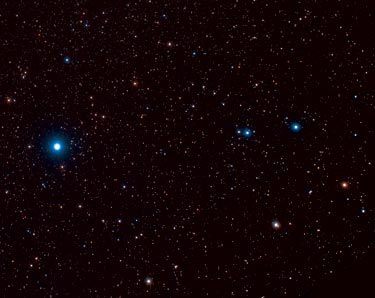
Spica (left) and Corvus (stars at right) glitter at the same height in the southeast shortly after dark in late April.
Akira Fujii
Friday, April 18
The bright star far off to the Moon's left, dominating the eastern sky, is ginger-ale-colored Arcturus.
Saturday, April 19
Sunday, April 20
Monday, April 21
Tuesday, April 22
Wednesday, April 23
Thursday, April 24
Friday, April 25
The rest of Hydra winds dimly all the way left across the sky to its tail at the southeastern horizon.
Saturday, April 26
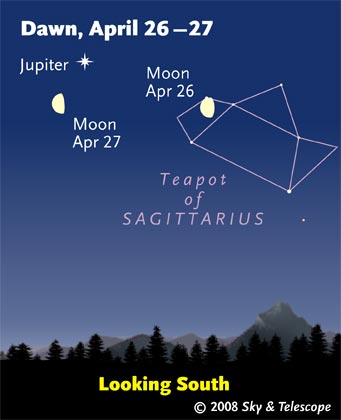
Early risers will see the waning Moon passing the Sagittarius Teapot and bright Jupiter. (These scenes are drawn for the middle of North America. European observers: move each Moon symbol a quarter of the way toward the one for the previous date.)
Sky & Telescope diagram
Want to become a better amateur astronomer? Learn your way around the constellations. They're the key to locating everything fainter and deeper to hunt with binoculars or a telescope. For an easy-to-use constellation guide covering the whole evening sky, use the big monthly foldout map in each issue of Sky & Telescope, the essential magazine of astronomy. Or download our free Getting Started in Astronomy booklet (which only has bimonthly maps).
Once you get a telescope, to put it to good use you'll need a detailed, large-scale sky atlas (set of maps; the standards are Sky Atlas 2000.0 or the smaller Pocket Sky Atlas) and good deep-sky guidebooks (such as Sky Atlas 2000.0 Companion by Strong and Sinnott, the even more detailed Night Sky Observer's Guide by Kepple and Sanner, or the enchanting though increasingly dated Burnham's Celestial Handbook). Read how to use them effectively.
More beginners' tips: "How to Start Right in Astronomy".
This Week's Planet Roundup
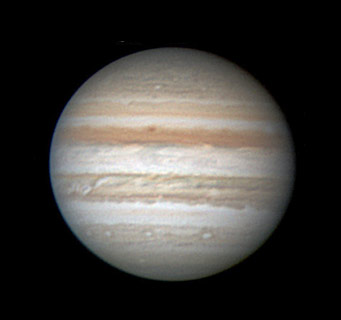
Jupiter is getting high enough now in early dawn to show detail well in a telescope . The North Equatorial Belt (brown band just above center) remains wide and very dark. The South Equatorial Belt (just below center) has divided into northern and southern halves. A South Equatorial Belt Disturbance has created the irregular white markings near the left (following) limb. Note the very different colors of the belts in the in the northern and southern hemispheres. The Equatorial Zone, after being remarkably dark last year, has returned to its normal bright state. Christopher Go took this extremely sharp image on April 3, 2008. The time was 20:20 UT, and the System II central-meridian longitude was 32°. North is up (but remember that many telescopes will show south up).
Mercury and Venus are lost in the glare of the Sun.
Mars (magnitude +1.1, in Gemini) shines high in the southwest to west during evening. It forms a skewed triangle with Pollux and Castor above it. The triangle grows flatter every day.
Compare Mars's color to that of Pollux, which now its equal in brightness. Pollux is an orange giant star of spectral type K0 III. To me, the tint of Mars looks slightly deeper.
In a telescope Mars is only 6.0 arcseconds wide — just a very tiny gibbous blob.
Jupiter (magnitude –2.3, in eastern Sagittarius) rises around 2 a.m. daylight saving time and glares in the south-southeast by dawn. The farther south you live, the higher you'll be able to observe it — and thus the sharper the view of it in your telescope — before dawn gets too bright.
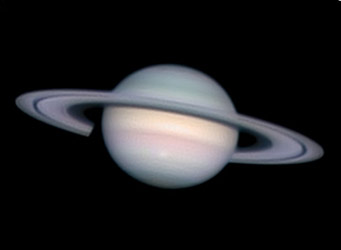
A white storm has broken out in Saturn's South Temperate Zone. It shows plainly in this stacked-video image, taken by Sean Walker through a 12.5-inch reflector at 0:42 UT April 23rd in excellent atmospheric seeing. The System II central-meridian longtude was 57°. "The white spot was visible in an eyepiece at over 500x, particularly through a green filter," he writes. North is up.
To find when this view will repeat: For your date, look up Saturn's System II central-meridian longitude in this table (it's the "CMII" column). That's the value for 0:00 Universal Time (UT or GMT) on your date. To this value, add 33.8° for each whole hour since 0:00 UT, and 0.56° for each minute, for the time you plan to observe. See what you get. Find a good Saturn-observing time and date that results in something around 57°, and plan to be out then with your scope.
S&T: Sean Walker
Saturn (magnitude +0.5, near Regulus in Leo) glows very high in the south to southwest during evening, just 2¼° from fainter Regulus (magnitude +1.4). They'll remain this close for a month to come.
Telescope users: there's more to Saturn than you may realize. See our Saturn observing guide in the April Sky & Telescope, page 66.
Uranus and Neptune are low in the southeast before dawn.
Pluto (magnitude 14.0, in northwestern Sagittarius) is highest in the south just before dawn's first light.
All descriptions that relate to your horizon or zenith — including the words up, down, right, and left — are written for the world's mid-northern latitudes. Descriptions that also depend on longitude (mainly Moon positions) are for North America. Eastern Daylight Time (EDT) equals Universal Time (UT, UTC, or GMT) minus 4 hours.
To be sure to get the current Sky at a Glance, bookmark this URL:
http://SkyandTelescope.com/observing/ataglance?1=1
If pictures fail to load, refresh the page. If they still fail to load, change the 1 at the end of the URL to any other character and try again.
About Alan MacRobert
Alan M. MacRobert became an avid Sky & Telescope subscriber in 1966 at age 14, joined the editorial staff in 1982, and is now a senior contributing editor, semi-retired. He played a role in practically every part of the magazine and the company's other products for more than a generation, both on the amateur-observing side and the science-reporting side. In 1994 a book collection of his observing how-tos and telescopic sky tours was published as Star Hopping for Backyard Astronomers. He has produced This Week's Sky at a Glance online every week since 1989.


Comments
You must be logged in to post a comment.