 SUNSET:

 0
0Some daily events in the changing sky for February 29 – March 8.
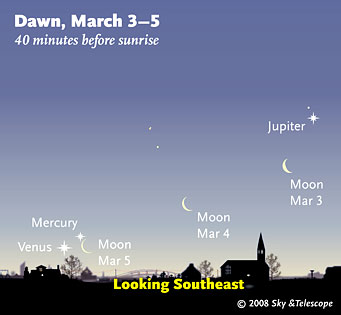
If you're up early, look low in the brightening dawn for every significant object in the solar system that's currently closer to the Sun than Earth is. Plus Jupiter. (These scenes are drawn for the middle of North America. Southerners will see all the objects higher. European observers: move each Moon symbol a quarter of the way toward the one for the previous date. For clarity, the Moon is shown three times actual size.)
Sky & Telescope illustration
Friday, February 29
Saturday, March 1
Sunday, March 2
This is the best season of the year for seeing the evening zodiacal light if you're in the Northern Hemisphere — because this is when the ecliptic extends most nearly upright from the western horizon at dusk.
Monday, March 3
Tuesday, March 4
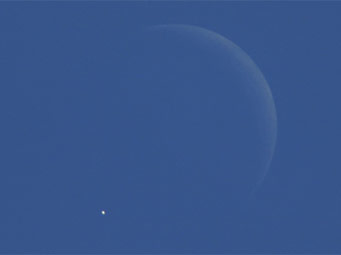
In daylight on June 18, 2007, Alan C. Tough in Scotland took this shot of Venus just before it was occulted by the dark limb of a thin waxing Moon. The Moon was much thicker (15% illuminated) and farther from the Sun than it will be on March 5th. Tough used a Canon EOS 300D camera with a 600-mm lens. Exposure: 1/320th second, f/6.3, ISO 100. Click image for larger view.
Alan C. Tough
Wednesday, March 5
Thursday, March 6
Friday, March 7
Saturday, March 8
Want to become a better amateur astronomer? Learn your way around the constellations. They're the key to locating everything fainter and deeper to hunt with binoculars or a telescope. For an easy-to-use constellation guide covering the whole evening sky, use the big monthly foldout map in each issue of Sky & Telescope, the essential magazine of astronomy. Or download our free Getting Started in Astronomy booklet (which only has bimonthly maps).
Once you get a telescope, to put it to good use you'll need a detailed, large-scale sky atlas (set of maps; the standards are Sky Atlas 2000.0 or the smaller Pocket Sky Atlas) and good deep-sky guidebooks (such as Sky Atlas 2000.0 Companion by Strong and Sinnott, the even more detailed Night Sky Observer's Guide by Kepple and Sanner, or the enchanting though increasingly dated Burnham's Celestial Handbook). Read how to use them effectively.
More beginners' tips: "How to Start Right in Astronomy".
This Week's Planet Roundup
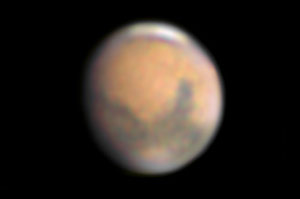
Mars is now a featureless little gibbous blob in most telescopes, but Sean Walker recorded its major features well on the evening of March 2nd using a 12.5-inch scope, stacked video frames, and some fairly intense image processing. North is up. Syrtis Major pokes upward on the right, and Sinus Sabaeus runs leftward to Sinus Meridiani on the sunrise terminator. Mars was just 8.9 arcseconds in diameter at the time. The central-meridian longitude was 320°.
S&T: Sean Walker
Mercury (about magnitude +0.0) is just 2° or 3° to the upper right of brilliant Venus low before sunrise. But it's dozens of times fainter, so bring binoculars.
Venus (magnitude –3.9, in Capricornus) is getting lower every morning. Look for it above the southeast horizon about 30 minutes before sunrise, far lower left of Jupiter.
Mars (about magnitude +0.3, at the Taurus-Gemini border) shines very high in the south to southwest during evening, high over Orion. In the same binocular field of view with Mars is the star cluster M35 in Gemini. In a telescope this week, Mars dwindles from 9.1 to 8.4 arcseconds wide — pretty tiny.
Jupiter (magnitude –2.0, in Sagittarius) shines low in the southeast before and during dawn. It's moving ever farther to the upper right of Venus.
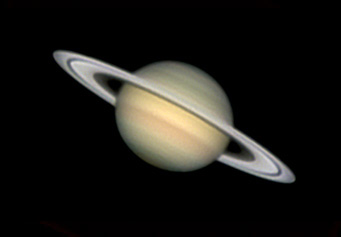
Saturn's rings are currently tilted only 8° to our line of sight, as seen in this image taken on the evening of February 23rd when Saturn was at opposition. Two weeks earlier, the outer edge of the rings was sharply outlined by a thin line of their black shadow on the globe, but now the shadow is hidden. Note the dusky C ring just inside the broad, bright B ring. The C ring is obvious as a dark silhouette where it crosses in front of the globe. North is up.
S&T: Sean Walker
Saturn (magnitude +0.2, in Leo) was at opposition on February 23rd. It glows low in the east as twilight fades, rises higher all evening, and stands highest in the south around 11 p.m.
Fainter Regulus (magnitude +1.4) is 5° west of Saturn: to its upper right in early evening, and directly right of it later. Only a little dimmer than Regulus is Gamma (γ) Leonis (magnitude +2.1), located 8° more or less to Regulus's north. The three make an eye-catching triangle. Watch the triangle narrow in the coming weeks.
Uranus and Neptune are hidden in the glare of the Sun. (Neptune is in the vicinity of Venus and Mercury, but it's too dim to see through the bright dawn even with a telescope.)
Pluto (magnitude 14.0, in Sagittarius) is in the southeast before dawn's first light.
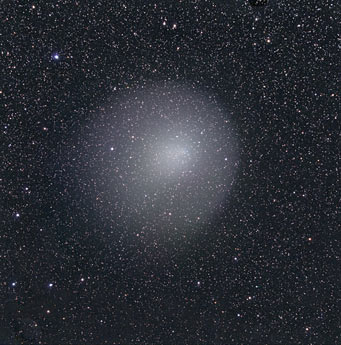
Dennis di Cicco shot this image of Comet Holmes using a Tele Vue NP127is (5-inch) refractor and Apogee Alta camera on February 11th. The field is 3° tall, with north up. "This comet is getting huge!" he writes. "So much so that I initially had a difficult time seeing it in a short exposure, because it looked like the typical 'hot spot' in the center of the frame due to optical vignetting." Click image for larger view.
S&T: Dennis di Cicco
Comet Holmes is passing the California Nebula this week. Both are dim but large. Think photo opportunity!
The comet itself continues to dim. On February 11th through suburban light pollution, Dennis di Cicco could not see it with the naked eye at all when he took the picture at right.
On February 24th, says Tony Flanders, "the comet was barely visible naked-eye from a modestly dark rural site. It was still pretty obvious in 15x70 binoculars, and it looked to me to be about 1° by 3/4°. I could see no sign of internal detail at all." Holmes is now shrinking slightly in apparent size as it moves farther from Earth and, also, as its outermost parts fade to invisibility.
The comet continues moving eastward in Perseus; look as soon as nightfall is complete. Chart.
All descriptions that relate to your horizon or zenith — including the words up, down, right, and left — are written for the world's mid-northern latitudes. Descriptions that also depend on longitude (mainly Moon positions) are for North America. Eastern Standard Time (EST) equals Universal Time (UT, UTC, or GMT) minus 5 hours. Eastern Daylight Time (EDT) is UT minus 4 hours.
To be sure you always get the current Sky at a Glance, bookmark this URL:
http://SkyandTelescope.com/observing/ataglance?1=1
If pictures fail to load, refresh the page.
About Alan MacRobert
Alan M. MacRobert became an avid Sky & Telescope subscriber in 1966 at age 14, joined the editorial staff in 1982, and is now a senior contributing editor, semi-retired. He played a role in practically every part of the magazine and the company's other products for more than a generation, both on the amateur-observing side and the science-reporting side. In 1994 a book collection of his observing how-tos and telescopic sky tours was published as Star Hopping for Backyard Astronomers. He has produced This Week's Sky at a Glance online every week since 1989.


Comments
You must be logged in to post a comment.