 SUNSET:

 0
0Some daily events in the changing sky for December 28 – January 5.
Two comets float high in the dark, moonless evening sky this week. They're not very far apart. Comet Holmes remains in Perseus, dim but big — more than 1° across. Look for it north of Algol all week, and bring binoculars. Comet 8P/Tuttle is much tinier, and it's greenish. It was about magnitude 6.5 on December 26th and should be about 6.0 this week.
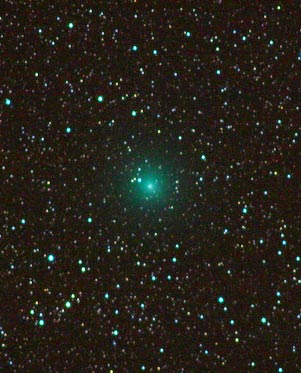
Comet Tuttle is small and green, the color of the gases C2 and CN fluorescing in sunlight. (Comet Holmes, by contrast, is the white color of sunlight reflected from dust.) "The sky was perfectly clear at sunset on Christmas Day, which permitted my first look at 8P/Tuttle," writes photographer Doug Zubenel in Kansas. "With long, careful observations using averted vision, I could barely pick the comet out with my naked eye!" He took this 2-minute exposure with a 300mm lens at f/5.6 on a Hutech-modified Canon Rebel XTi camera set at ISO 800.
Alan MacRobert
Watch Tuttle race southward from night to night. It moves from Andromeda into Triangulum and skims the western edge of M33, the Triangulum Galaxy, on the evening of December 30th. (Closest approach is around 23h Universal Time on the 30th, just after dark on the East Coast of North America. Think photo opportunity!). Then in early January Comet Tuttle crosses Pisces and part of Cetus. See the article and charts in the January Sky & Telescope, page 73, and the brief version online. Moonlight returns to brighten the sky around January 12th.
Friday, December 28
Saturday, December 29
Sunday, December 30
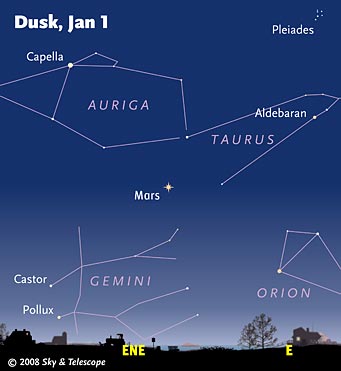
Mars glares near the center of a huge quadrilateral of bright stars: Capella, Aldebaran, Betelgeuse, and Pollux.
Sky & Telescope diagram
Monday, December 31
Tuesday, January 1
Wednesday, January 2
Thursday, January 3
And prepare for the cold! Quad watching is the coldest activity you will ever do near your home. It's January, you'll be out for a long stretch at the coldest time of the 24-hour cycle, you'll be lying motionless rather than moving and generating heat as most people do when outdoors in winter, and whenever the sky is clear, there's extra chill from radiational cooling. Electric hot pads inside your coat, a sleeping bag wrapped around you... treat this as a winter adventure.
Friday, January 4
Saturday, January 5
Sky & Telescope diagram
Want to become a better amateur astronomer? Learn your way around the constellations. They're the key to locating everything fainter and deeper to hunt with binoculars or a telescope. For an easy-to-use constellation guide covering the whole evening sky, use the big monthly foldout map in each issue of Sky & Telescope, the essential magazine of astronomy. Or download our free Getting Started in Astronomy booklet (which only has bimonthly maps).
Once you get a telescope, to put it to good use you'll need a detailed, large-scale sky atlas (set of maps; the standard is Sky Atlas 2000.0) and good deep-sky guidebooks (such as Sky Atlas 2000.0 Companion by Strong and Sinnott, the even more detailed Night Sky Observer's Guide by Kepple and Sanner, or the enchanting though increasingly dated Burnham's Celestial Handbook). Read how to use them effectively.
More beginners' tips: "How to Start Right in Astronomy".
This Week's Planet Roundup
Mercury, Jupiter, and Pluto are still "combust": an old astronomical term meaning hidden in the glare of the Sun.
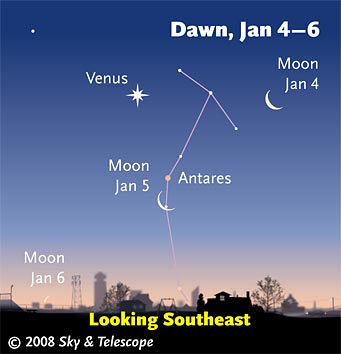
Venus (magnitude –4.1, moving from Libra to Scorpius) is the bright "Morning Star" shining moderately low in the southeast before and during dawn. Well below it, look for much dimmer Antares sparkling orange-red.
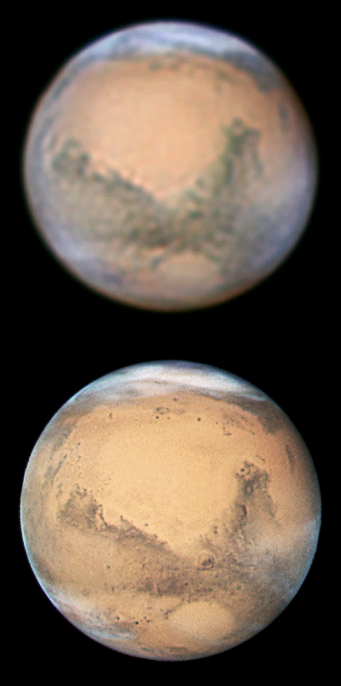
The same face of Mars as imaged by an amateur (S&T's Sean Walker) stacking video frames taken through a 12.5-inch scope, and by the Hubble Space Telescope. Both images were taken on Dec. 18, 2007, when Mars was nearest to Earth for the year. For larger views and other recent Hubble shots of Mars, which show difference faces of the planet, see the Hubble Heritage Project press release issued Dec. 18th.
S&T: Sean Walker
Mars is just past opposition, shining bright yellow-orange (magnitude –1.5) in the eastern evening sky as it moves from Gemini into Taurus. It's highest toward the south around 11 or midnight — near the zenith, in fact, for observers at mid-northern latitudes.
Mars diminishes slightly in apparent size this week, from 15.6 to 15.1 arcseconds in apparent diameter. It's falling behind us as Earth moves ahead of it in our faster orbit around the Sun. For all about observing Mars with a telescope, see the guide and Martian surface-feature map in the November Sky & Telescope, page 66. A short version is online.
Saturn (magnitude +0.7, in Leo) rises in the east around 9 or 10 p.m. It's highest in the south a couple hours before the first light of dawn. Fainter Regulus (magnitude +1.4) is 9° to Saturn's upper right after they rise, and to Saturn's lower right when they fade out in the glow of dawn high in the southwest. Only a little dimmer than Regulus is Gamma Leonis (magnitude +2.1), 8° to Regulus's north. The three make a striking triangle.
Uranus (magnitude 5.9, in Aquarius) remains in the southwest right after dark. Use the finder chart in the July Sky & Telescope, page 60, or online.
Neptune (magnitude 7.9, in Capricornus) is getting low in the southwest right after dark.
All descriptions that relate to your horizon or zenith — including the words up, down, right, and left — are written for the world's midnorthern latitudes. Descriptions that also depend on longitude (mainly Moon positions) are for North America. Eastern Standard Time (EST) equals Universal Time (UT, UTC, or GMT) minus 5 hours.
To be sure you always get the current Sky at a Glance, bookmark this URL:
http://SkyandTelescope.com/observing/ataglance?1=1
If pictures fail to load, refresh the page.
About Alan MacRobert
Alan M. MacRobert became an avid Sky & Telescope subscriber in 1966 at age 14, joined the editorial staff in 1982, and is now a senior contributing editor, semi-retired. He played a role in practically every part of the magazine and the company's other products for more than a generation, both on the amateur-observing side and the science-reporting side. In 1994 a book collection of his observing how-tos and telescopic sky tours was published as Star Hopping for Backyard Astronomers. He has produced This Week's Sky at a Glance online every week since 1989.


Comments
You must be logged in to post a comment.