Some daily events in the changing sky for May 2 – 10.
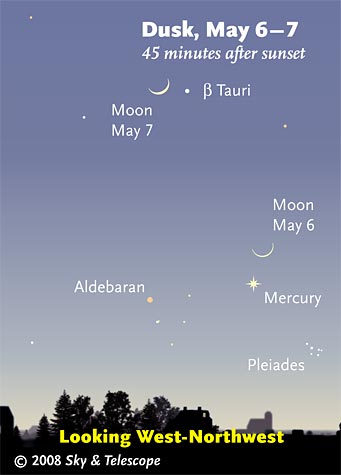
On Tuesday and Wednesday the 6th and 7th, the waxing crescent Moon guides the way to Mercury in twilight . (These scenes are drawn for the middle of North America. European observers: move each Moon symbol a quarter of the way toward the one for the previous date.)
Sky & Telescope diagram
"="right
Friday, May 2
Now that it's May, the Big Dipper floats upside down nearly overhead in the north after dark. Its curving handle points around toward bright Arcturus, the "Spring Star," which dominates the high eastern sky. Arcturus is a yellow-orange giant, spectral type K1.5 III. To me it looks ginger-ale colored — or as Sky & Telescope columnist Fred Schaaf more elegantly put it, "champaign colored."
Saturday, May 3
For observers in the tropics and the Southern Hemisphere, the annual Eta Aquarid meteor shower is getting under way. It runs for about five days. The time to watch is in the hours before dawn. (You can find the time of dawn's first light at any location worldwide using our online almanac.) The Eta Aquarids are often the year's best meteor shower for the Southern Hemisphere, but at northerly latitudes around the curve of the Earth, the shower is weak to nonexistent.
Opposing crescent Moons (the old waning crescent and the new waxing crescent seen on consecutive days) may be observable at dawn Sunday and dusk Monday, especially from North America's Far West. Robert C. Victor of Abrams Planetarium in Michigan writes:
"On Sunday morning, about 40 minutes before sunrise, look for the thin old crescent Moon very low 15° or 20° to the left of due east. The Moon will be about 26 or 27 hours from new as seen from the East Coast, 24 hours before new from the West Coast." (Find your local sunrise time by putting your location and time zone into our online almanac. If you're on daylight saving time like most of North America, make sure the Daylight Saving Time box is checked.)
"Much more difficult is the very young crescent the following day, Monday May 5th." See below, and see our article.
Sunday, May 4
Tonight is the night when Mars lines up in a perfectly straight line with Pollux and Castor to its right (as seen during the evening hours from the Americas). Can you tell that the line is not quite straight the day before and after?
Monday, May 5
New Moon (exact at 8:18 a.m. Eastern Daylight Time). Just after sunset today, clear sky permitting, a record-breaking thin crescent Moon may be detectable from North America. Writes Robert C. Victor:
"About 25 minutes after sunset, try for a hairline-thin Moon very low in the west-northwest, about 13° lower right of Mercury. Its age is a near-record 12 hours or so when seen from the East Coast (extremely difficult), 15 or 16 hours from the West Coast, 17 hours from Hawaii." Bring binoculars for sure. More details, and young crescent Moon predictions for the whole year, are in your February Sky & Telescope, page 72.
Tuesday, May 6
The waxing crescent Moon, still thin, poses close above Mercury (for North America) in twilight this evening and tomorrow evening. See the illustration at the top of this page.
Wednesday, May 7
The red variable stars T Ursae Majoris and R Bootis should be reaching maximum light (6th or 7th magnitude) this week.
Thursday, May 8
Tonight and tomorrow, use your telescope to find the 10th-magnitude asteroid 5 Astraea passing less than 5 arcminutes south of the 6th-magnitude star 37 Virginis. Also in Virgo is 41 Daphne. See the chart in the May Sky & Telescope, page 70.
A small telescope will always show Titan, Saturn's largest and wildest moon. Tonight Titan appears four ring-lengths to Saturn's east. A guide to identifying all six of Saturn's satellites that are sometimes visible in amateur scopes is in the May Sky & Telescope, page 60.
Friday, May 9
There's lots going on across the western side of the sky. The Moon hangs just below the lengthening line of Mars, Pollux, and Castor, as shown below. Down to their lower left shines Procyon. Farther to their lower right twinkles Capella. And the Saturn-Regulus pair poses high to the Moon's upper left.
And there's more going on lower down. Between 8 and 9 p.m. daylight saving time (depending where you live in your time zone), viewers at mid-northern latitudes can see Mercury at exactly the same altitude in the west-northwest as Vega is on the other side of the sky in the northeast — on the night they're exactly the same magnitude, 0.0. Clear, unobstructed horizons are important, as both will be less than 9° high. (Thanks to David Likuski for spotting this event.)
Saturday, May 10
The Moon, nearly first quarter now, skims the edge of the Beehive star cluster as seen from eastern North America. Use binoculars or a telescope at low power.
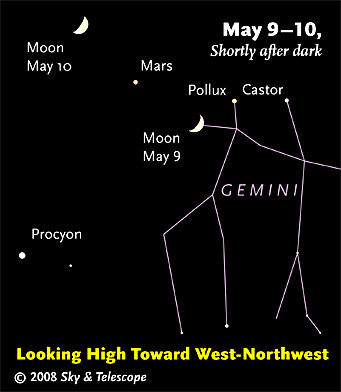
On Friday and Saturday nights, the Moon, thicker now, joins the Mars-Pollux-Castor lineup. (These scenes are drawn for the middle of North America. European observers: move each Moon symbol a quarter of the way toward the one for the previous date.)
Sky & Telescope diagram
"="right
Want to become a better amateur astronomer? Learn your way around the constellations. They're the key to locating everything fainter and deeper to hunt with binoculars or a telescope. For an easy-to-use constellation guide covering the whole evening sky, use the big monthly foldout map in each issue of Sky & Telescope, the essential magazine of astronomy. Or download our free Getting Started in Astronomy booklet (which only has bimonthly maps).
Once you get a telescope, to put it to good use you'll need a detailed, large-scale sky atlas (set of maps; the standards are Sky Atlas 2000.0 or the smaller Pocket Sky Atlas) and good deep-sky guidebooks (such as Sky Atlas 2000.0 Companion by Strong and Sinnott, the even more detailed Night Sky Observer's Guide by Kepple and Sanner, or the enchanting though increasingly dated Burnham's Celestial Handbook). Read how to use them effectively.
More beginners' tips: "How to Start Right in Astronomy".
This Week's Planet Roundup
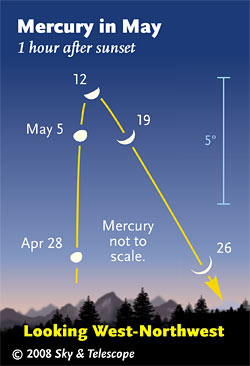
Shown here are Mercury's positions 1 hour after sunset (as seen from latitude 40° north) all through May. Its phase as seen in a telescope is shown on various dates. (The blue 5° scale, for judging height above the horizon, is about half the width of your fist at arm's length.)
S&T Illustration
Mercury (about magnitude –0.5) is having its best evening apparition of the year. Look for it shining low in the west-northwest as twilight fades. See article.
On May 2nd and 3rd, Mercury passes left of the Pleiades. Aldebaran sparkles much farther to Mercury's left — or by late in the week, lower left.
Venus is lost in the glare of the Sun.
Mars (magnitude +1.2, in Gemini) shines high in the west after dark, left of Pollux and Castor. On May 4th the three form a straight line. After that, watch as the line lengthens and curves day by day. Mars is moving to the upper left in the direction of Saturn and Regulus.
Compare Mars's color to that of Pollux, an orange giant star of spectral type K0 III. In a telescope Mars is a minuscule 5.6 arcseconds wide.
Jupiter (magnitude –2.4, in eastern Sagittarius) rises around 1 a.m. daylight saving time. It glares in the south at dawn. (The table of Jupiter's satellite phenomena in the May Sky & Telescope is incorrect; use our corrected version here.)
Saturn (magnitude +0.6, in Leo) glows high in the southwest after dark, just 2¼° from fainter Regulus (magnitude +1.4). The two of them are quite the eye-catching couple! They'll remain nearly this close all month.
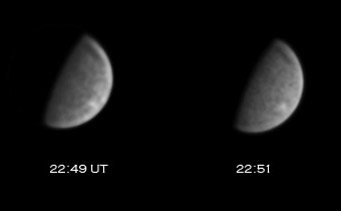
To your eyeball, a telescope is doing well if it just shows Mercury's phase clearly. Centuries of astronomers couldn't distinguish surface markings reliably enough to find the planet's correct rotation period. But infrared imaging and video-frame stacking have brought Mercurian surface features in range of amateurs. Sean Walker used a 12.5-inch reflector in broad daylight to take these infrared images on May 5, 2008, about an hour before sunset. The times are in Universal Time.
S&T: Sean Walker
Telescope users: can you see the pair of white storms on Saturn? How big a telescope do you need? See the picture caption at the bottom of this page to predict when they'll be turned into view (which happens at least twice a day.)
There's more to Saturn than you may realize. See our Saturn observing guide in the April Sky & Telescope, page 66.
Uranus and Neptune are low in the southeast before dawn.
Pluto (magnitude 14.0, in northwestern Sagittarius) is highest in the south before dawn's first light. If you've got a big scope and ambition to match, see our article and finder chart.
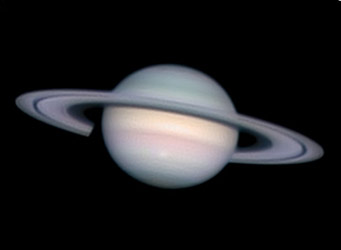
A white storm is visible in Saturn's South Temperate Zone — and since this picture was taken, it has divided into two! The original storm shows plainly in this stacked-video image taken by Sean Walker through a 12.5-inch reflector at 0:42 UT April 23rd during excellent seeing. "The white spot was visible in an eyepiece at over 500x, particularly through a green filter," Walker writes. North is up.
To find when the white spots are in view: For your date, look up Saturn's System II central-meridian longitude in this table (it's the "CMII" column). That's the value for 0:00 Universal Time (UT or GMT) on your date. To this value, add 33.8° for each whole hour since 0:00 UT, and 0.56° for each minute, for the time you plan to observe. See what you get. Find a good Saturn-observing time and date for you that results in something around 75°, and plan to be out then with your scope.
P.S.: Here's an incredible closeup shot of the storm by Cassini taken on March 4th. Cassini's radio instruments find that the storm is full of lightning.
S&T: Sean Walker
All descriptions that relate to your horizon or zenith — including the words up, down, right, and left — are written for the world's mid-northern latitudes. Descriptions that also depend on longitude (mainly Moon positions) are for North America. Eastern Daylight Time (EDT) equals Universal Time (UT, UTC, or GMT) minus 4 hours.
If pictures fail to load, refresh the page. If they still fail to load, change the 1 at the end of the URL to any other character and try again.
 SUNSET:

 0
0

Comments
You must be logged in to post a comment.