 SUNSET:

 0
0Read the tale of the death of Comet ISON. Sigh. This might have been the week when it was at its best.
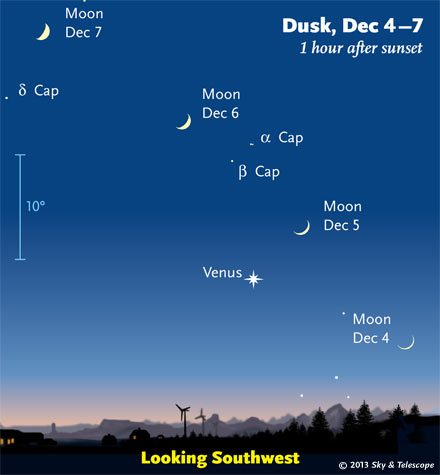
The waxing Moon is high above Venus during and after dusk on Friday the 6th and higher on Saturday. (The 10° scale is about as big as your fist at arm's length.)
Friday, Dec. 6
Saturday, Dec. 7
The reason? Local Apparent Solar Time is shifting with respect to Local Mean Time during this part of the year, an effect caused by the tilt of Earth's axis and the ellipticity of Earth's orbit. Be glad that we use standard time, so you don't have to keep adjusting your clocks to the inconstant Sun like in olden days. Standard time made things simpler for society but complicated things for skywatchers.
Sunday, December 8
Monday, December 9
Tuesday, December 10
Wednesday, December 11
Thursday, December 12
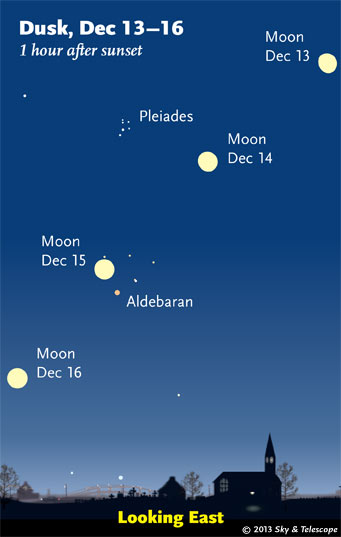
The Moon brightens as it waxes to full on the night of the 16th.
Sky & Telescope diagram
Friday, December 13
Saturday, December 14
Want to become a better astronomer? Learn your way around the constellations. They're the key to locating everything fainter and deeper to hunt with binoculars or a telescope.
This is an outdoor nature hobby. For an easy-to-use constellation guide covering the whole evening sky, use the big monthly map in the center of each issue of Sky & Telescope, the essential guide to astronomy. Or download our free Getting Started in Astronomy booklet (which only has bimonthly maps).
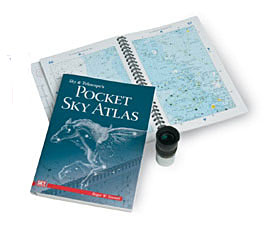
The Pocket Sky Atlas plots 30,796 stars to magnitude 7.6 — which may sound like a lot, but that's less than one star in an entire telescopic field of view, on average. By comparison, Sky Atlas 2000.0 plots 81,312 stars to magnitude 8.5, typically one or two stars per telescopic field. Both atlases include many hundreds of deep-sky targets — galaxies, star clusters, and nebulae — to hunt among the stars.
Sky & Telescope
Once you get a telescope, to put it to good use you'll need a detailed, large-scale sky atlas (set of charts). The standards are the little Pocket Sky Atlas, which shows stars to magnitude 7.6; the larger and deeper Sky Atlas 2000.0 (stars to magnitude 8.5); and once you know your way around, the even larger Uranometria 2000.0 (stars to magnitude 9.75). And read how to use sky charts with a telescope.
You'll also want a good deep-sky guidebook, such as Sue French's Deep-Sky Wonders collection (which includes its own charts), Sky Atlas 2000.0 Companion by Strong and Sinnott, the bigger Night Sky Observer's Guide by Kepple and Sanner, or the beloved if dated Burnham's Celestial Handbook.
Can a computerized telescope replace charts? Not for beginners, I don't think, and not on mounts and tripods that are less than top-quality mechanically (able to point with better than 0.2° repeatability, which means heavy and expensive). As Terence Dickinson and Alan Dyer say in their invaluable Backyard Astronomer's Guide, "A full appreciation of the universe cannot come without developing the skills to find things in the sky and understanding how the sky works. This knowledge comes only by spending time under the stars with star maps in hand."
This Week's Planet Roundup
Mercury (magnitude –0.7) is sinking away deep into the glow of sunrise.
Venus (magnitude –4.9) is the brilliant "Evening Star" in the southwest during and after dusk. It's shining at its brightest for the year, and it doesn't set until more than an hour after dark. In a telescope, Venus has waned to a crescent about 25% lit and has enlarged to about 42 arcseconds tall, as it swings toward us around the Sun.
Mars (magnitude 1.2, in the head of Virgo) rises around 1 a.m. By dawn it's very high in the south. In a telescope Mars is still tiny and gibbous, 5.8 arcseconds wide.
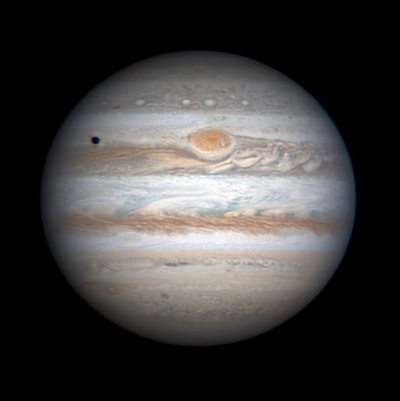
Jupiter on December 11th, imaged almost as well as it ever can be from Earth. Christopher Go used a Celestron-14 scope from his apartment balcony in Cebu City, Philippines. South here is up. Just visible on the right end of the Great Red Spot is Europa, nearly white. More obvious is Europa's black shadow. It's being cast toward celestial west ("preceding") because Jupiter has not yet reached opposition.
The System II longitude at the time of this image was 199°. Through the eyepiece of a medium-aperture scope when Jupiter is again turned this way, in moments of good seeing you should be able to see the Red Spot's unusually strong orange color, the turbulence on its following (celestial east) side, perhaps the white ovals south of it, the differing widths and darknesses of the big South and North Equatorial Belts, and perhaps the blue festoons in the Equatorial Zone.
Jupiter (magnitude –2.6, in Gemini) rises in the east-northeast soon after dark, with Pollux and Castor to its left. It blazes highest around 2 a.m. In a telescope Jupiter has grown to a big 45 arcseconds wide as it nears its January 5th opposition.
Saturn (magnitude +0.6, in Libra) is low in the southeast as dawn begins to brighten. Look for it then far to the lower left of Mars and Spica, and far lower right of brighter Arcturus.
Uranus (magnitude 5.8, in Pisces) and Neptune (magnitude 7.9, in Aquarius) are still well placed in the southern sky shortly after dark. Finder charts for Uranus and Neptune.
All descriptions that relate to your horizon — including the words up, down, right, and left — are written for the world's mid-northern latitudes. Descriptions that also depend on longitude (mainly Moon positions) are for North America.
Eastern Standard Time (EST) is Universal Time (UT, UTC, or GMT) minus 5 hours.
Like This Week's Sky at a Glance? Watch our SkyWeek TV short, also playing on PBS.
To be sure to get the current Sky at a Glance, bookmark this URL:
http://SkyandTelescope.com/observing/ataglance?1=1
If pictures fail to load, refresh the page. If they still fail to load, change the 1 at the end of the URL to any other character and try again.
About Alan MacRobert
Alan M. MacRobert became an avid Sky & Telescope subscriber in 1966 at age 14, joined the editorial staff in 1982, and is now a senior contributing editor, semi-retired. He played a role in practically every part of the magazine and the company's other products for more than a generation, both on the amateur-observing side and the science-reporting side. In 1994 a book collection of his observing how-tos and telescopic sky tours was published as Star Hopping for Backyard Astronomers. He has produced This Week's Sky at a Glance online every week since 1989.


Comments
You must be logged in to post a comment.