 SUNSET:

 0
0Some daily events in the changing sky for May 25 – June 2.
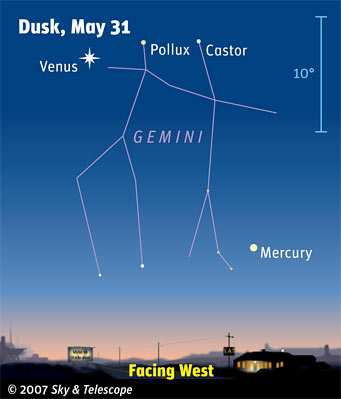
Don't miss the two innermost planets shining after sunset in Gemini — and watch them moving rapidly from day to day. (The blue 10° scale is about the size of your fist held at arm's length.)
Sky & Telescope diagram
Friday, May 25
Saturday, May 26
Sunday, May 27
Monday, May 28
Tuesday, May 29
Wednesday, May 30
Thursday, May 31
Friday, June 1
Saturday, June 2
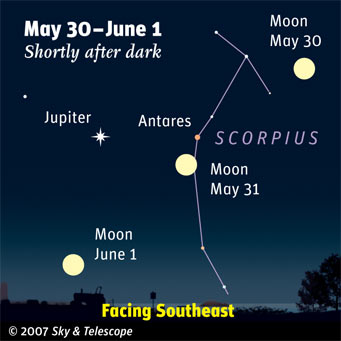
Watch the big bright Moon pass through Scorpius and under Jupiter as May turns to June. (These diagrams are drawn for the middle of North America. European observers: move each Moon symbol a quarter of the way toward the one for the previous date. For clarity, the Moon is shown three times actual size.)
Sky & Telescope diagram.
Want to become a better amateur astronomer? Learn your way around the constellations. They're the key to locating everything fainter and deeper to hunt with binoculars or a telescope. For an easy-to-use constellation guide covering the whole evening sky, use the big monthly foldout map in each issue of Sky & Telescope, the essential magazine of astronomy. Or download our free Getting Started in Astronomy booklet (which only has bimonthly maps).
Once you get a telescope, to put it to good use you'll need a detailed, large-scale sky atlas (set of maps; the standard is Sky Atlas 2000.0) and good deep-sky guidebooks (such as Sky Atlas 2000.0 Companion or the enchanting though dated Burnham's Celestial Handbook). Read here how to use them most effectively.
More beginners' tips: "How to Start Right in Astronomy".
This Week's Planet Roundup
Mercury (about magnitude 0) is usually elusive, but right now it's having a fine apparition in evening twilight. Don't miss it! Look for Mercury low in the west-northwest about an hour after sunset, far to the lower right of bright Venus.
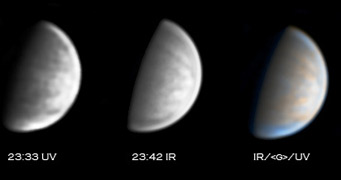
Sky & Telescope's Sean Walker continues to image Venus as the planet slowly wanes and enlarges. On May 20th its clouds were full of detail in both ultraviolet (UV) and near-infrared (IR) light. The Universal Times of the exposures are given. Walker made the color rendition by showing ultraviolet as blue, infrared as red, and adding a green channel created by interpolating between the two.
S&T: Sean Walker
Venus (magnitude –4.3, in Gemini) is the brilliant "Evening Star" in the west during and after twilight. Pollux and Castor are lined up above it at the beginning of the week, and to its right by June 2nd. In a telescope, Venus appears just about perfectly half-lit.
Mars (magnitude +0.9, in Pisces) is gradually getting higher in the east before and during dawn. It's the orange-yellow dot below the Great Square of Pegasus.
Jupiter (magnitude –2.6, in southern Ophiuchus) rises in the east-southeast during twilight and dominates the south by 1 a.m. daylight saving time. Antares, less bright, sparkles 8° to its right during the evening, and lower right after midnight. Jupiter will be at opposition on June 5th.
Saturn (magnitude +0.5, in Leo) shines high in the west during evening, far upper left of bright Venus (by 30° to 23° this week). Watch these two closing in on each other. They're on their way to a close conjunction at the end of June.
Regulus, less bright at magnitude +1.4, is 10° or 11° to Saturn's upper left. North of Regulus is 2nd-magnitude Algieba (Gamma Leonis), a fine telescopic double star.
Uranus (magnitude 6, in Aquarius) is in the east-southeast before dawn.
Neptune (magnitude 8, in Capricornus) is higher in the southeast before dawn.
Pluto (magnitude 14, in northwestern Sagittarius) is not far from Jupiter in the south during early morning hours.
All descriptions that relate to your horizon — including the words up, down, right, and left — are written for the world's midnorthern latitudes. Descriptions that also depend on longitude (mainly Moon positions) are for North America. Eastern Daylight Time (EDT) equals Universal Time (UT, UTC, or GMT) minus 4 hours.
To always get the up-to-date Sky at a Glance, bookmark this URL:
http://SkyandTelescope.com/observing/ataglance .
About Alan MacRobert
Alan M. MacRobert became an avid Sky & Telescope subscriber in 1966 at age 14, joined the editorial staff in 1982, and is now a senior contributing editor, semi-retired. He played a role in practically every part of the magazine and the company's other products for more than a generation, both on the amateur-observing side and the science-reporting side. In 1994 a book collection of his observing how-tos and telescopic sky tours was published as Star Hopping for Backyard Astronomers. He has produced This Week's Sky at a Glance online every week since 1989.


Comments
You must be logged in to post a comment.