 SUNSET:

 0
0Some daily events in the changing sky for August 24 – September 1.
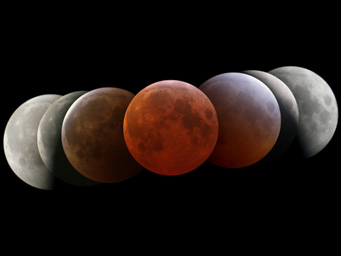
Last March 3rd, Europeans had a fine late-night view of the previous total lunar eclipse. In France, Laurent Laveder captured a series of images to make this composite. The August 28th eclipse, by contrast, will occur low in the west as dawn is brightening for many observers.
Laurent Laveder
Friday, August 24
Saturday, August 25
Sunday, August 26
Monday, August 27
Tuesday, August 28
Wednesday, August 29
Thursday, August 30
Friday, August 31
Saturday, September 1
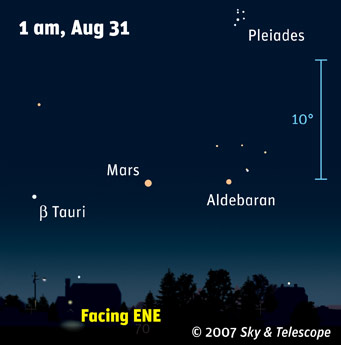
Mars and Aldebaran rise and shine together late these nights. The blue 10° scale is about the size of your fist held at arm's length.
Sky & Telescope diagram.
Want to become a better amateur astronomer? Learn your way around the constellations. They're the key to locating everything fainter and deeper to hunt with binoculars or a telescope. For an easy-to-use constellation guide covering the whole evening sky, use the big monthly foldout map in each issue of Sky & Telescope, the essential magazine of astronomy. Or download our free Getting Started in Astronomy booklet (which only has bimonthly maps).
Once you get a telescope, to put it to good use you'll need a detailed, large-scale sky atlas (set of maps; the standard is Sky Atlas 2000.0) and good deep-sky guidebooks (such as Sky Atlas 2000.0 Companion or the enchanting though somewhat dated Burnham's Celestial Handbook). Read here how to use them effectively.
More beginners' tips: "How to Start Right in Astronomy".
This Week's Planet Roundup
Mercury is deep in the glow of sunset.
Venus is emerging from the glow of sunrise, just beginning its grand apparition as the Morning Star for the next half-year. Look for it above the eastern horizon 60 to 40 minutes before sunrise. It's getting a little higher every day. (To find your local sunrise time, make sure you've put your location into our online almanac. If you're on daylight saving time like most of North America, make sure the Daylight Saving Time box is checked.)
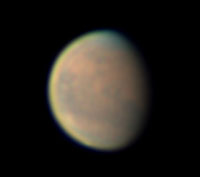
By August 28th, surface features were again showing more normally through Mars's dusty atmosphere, as the past two months' worth of dust activity abated. Just to the right of the central meridian in this image is Sinus Meridiani, where Opportunity has resumed roving. North is up. Sean Walker took this stacked video image through color filters using a DMK 12AF04 camera on a 12.5-inch Newtonian reflector. The time was 8:14 UT August 28th. Mars was (and is) still only 8 arcseconds in diameter.
S&T: Sean Walker
Mars (magnitude +0.3, in Taurus) rises around midnight daylight saving time and shines very high in the southeast before dawn. It's near twinkly Aldebaran, which is similarly colored but not as bright. Look above them after they rise for the Pleiades; see the sky scene above.
In a telescope Mars is now 8 arcseconds in diameter, half the size it will be around its Christmas-season opposition.
Incidentally: if friends or family tell you they've read that Mars will become as big and bright as the full Moon this week, point them to our article about the regular-as-clockwork August Mars Hoax.
Jupiter (magnitude –2.2, in southern Ophiuchus) glares in the south-southwest during twilight and lower in the southwest after dark. Get your telescope on it as early as possible (though it has shrunk to a small-for-Jupiter diameter of 38 arcseconds). Antares, less bright, sparkles redly 5° below Jupiter; the two have been evening companions all summer. Other stars of Scorpius shine to their right and lower left.
Saturn remains hidden deep in the glow of sunrise.
Uranus, imaged at high power on August 28, 2007, with a 12.5-inch reflector using the stacked-video technique. Visually Uranus appears nowhere near this colorful: pale gray with only a hint of green-blue.
S&T: Sean Walker
Uranus (magnitude 5.7, in Aquarius) and Neptune (magnitude 7.8, in Capricornus) are well up in the southeast by late evening. This week Uranus fits in the same telescopic field of view with Phi Aquarii, magnitude 4.2.
Pluto (magnitude 13.9, in the northwestern corner of Sagittarius) is highest in the south-southwest as soon as it gets dark, about 18° east-northeast of Jupiter. Finder charts for Uranus, Neptune, and Pluto are in the July Sky & Telescope, page 60.
All descriptions that relate to your horizon — including the words up, down, right, and left — are written for the world's midnorthern latitudes. Descriptions that also depend on longitude (mainly Moon positions) are for North America. Eastern Daylight Time (EDT) equals Universal Time (UT, UTC, or GMT) minus 4 hours.
To be sure you get the current Sky at a Glance, bookmark this URL:
http://SkyandTelescope.com/observing/ataglance?1=1
About Alan MacRobert
Alan M. MacRobert became an avid Sky & Telescope subscriber in 1966 at age 14, joined the editorial staff in 1982, and is now a senior contributing editor, semi-retired. He played a role in practically every part of the magazine and the company's other products for more than a generation, both on the amateur-observing side and the science-reporting side. In 1994 a book collection of his observing how-tos and telescopic sky tours was published as Star Hopping for Backyard Astronomers. He has produced This Week's Sky at a Glance online every week since 1989.


Comments
You must be logged in to post a comment.