 SUNSET:

 5
5We live our lives in a blink of universal time.
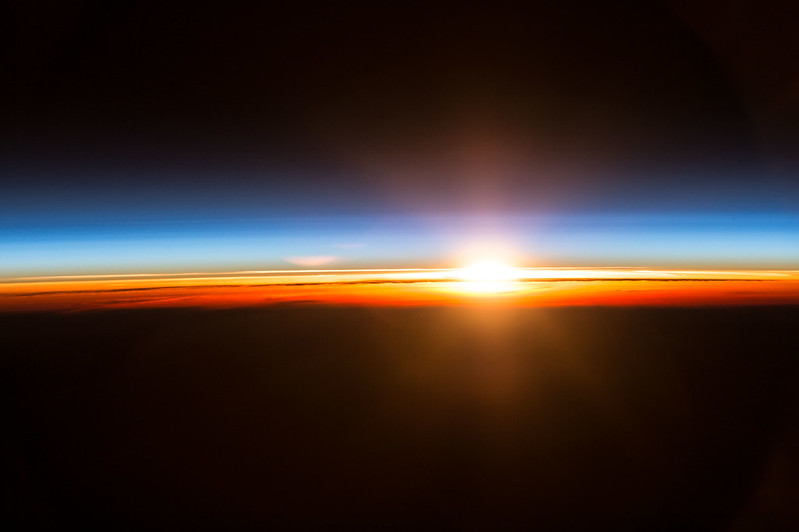
NASA
In the inaugural season of Star Trek: Starfleet Academy, Captain Nahla Ake gives a thoughtful and rousing address to her cadets as their starship circles the fictional Val Nebula. “I’m struck by its very existence,” she says of the nebula. “The incalculable number of atoms that had to converge in this tiny patch of a seemingly infinite universe. This nebula was once a star. It could not have evolved into this present without every moment of its past.”
She uses the nebula as a metaphor for personal evolution, and for becoming. It’s quite beautiful. For me, this speech stirs a deeper yearning. I’ve written before about my individual growth as a stargazer beneath a seemingly timeless sky. But what about the sky’s evolution? I want to know more, and to see more. I am greedy for the stars.
It's easy to think of the night sky as static, eternal, with the same sights rotating in with each season like a Viewmaster wheel. The cosmos is constantly changing, just on a longer timeline. Evolving. Becoming. Except for a passing comet or a spectacular supernova, most of us are unlikely to notice real change.
We live our lives in a blink of universal time. We are cosmic mayflies.
Traveling at an average speed of 230 kilometers per second (that’s more than 500,000 mph), it takes our Sun about 225 million years to make a complete rotation around the center of the Milky Way Galaxy. A human lifespan is laughably short in comparison.
Through generations of observation and study, we have pieced together the story of the universe so far, to the best of our understanding. It’s a means of telling our story — as a planet, a species, and individuals. We’re not content to simply admire the star; we want to know how it got there, what came before it, and what will happen next.
“Life is like arriving late for a movie,” Joseph Campbell wrote in Creative Mythology, “having to figure out what was going on without bothering everybody with a lot of questions, and then being unexpectedly called away before you find out how it ends.”
Years ago, I was interviewed about a new urban fantasy novel I had coming out. I was asked if I would accept a hypothetical invitation to become a vampire. I surprised the interviewer by replying in the negative. I don’t want to live “forever,” or whatever the vampire equivalent is. That would be torturous. But that speculative immortality is tempting when I consider what I might witness.
I want to see the expected Betelgeuse supernova, which could happen tomorrow or thousands of years from now. I want to see the return of Halley’s Comet, which I missed in 1986 due to sky conditions and teenage obligations. I want to see how the constellations change over the coming millennia as the Milky Way rotates. I want to know what, if anything, the Voyager probes encounter, and what additional data they send back. I’m still waiting for the recurrent nova of T Coronae Borealis. And I want the answer to the timeless question: Are we alone? For that, yeah, I might join the vampire ranks if given the chance.
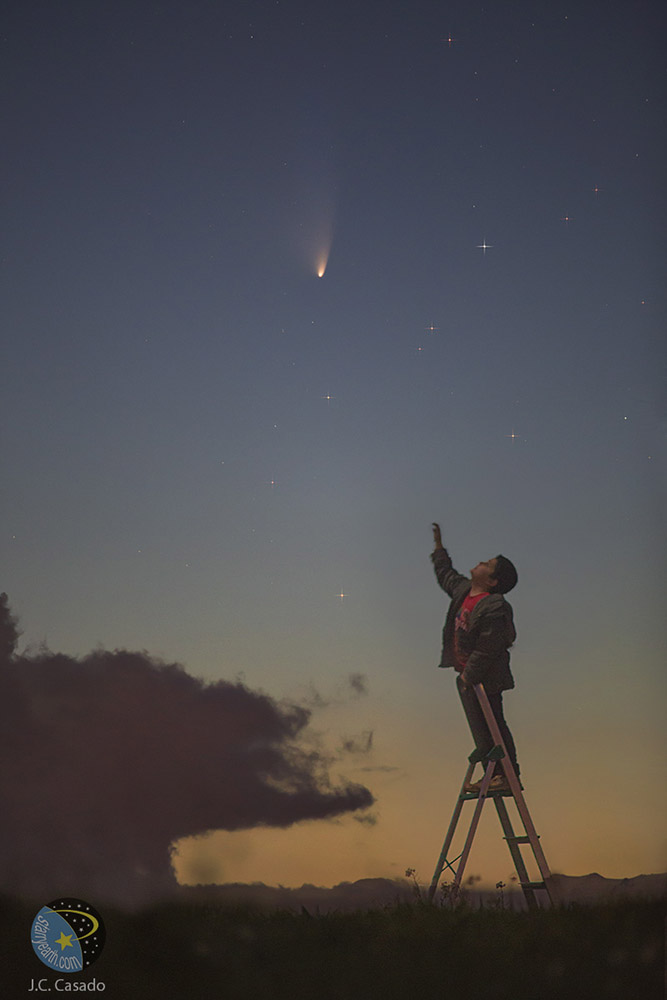
The frustrating truth is that we leave these revelations and verifications to future astronomers and stargazers, perhaps many many generations removed from us.
Like most other cosmic mayflies, nothing I do in this life will be as lasting or as influential as, say, the Orion Nebula. My work and my name will be forgotten within a generation after I’m gone, which is appropriate and normal. I’ve not made any huge contributions to astronomy. There will be no Comet Willis or Supernova Jen (as if) to captivate Earth-dwellers in the centuries to come. But even the Orion Nebula is ultimately impermanent.
Though I’m at that stage of life when the babies are going off to college — and when I’m increasingly cognizant of having fewer days ahead than behind — I’m not done learning, because I’m still evolving, too. I have this minuscule, human-sized window to be a “way for the universe to know itself,” in the words of Carl Sagan, and to contribute to collective understanding. I am woven into what the universe has been and is now. It’s a simultaneously comforting and overwhelming perspective.
Every night is a new opportunity to be a tiny part of this cosmic becoming. Clear skies throw open the classroom doors to any who are willing to look up. How might we teach the universe about itself tonight? What will we stretch and grow into next?
The evolving celestial sights that have inspired and informed my pursuits will remain recognizable for a good while longer. Vampire or not, I get to see and marvel at them, with more new-to-me discoveries to look forward to. And though I will never be a Starfleet cadet hurtling across space to view deep-sky objects up close, when I close my eyes after a good night of stargazing, perhaps I can dream of what might be yet to come.


Comments
Anthony Barreiro
March 7, 2026 at 10:53 pm
So true. Thank you. Humanity's understanding of the cosmos has grown remarkably during a short time. Just over a century ago the Milky Way was the entire universe. Since then we've figured out how stars make all the chemical elements heavier than hydrogen and helium, deduced when the universe began, and realized that we don't understand 95% of the energy content of this universe. On a personal level, at least I can hope to see another T CrB nova before I shuffle off this mortal coil. I keep looking for it.
You must be logged in to post a comment.
Jen Willis
March 9, 2026 at 2:39 pm
Excellent points about how far we've come in just the last one hundred years, and how we're benefiting now from the work and discoveries of those who came before us — and that we still have so much more to learn. As Corona Borealis slides into the sky again, perhaps we'll get lucky this time around?
You must be logged in to post a comment.
oldfarmer
March 10, 2026 at 8:17 pm
I am pretty sure I found that quote on the Vatican Observatory's website.
You must be logged in to post a comment.
oldfarmer
March 8, 2026 at 5:52 pm
Again a great article by Jennifer Willis. I think the quote from Pope Francis fits well here.
Referring to Psalm 8, Pope Francis said:
“ The ‘Glory and Honour’ of the Psalmist is . . . astronomy. . . through us this universe can become aware of itself and of its Maker. This is the gift, and responsibility, given to us as rational creatures in this cosmos.
You must be logged in to post a comment.
Jen Willis
March 9, 2026 at 2:40 pm
Thanks! I'll have to look for this quote from Pope Francis.
You must be logged in to post a comment.
You must be logged in to post a comment.