 SUNSET:

 2
2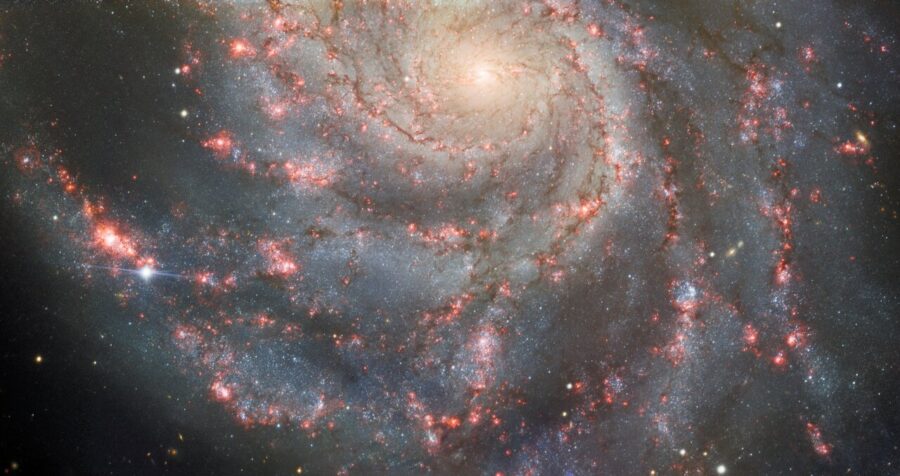
International Gemini Observatory / NOIRLab / NSF / AURA; Image processing: J. Miller (Gemini Observatory / NSF’s NOIRLab), M. Rodriguez (Gemini Observatory / NSF’s NOIRLab), M. Zamani (NSF’s NOIRLab) / T.A. Rector (University of Alaska Anchorage / NSF’s NOIRLab) & D. de Martin (NSF’s NOIRLab)
One of the many cool things about astronomy is that peering out into space allows us to look back in cosmic time. This isn’t limited to the big space telescopes. Amateur astronomers, too, get to see what our favorite nebulae and other deep sky objects looked like so many hundreds or thousands of years ago — or millions of years ago, for our best-loved galaxies.
It can be mind bending for astro-curious friends and family to grasp. That spectacular supernova in the Pinwheel Galaxy that dazzled backyard astronomers a couple of years ago? The actual event happened 21 million years ago.
But while these views through telescopes offer a glimpse of where the universe has been, I’d argue that stargazing helps us connect to our past selves as individuals, too, as we stand on the same spot, year after year, looking up at the same stars.
Stick with me here.
Like family and holiday traditions, the stars help us to mark time. In Ancient Egypt, the annual flooding of the Nile was announced by the heliacal rising of Sirius. The Maya looked for the rise of the Pleiades in the pre-dawn sky to herald the beginning of the rainy season and as a guide to seasonal planting.
Every calendar is astronomical, as we observe our planet’s rotations and revolutions around the Sun. But our nighttime progression through time and space feels different, removed from the mundane daylight hours. In these moments, I find a convergence, almost as though the past, present, and future versions of myself stand together, looking up at the stars.
When I set up my equipment in the back yard tonight, I feel a visceral reminder of when, years ago, I lay on our rickety picnic table to gaze up at Cassiopeia as I contemplated an astronomy purchase. Money was tight, but I yearned for the night sky. Would it be irresponsible to buy a pair of Orion 2x54 Ultra Wide Angle binoculars? The stars drifted silently above as I dithered. I decided not to postpone joy, and I ordered my “star goggles.” That picnic table is long since gone, and now I have a small stable of binoculars and telescopes. But while observing the “Big W” tonight, that old anxiety now mingles with gratitude for the chance I took, and I recognize how steeply that investment has paid off in delight.
I look around and see my familiar spots for observing. I imagine myself in my zero gravity chair as I stay up well past midnight trying to learn the summer stars. My heart clenches at the spot where I looked to Orion three years ago, searching for solace with my cat Kenobi’s imminent death. From the driveway, I hear echoes of my enthusiastic gasp when I found M31 for the first time, and from when I first pointed my 10x50 binoculars at the Pleiades. There’s the spot I lay on the grass during the pandemic to study Lyra, and by the lumber pile is where I experimented with my new Dwarf 2 telescope during galaxy season to see deeper into the sky than I ever had before.
Some of the quietest and most profound moments of my life have happened beneath the stars, and every time I step outside is another new milestone. During a surprise gap in the clouds the other night, I enjoyed the planetary parade of Venus, Jupiter, and Mars without my instruments and tried to brainstorm a description of this liminal feeling. I laughed when the nearest I could come was a paraphrase of a daytime soap opera: Like meteors through the atmosphere, these are the nights of our lives.
“We are a way for the universe to know itself,” Carl Sagan told us. We use our instruments to look back in time and to deepen our understanding of the universe, and we reveal ourselves in the process.
As I observe the stars, I also observe how I’ve grown and changed since the first time I found the Double Cluster in my 114mm tabletop Dobsonian telescope, or since I lingered over Coma Berenices with low-power binoculars just last year. I’m grayer now, more deft and wise in some respects but creakier and slower in others. Every bit as much of an astro-nut.
Looking for the backward question mark of the constellation Leo, I feel both my younger self searching for the same asterism and my future self gazing upward (even if through worsened light pollution). While showing me what the cosmos once looked like, the stars remind me of who I once was, and who I might yet become.


Comments
Anthony Barreiro
March 7, 2025 at 1:11 am
This is really beautiful and thoughtful. Thank you. Tomorrow morning when I breeze by M13 with my 10x42 binoculars, I will remember the first time I laboriously star-hopped to the globular cluster with a 76 mm reflector, and the accomplishment I felt when I finally saw a little fuzzball through the eyepiece.
You must be logged in to post a comment.
Jen Willis
March 17, 2025 at 6:33 pm
Thanks, Anthony! Those first views of any DSO are precious indeed. I cherish the memory of the first time I found the Beehive Cluster, and when I stumbled across the Double Cluster by accident — both with my 114mm tabletop Dobsonian. Now they're both old friends.
You must be logged in to post a comment.
You must be logged in to post a comment.