 SUNSET:

 0
0This periodic visitor is now bright enough to see in binoculars from a dark sky. We also report on a bright supernova in Ursa Major.
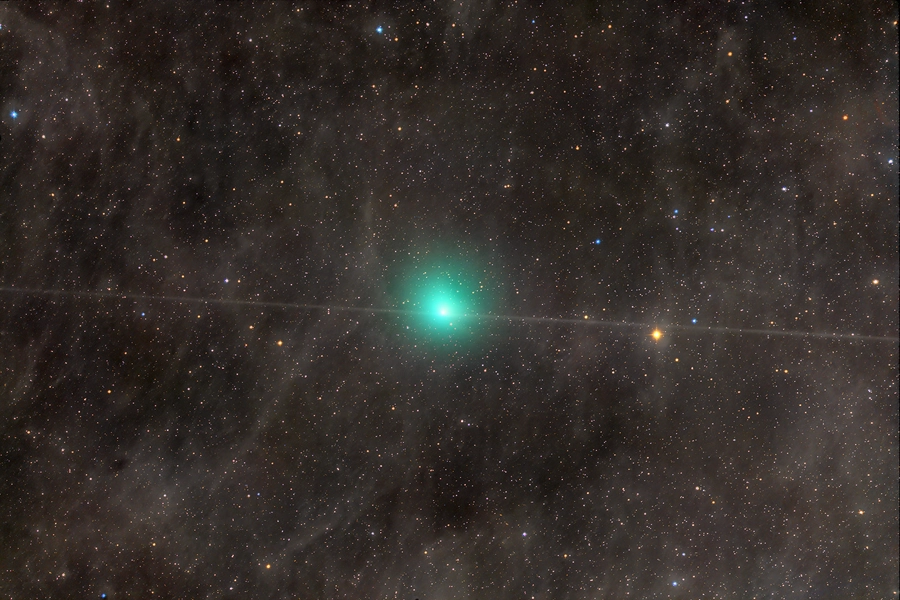
Chris Schur
Some comets you'll see just once in your lifetime. Others like 10P/Tempel drop by more often. Discovered on July 4, 1873, by German astronomer Wilhelm Tempel, this regular celestial visitor circles the Sun every 5.4 years. I first met the comet during its 1983 apparition, then again in 1988, 1999, and 2010. In 2026, it's back for another round and bright enough to see in 50-mm binoculars from a rural sky. If this is your first time seeing the comet, I hope it leads to renewed observations at every favorable apparition over a lifetime.
This summer's icy visitor is a Jupiter-family comet. Although it likely originated in the outer solar system's Kuiper Belt, 10P was captured by the gas giant, which reworked its orbit into a short-period one with a low inclination. These nights, look for the interplanetary itinerant in eastern Capricornus, where it clears the horizon muck around 11 p.m. local time for mid-northern-latitude observers. Due to its low declination, the comet is best viewed after midnight, with meridian crossing occurring around 3 a.m.
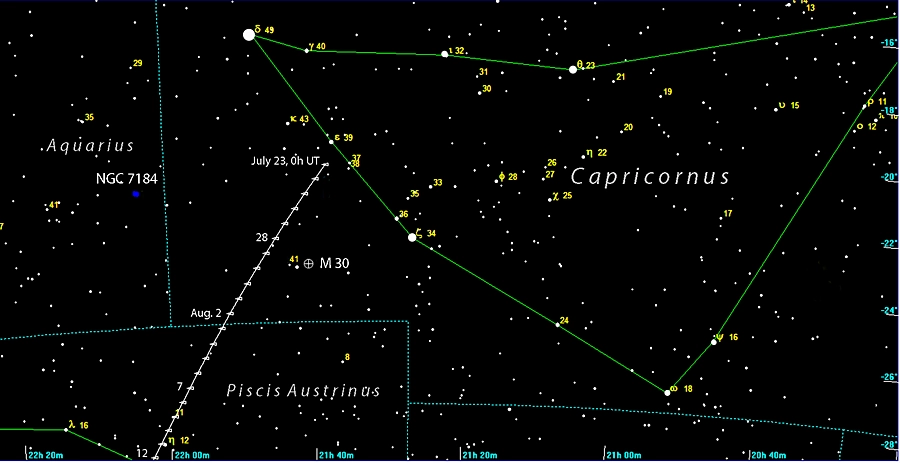
MegaStar, courtesy of Emil Bonanno, with annotations by Bob King
Tempel's comet sinks slowly southeast in July and August while continuing to brighten. On July 14th under a Bortle 3 (Sky Quality Meter reading of 21.3) sky, I found it in my 10×50 binoculars. The coma was a soft, diffuse patch of light 15′ across with a hint of a brighter center. I estimated its magnitude at 9.0. Given how few and far between binocular-bright comets are, I was excited to see Tempel had crossed that threshold.
Through my 15-inch (38-cm) Dobsonian reflector at 86×, the outer coma looked smooth and diffuse like breath on a mirror. With averted vision it extended more to the north-northwest, giving the comet an asymmetric, fan-shaped appearance. The small central region was considerably brighter and more concentrated, with a DC of 5. Comet observers use the Degree of Concentration (DC) scale to describe how intense a comet's light is spread across its coma. It grades from 0 to 9, with DC=0 being completely diffuse (no central condensation) to DC=9 being starlike (no coma visible).
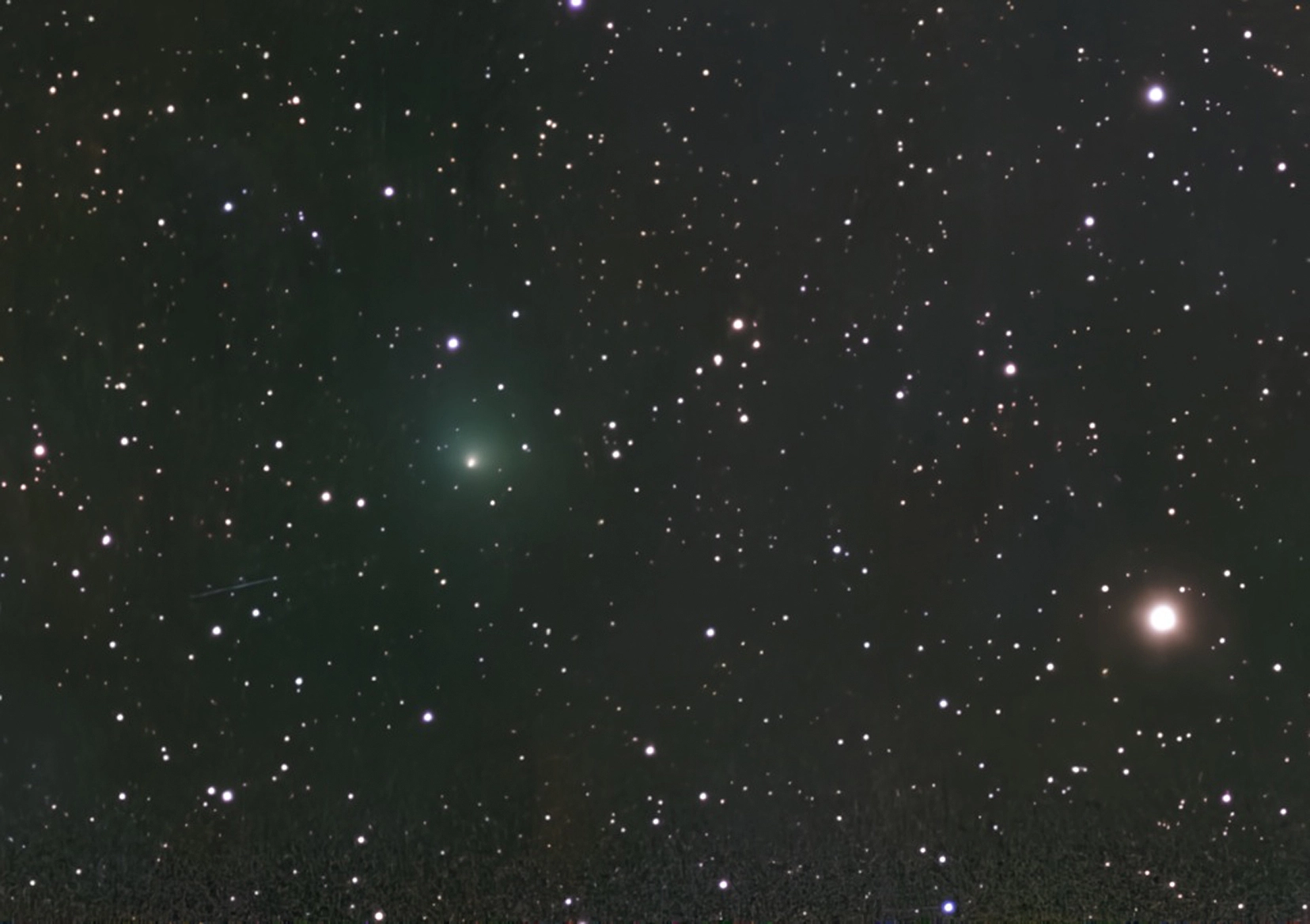
Bob King
Increasing my Dob's magnification to 381× I discerned a nearly stellar pseudo-nucleus of approximately magnitude 13.5 at the tip of a bright, jet-like feature that extended north-northwest into the coma. I believe this may have been related to the comet's dust tail, which is just lately starting to show. At first glance 10P/Tempel may look like all fuzz, but I encourage you to use high magnification like a scalpel to dissect the inner coma for fascinating morsels of detail and potential jet activity.
Provided the bright Moon's out of the sky, the comet should be visible in a 4-inch scope from outer suburban sites and in binoculars from the countryside. There's still time to observe it in a dark, moonless sky — if you're willing to stay up late — through July 26th. Thereafter, the Moon compromises the view until moonless skies return on August 4th.
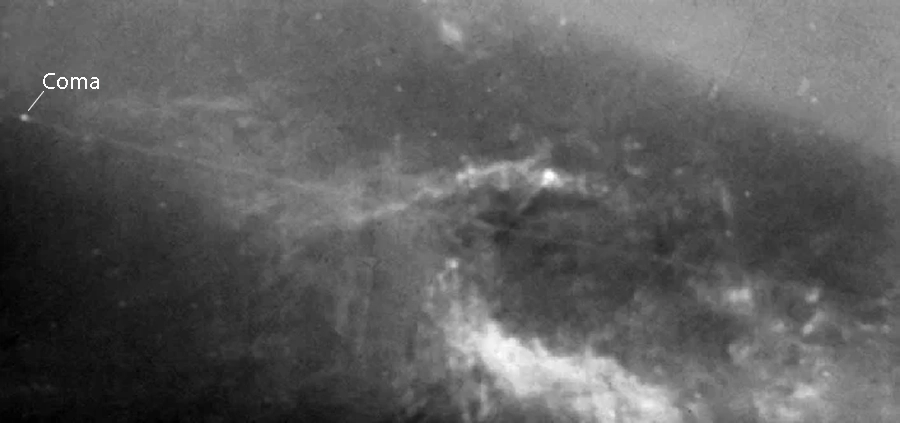
NASA
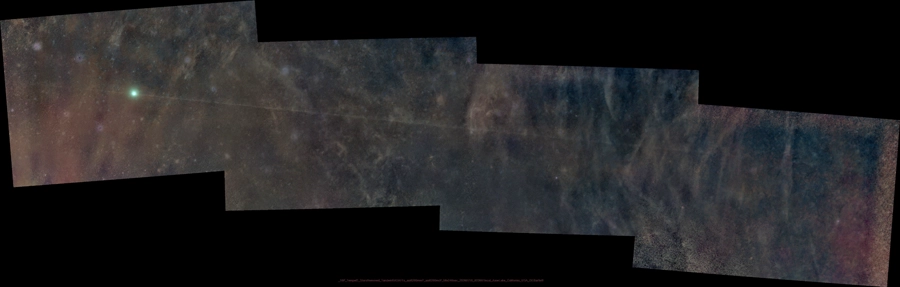
During its all-sky survey in 1983, NASA's Infrared Astronomical Satellite (IRAS) discovered a linear dust trail ahead of and behind the comet made of large dust particles deposited along its orbital plane over the past several hundred years. Composite imagery showed the dust trail extending across more than 30° of sky. IRAS also detected similar trails associated with comets 2P/Encke, 7P/Pons-Winnecke, and others.
Dan Bartlett
It didn't take very long for amateur astrophotographers to duplicate, and even improve, on the satellite's imagery. Some recorded the comet's dust trail at least as far back as 2010. But the color images from the current apparition have been nothing short of spectacular. They depict a long, well-defined trail as narrow as a laser beam, extending from either side of the comet. Amateurs began recording the dust trail in deep exposures in early June. On July 20th, Earth crossed 10P/Tempel's orbital plane, which caused the trail to brighten slightly, a perspective effect that will linger through about July 22nd. I've searched for it visually without success.
No comets are predicted to become brighter than 10th magnitude for the reminder of the year, so be sure to drop by 10P/Tempel for a look. The comet may be just 10.6 km (6.6 miles) across, but it's sure kicking up some dust.
breaking news: Bright Supernova explodes in the Great Bear
Bob King
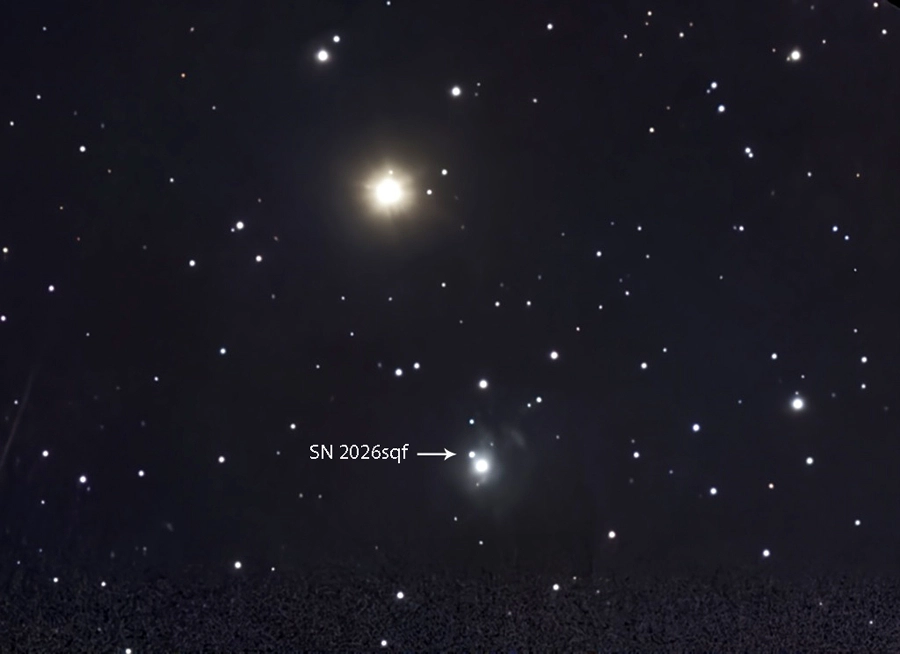
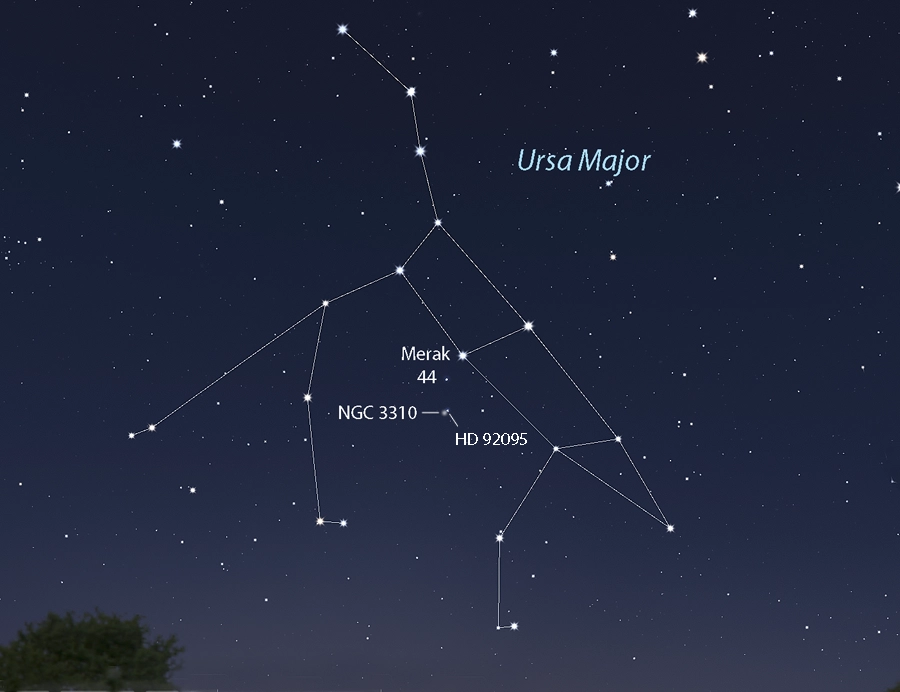
Congratulations to American amateur astronomer Patrick Wiggins on his discovery of his 10th supernova! Wiggins captured images of the stellar explosion on July 8th in the 11th-magnitude spiral galaxy NGC 3310, located 4.2° southwest of Beta (β) Ursae Majoris, or Merak, in the Big Dipper's Bowl. When first seen, the shattered star was about magnitude 13, but it's since brightened to 11.9, and is now within reach of a 6-inch telescope. Designated 2026sqf, it's a Type II supernova, which marks the catastrophic collapse and detonation of a massive star at the end of its life. In my 15-inch, the supernova dominated the galaxy and was easy to spot even at 61×.
Stellarium
The supernova should begin to fade soon, so grab a look while you can. Best viewing time is at the end of evening twilight before the Dipper gets too low. To witness the end of a star's life is also to see the beginning of something new. Freshly wrought chemical elements and molecules blasted into the cosmic void will eventually become the grist of a new generation of suns.
About Bob King
I love the sky (day and night) and have been a skywatcher and amateur astronomer since childhood. I'm also a long-time member of the American Association of Variable Star Observers (AAVSO) and Astronomical League. I pen the Astro Bob blog and have written four books: Night Sky with the Naked Eye (2016); Wonders of the Night Sky You Must See Before You Die (2018) and Urban Legends from Space (2019) and Magnificent Aurora, published in 2024. The universe invites us on an adventure every single night. To accept the invitation, we only need look up.



Comments
You must be logged in to post a comment.