 SUNSET:

 0
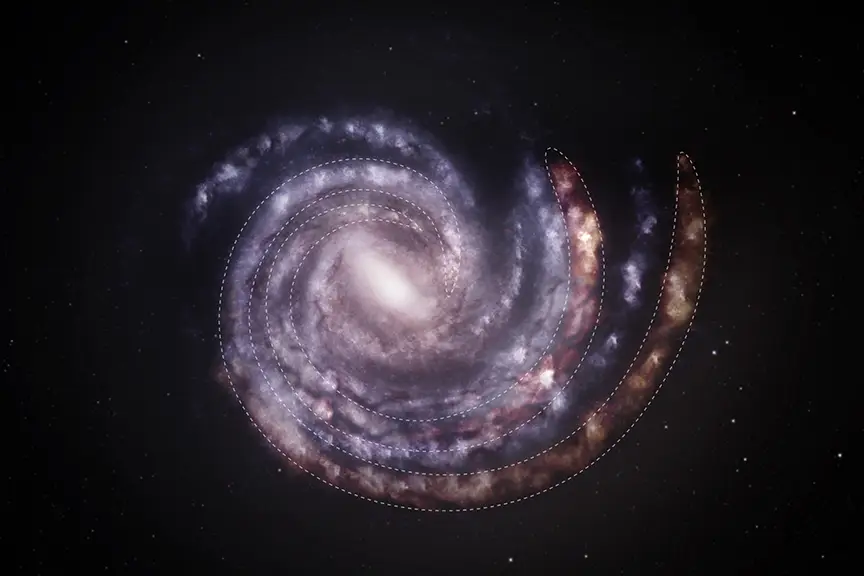
0Observations of remote cosmic explosions reveal that the outer spiral arms of the Milky Way might extend farther out than previously thought.
Based on measurements of X-ray light echoes created by three distant powerful explosions, a team of astronomers led by Beatrice Vaia (Scuola Universitaria Superiore IUSS of Pavia, Italy) concludes that the Outer and the Outer Scutum-Centaurus arms of our home galaxy may lie up to 10% farther away than earlier estimates.
NASA / CXC / SAO / M. Weiss
Determining the size and structure of the Milky Way is hard, since we live inside it. It’s like trying to draw up a map of a city when you’re stuck in a house in one of the suburbs.
The European Space Agency’s (ESA’s) Gaia mission has yielded precise distances for 2 billion stars in our galaxy, but only out to some 10,000 light-years. The galaxy’s disk stretches well beyond that horizon. So to map the Milky Way’s outer spiral arms, astronomers have had to rely on less direct methods.
Now, long gamma-ray bursts (GRBs) have come to the rescue. These gigantic blasts of gamma- and X-rays result from the dramatic collapse and subsequent explosion of very massive, rapidly rotating stars in distant galaxies.
Vaia and her colleagues studied three gamma-ray bursts: GRB 031203, GRB 160623A, and GRB 221009A. (The numbers refer to the dates they went off; GRB 221009A is the most luminous burst ever recorded.) These explosions happened to occur in places that put them close to the Milky Way’s central plane on the sky, called the galactic equator, so that we’re looking at them through the dust and gas of the disk. As a result, the high-energy radiation from the three blasts passed through one or more galactic spiral arms before arriving at Earth.
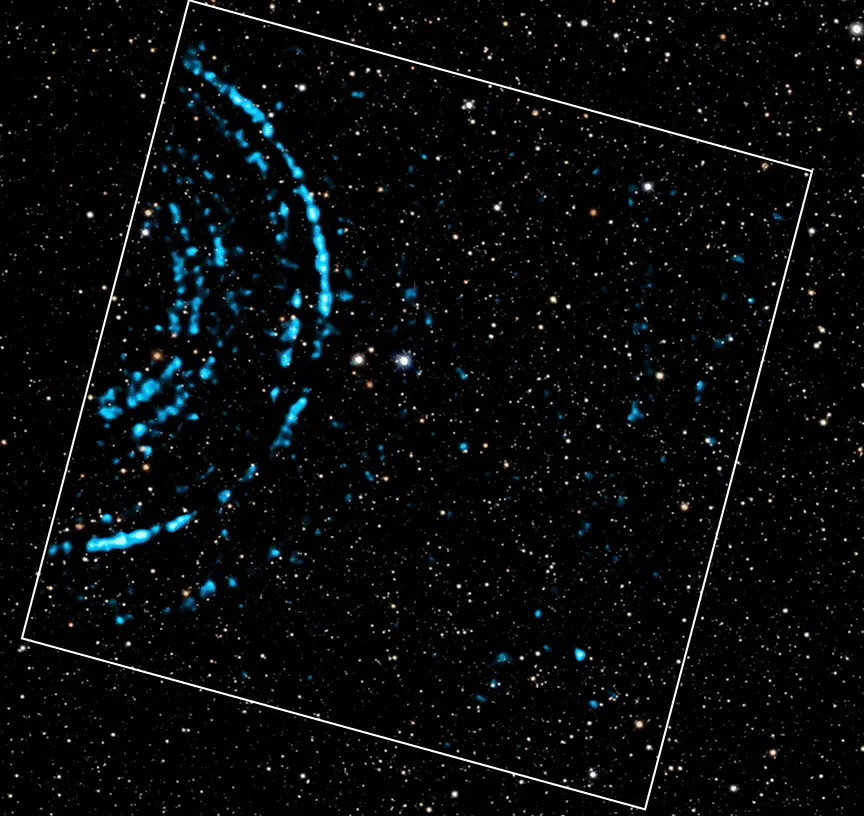
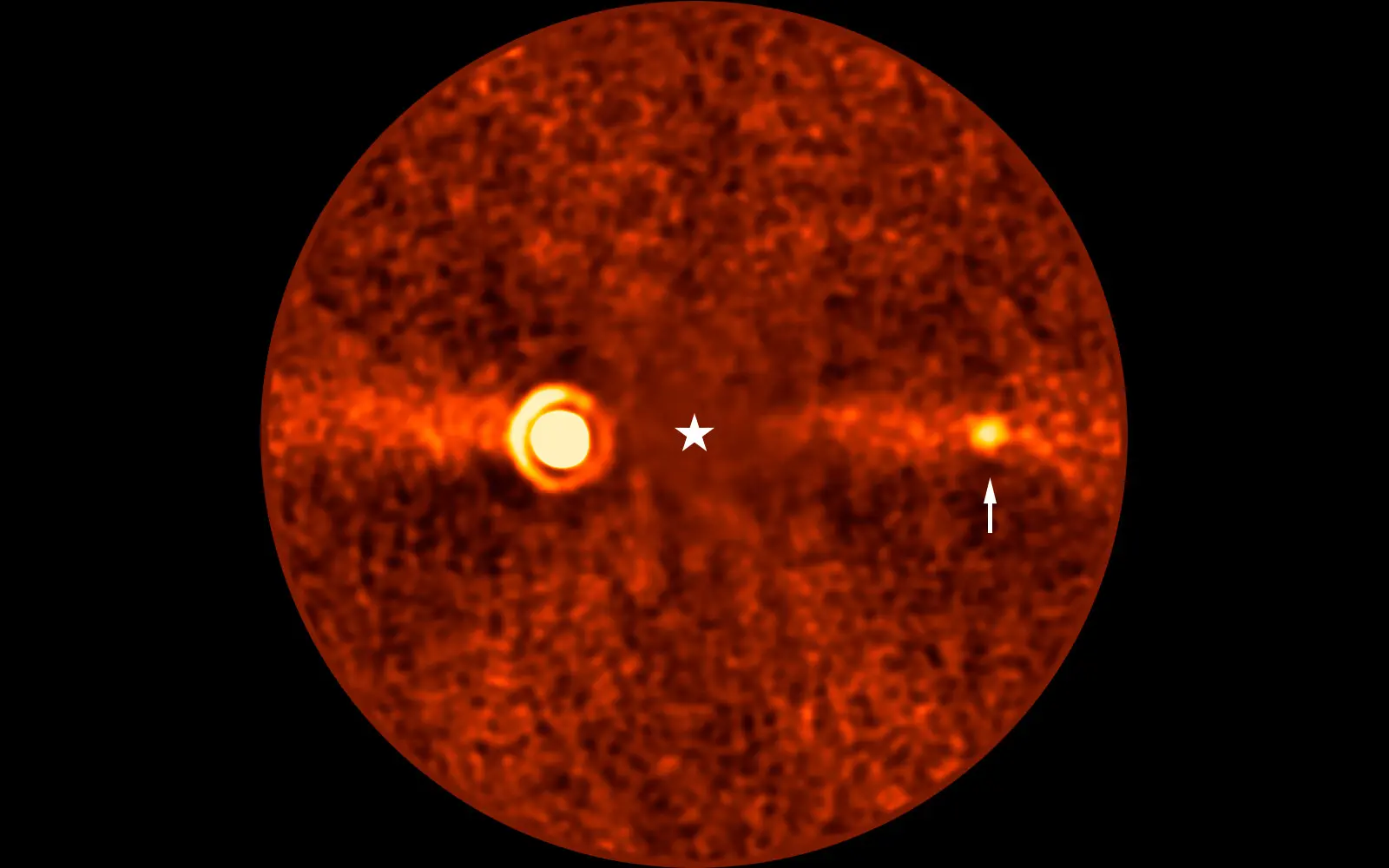
In the days after the explosions, NASA’s Chandra X-ray Observatory and ESA’s XMM-Newton space telescope detected numerous expanding rings around each burst. Such light echoes are produced when radiation is scattered by intervening dust clouds in our galaxy.
Since the scattered X-rays follow a slightly longer path, they arrive a bit later than the instantaneous flash of the gamma-ray burst, just like an echo arrives after the initial sound because it took a longer path by bouncing off a surface before reaching the listener.
It turns out there’s a direct relation between this delay time, the size of a light echo on the sky, and the distance of the echo-producing dust.
“By measuring the radius of each ring in the available X-ray observations and using the elapsed time since the burst, we can identify the corresponding dust layer and determine its distance,” explains Vaia.
X-ray: NASA / CXC / INAF / B. Vaia et al.; Optical: Pan-STARRS; Image processing: NASA / CXC / SAO / N. Wolk & P. Edmonds
Large dust complexes are located in our galaxy’s spiral arms, so this is a neat way to map the arms’ extent. In a paper published last month in Astronomy & Astrophysics, the team concludes that the Perseus Arm — the one just beyond our Local Arm — lies where we thought it did. But the Outer Arm beyond it and the Outer Scutum-Centaurus Arm beyond that may both be up to 10% more distant than earlier studies predicted.
In a press statement, team member Ilaria Fornasiero (University of Trento, Italy) says that “this could mean that astronomers have to revise estimates of the mass of the galaxy, because that affects how wide the arms stretch.”
With just three sightlines and no independent way of knowing where exactly the dust clouds are located in the spiral arms, the results are necessarily preliminary. Future observations of X-ray light echoes around new gamma-ray bursts that occur close to the galactic equator may further improve the distance estimates of the arms.
About Govert Schilling
Sky & Telescope Contributing Editor Govert Schilling lives in The Netherlands but loves to explore his home planet. In May 2022, Harvard University Press published The Elephant in the Universe: Our Hundred-Year Search for Dark Matter. His latest book is Target Earth - Meteorites, Asteroids, Comets, and Other Cosmic Intruders That Threaten Our Planet.




Comments
You must be logged in to post a comment.