 SUNSET:

 0
0The sharp-eyed and far-seeing Euclid space telescope has picked up 31 early quasars that have evaded detection until now.
T. Müller, HdA / MPIA
Weeks after probing the heart of the Milky Way, the astronomers behind the European Space Agency’s Euclid telescope have announced another discovery from this wide- and sharp-eyed observatory: 31 of the most distant quasars in the universe. One of these is the new record-holder — it formed within just 670 million years of the Big Bang.
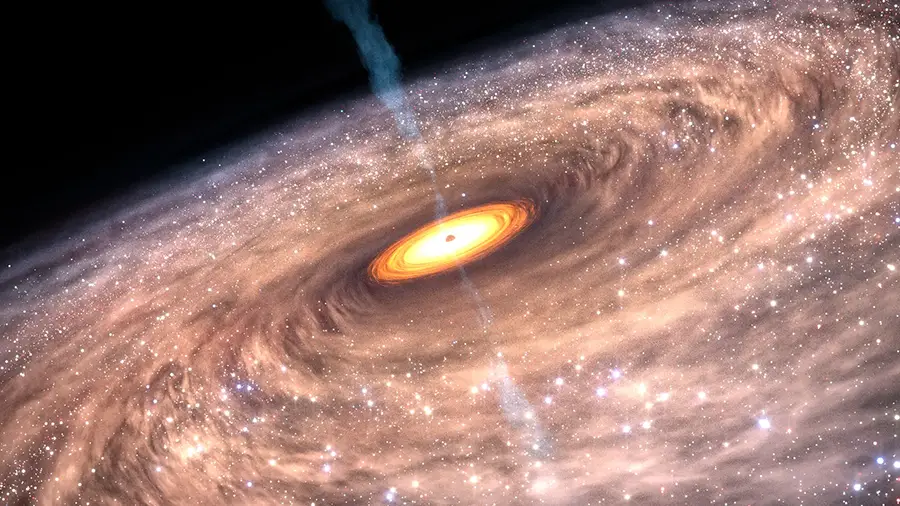
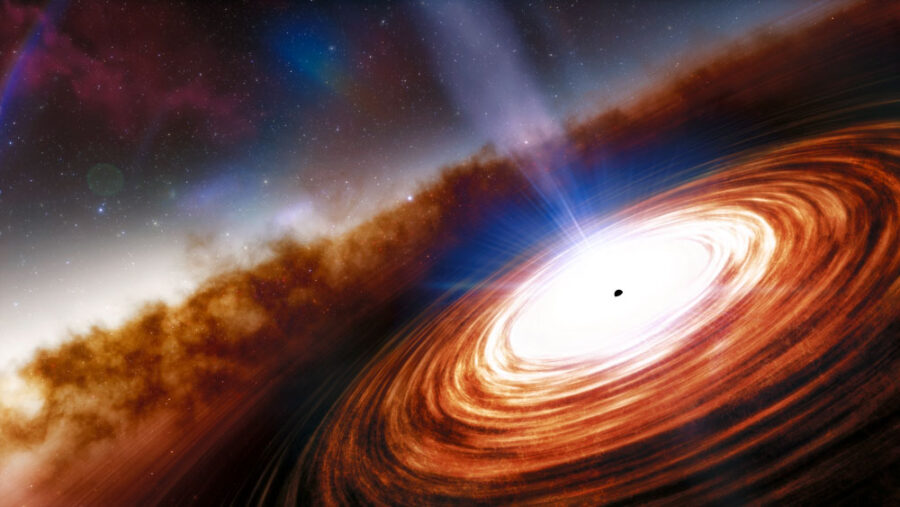
Quasars are voracious supermassive black holes squatting at the center of large galaxies. These black holes that exist so early on have already swallowed up millions of Suns’ worth of gas and stars. To gather so much mass so quickly suggests these black holes were born with significant heft — a challenge that astronomers are still seeking to understand.
Wide-eyed and Far-seeing
Over its first 1½ years, the Euclid space telescope has already surveyed 3,000 square degrees — almost a tenth of the whole sky — thanks to its wide field of view. The resolution and sensitivity of each Euclid image is equivalent to that of the Hubble Space Telescope, but every few-hours-long pointing captures a field of sky 270 times larger.
As a result, Euclid can sweep across vast swaths of sky on the hunt for precious things such as quasars. Early quasars are among the rarest of celestial objects. For those residing within the universe’s first 770 million years (equivalent to redshifts greater than 7), there’s only expected to be one every 100 square degrees or so (equivalent to the area covered by 500 full Moons).
To find such quasars, images aren’t enough. While Euclid can image promising candidates, astronomers must obtain follow-up spectroscopy to secure their identifications. And spectroscopy is expensive — obtaining a spectrum of a single object takes much longer than imaging it, and as we all know, time is money.
So Daming Yang (Leiden University, The Netherlands) employed artificial intelligence (AI) as well as statistical methods to first select the most promising candidates. “The parent catalog contains millions of sources,” Yang says. “Our machine-learning selection brings that down to the level of a few thousand candidates.”
Yang and his team then applied for follow-up spectroscopy of 123 of these objects to start with, using large ground-based telescopes: Keck I and II, Magellan Baade, and the Large Binocular Telescope.
Panning for Gold
Despite the selection process, the majority of the follow-up spectra turned up nothing — either the object was something else other than a quasar, or there was not enough light there to obtain a spectrum at all.
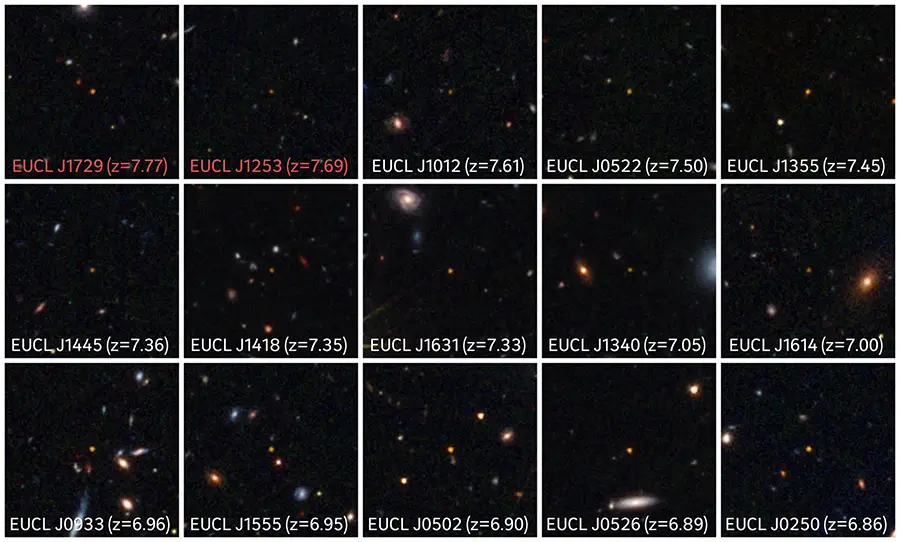
But the researchers were panning for gold and, amidst the dirt and gravel, they struck it rich. Before Euclid, there were nine quasars at redshifts greater than 7. Using Euclid Yang and colleagues more than doubled that number, with 12 new early quasars, as well as 19 additional ones that were born within the first 830 million years (that is, with redshifts greater than 6). A report on the total of 31 early quasars appears in Astronomy & Astrophysics.
Additional follow-up is forthcoming. “This sample is very much a first trial rather than the end of the story,” Yang says.
ESA / Euclid / Euclid Consortium / NASA, image processing by the Euclid Science Ground Segment and Antoine Basset (CNES)
The best thing about this treasure haul is that the quasars the team found are so very ordinary. Unlike previous record-breaking discoveries, which were found precisely because they were exceptionally luminous, these new quasars aren’t all that bright.
“For the first time, we can study the typical early-universe quasar, not just exceptional outliers,” says team member Eduardo Bañados (Max Planck Institute for Astronomy, Germany). “We now have a real window onto how the bulk of the first black holes grew — and how they shaped the galaxies around them.”
A follow-up study, to appear in Astronomy & Astrophysics, opened a window on one such pair: the galaxy and its quasar, dubbed EUCL J1253 for short. Silvia Belladitta (also at Max Planck) led a team that investigated this galaxy using the Northern Extended Millimeter Array (NOEMA) in France, discovering a vast reservoir of gas that helps fuel the formation of 250 solar masses’ worth of new stars every year.
In other words, the galaxy around this supermassive black hole is itself massive and bursting with stars. (That is, it’s massive considering how young the universe is — it has only a tenth the mass of the Milky Way.)
Despite the host galaxy’s heft, it belies the mass of the black hole at its center. In the local universe, galaxies tend to outweigh their black holes by 200 to 1. This host galaxy still outweighs its black hole, but by only 100 to 1. According to a preliminary mass estimate, the black hole is at least twice as massive relative to its galaxy compared to what’s expected.
In fact, while only two of the black holes in these studies have preliminary estimates of their masses (emphasis on preliminary), both appear to be about 100 million times the Sun’s mass. That’s a lot. During these early, gas-guzzling times, black holes could grow by a factor of 100 over only 200 million years. But even wolfing down gas can’t explain their masses.
Unless, that is, they were not born of stars — not even of the first, colossal generation of stars. Instead, specialized conditions might have allowed for black hole “seeds” of at least 1,000 solar masses, which then grew into the million-solar-mass giants that Euclid picked up.
NOIRLab / NSF / AURA / J. da Silva
It’s too early to say whether any of these new quasars back such a conclusion, though. There are reasons to doubt both of the mass estimates provided in the papers, so the team has plans to obtain additional measurements to make those estimates more certain. “Ideally these measurements need the James Webb Space Telescope,” Yang says, “and that is exactly what’s happening: Webb observations of the sample are underway.”
“If they prove to be ‘overmassive’ relative to their host galaxies,” posits Ryan Hickox (Dartmouth University), who was not involved in the study, “that would imply that the black hole grows more rapidly than the galaxy it forms within.” In other words, he adds, it would mean that the formation of the black hole outpaces the formation of the stars around it.
“Every one of these 31 quasars is a new sightline into the early universe, and the follow up science is just beginning,” says team member Joseph Hennawi (University of California, Santa Barbara).
What’s more, Hickox adds, there’s likely far more to come: “This is only using about a quarter of the area that will ultimately be covered by the Euclid surveys, so there is exciting potential for lots more of these rare high-redshift quasars.”
About Monica Young
Monica Young, a professional astronomer by training, is News Editor of Sky & Telescope.



Comments
You must be logged in to post a comment.