 SUNSET:

 0
0Meet Cygnus, the Swan, a high-flying constellation that looks like its namesake and has a rich mythological history.
Daniel Johnson
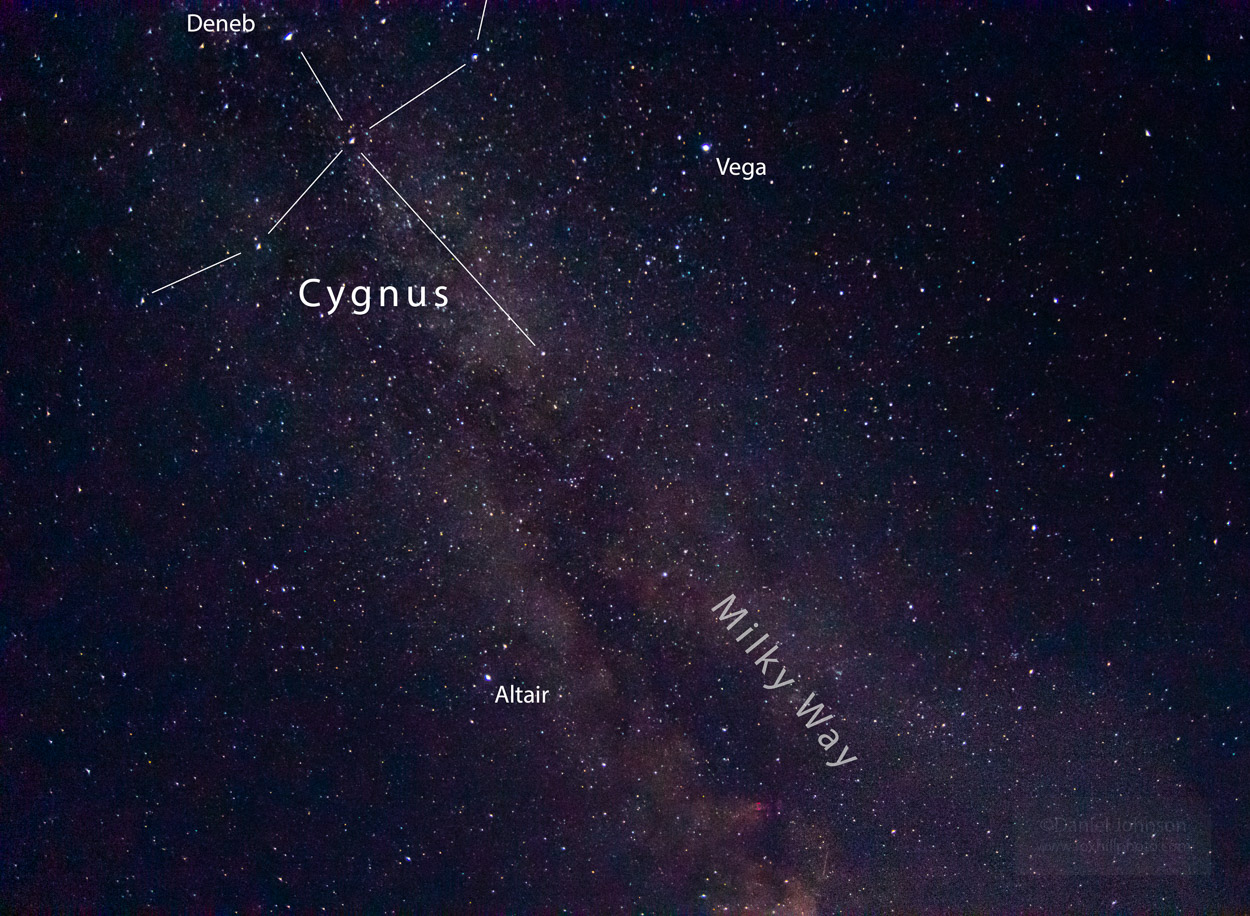
Some constellations don’t really resemble the object they’re supposed to depict. But not so with Cygnus, the Swan. Not only does the basic shape really seem to fit the image of a bird with outstretched wings, it even looks like a swan specifically. Add in the fact that Cygnus can “fly” high overhead during the summer, and you have a wonderfully apt image. Yet Cygnus doesn’t always get the attention it should — beginning stargazers are naturally more drawn to Orion, Cassiopeia, or Leo. Don’t let the Swan fly away unnoticed! There are some terrific sights to be found in this little gem.
The Stars of Cygnus
Roberto Mura / Digitized Sky Survey
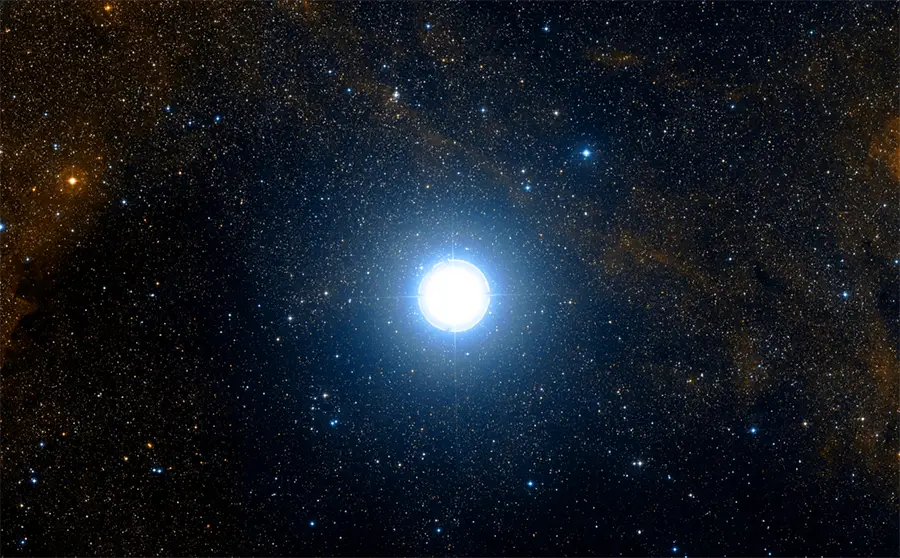
- Alpha (α) Cygni - We begin with Deneb — the Swan’s tail and one of the Northern Hemisphere’s most spectacular stars. At magnitude 1.25, it’s the 19th brightest star in the night sky. But what’s truly amazing is the star’s power. Many of the sky’s brightest stars seem so vivid because of their proximity — think Vega or Sirius; they’re nearby but not particularly luminous of their own accord. But Deneb is different — it’s between 1,500 and 3,000 light-years away (exact measurements are challenging). To appear as bright as it does from that distance, it must be emitting 50,000 to 200,000 times more than the Sun’s luminosity.
- Beta (β) Cygni - The head of the Swan is marked by Albireo, one of the best binary stars to observe with small telescopes. This pair consists of a bright yellow/orange giant star (similar to Aldebaran) and a dimmer, hot blue star (similar to Regulus). The contrasting colors when viewed under a telescope are striking and well worth pursuing. Despite the Beta designation, Albireo is fainter than the other stars listed here.
- Gamma (γ) Cygni – Sadr represents the bird’s body. This is another distant star, about 1,800 light-years away. Sitting within a large nebula cloud that shows up beautifully in photographs, 2.2-magnitude Sadr might appear half a magnitude brighter were it not surrounded by so much cloud dust.
- Delta (δ) Cygni - Fawaris is another bright star that forms one of the Swan’s wings. It's a fast-spinning, very hot B-class star, similar to Vega. While Fawaris is not significantly larger than the Sun, it delivers a much higher luminosity. There are also two smaller companion stars here, making it a triple system.
- Epsilon (ε) Cygni - The Swan’s opposite wing is marked by Aljanah, a giant K star with a definite yellow glow. Of the five stars on this list that form the basic outline of Cygnus, Alijanah is by far the closest to Earth, only 73 light-years away.
Many other slightly fainter stars fill in the Swan’s shape — particularly along the wings and neck — but these five provide the basic outline of a flying bird with outstretched wings.
Mythology
There are a few Greek stories involving Cygnus, but one in particular matches up well with what you see in the sky. This version centers around Orpheus, one of the world’s earliest musicians — a man who could play the lyre so well that rocks came to life and rivers paused to listen. After his death, the musical Muses sent him to the sky as Cygnus, the Swan. The tale might have engendered the concept of a “swan song” or last great deed. Fittingly, the constellation Lyra, the Lyre, is right next door on the sky, so Orpheus/Cygnus is never without his beloved musical instrument.
Earlier than this, ancient Arabic astronomers referred to Cygnus as a hen, not a swan, and brilliant Deneb was known as the “tail of the hen.” So the concept of an avian constellation persisted across centuries, though the species changed to fit cultural preferences.
Jeffrey Gammon
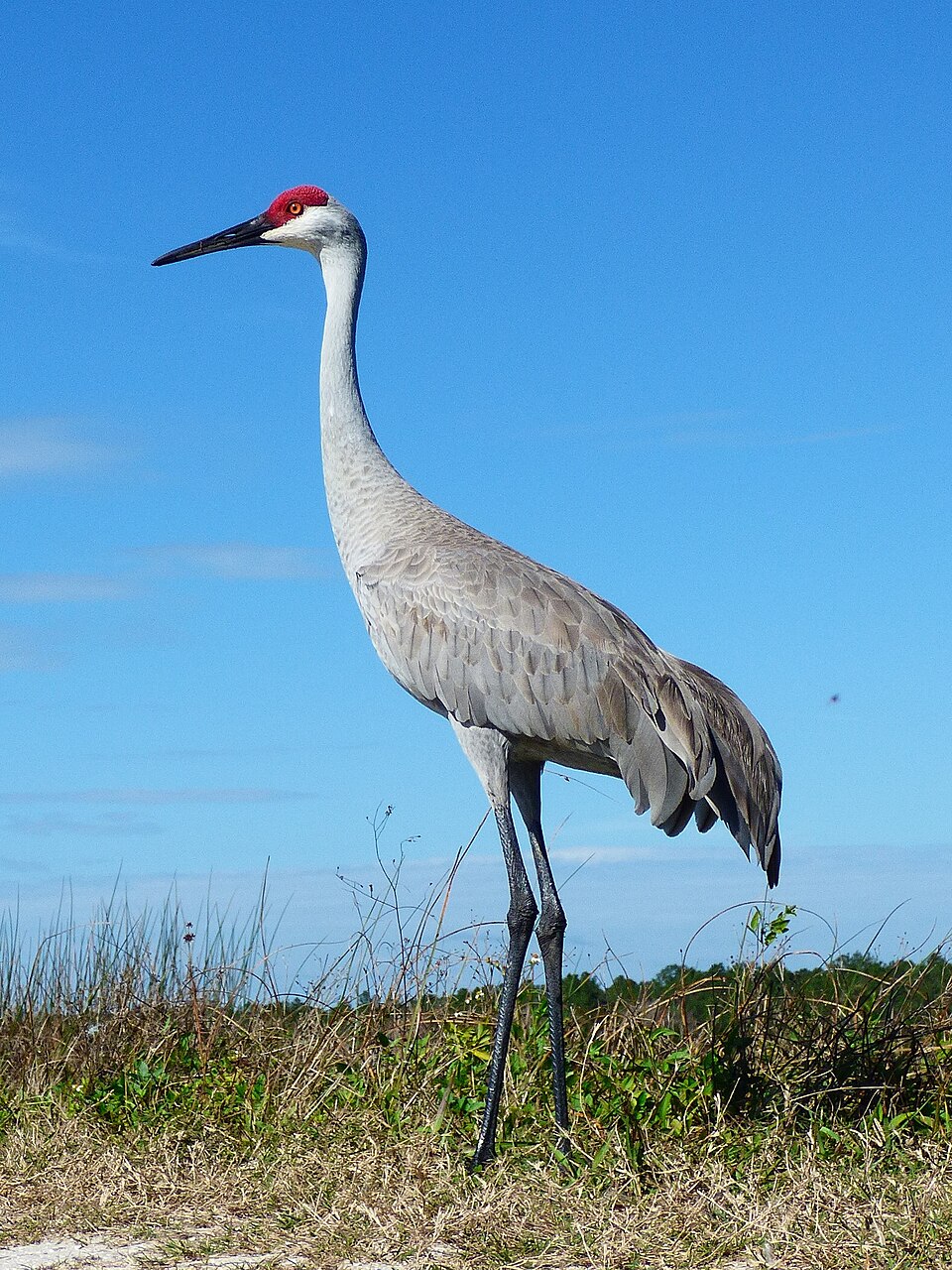
Another example of this is in the Great Lakes region, where the stars of Cygnus form the Ojibwe constellation Ajiijaak, a Sandhill Crane. These tall, slender birds spend their summers in the region. In this interpretation, though, Deneb marks the crane’s head, not its tail, so the bird is flying in the opposite direction.
How to See Cygnus
Summer is an excellent time to seek out this high-flying swan (or hen, or crane), and watch it soar around the ceiling of the sky. The Swan starts out pretty high in the evening sky, and then continues to rise higher and higher as the night hours pass, sometimes even reaching the zenith — the point directly overhead — depending on your local latitude and time of year.
It’s important to note that Cygnus sits directly on a bright swath of the summer end of the Milky Way band, so if you have access to a dark viewing site — and you let your eyes adjust properly — you might see the Swan gliding across the deep band of glowing galaxy.
Don’t worry if your viewing site is hampered by light pollution. The main stars of Cygnus are bright enough to shine through skyglow, and the Swan’s body and its outspread wings are easy to pick out.
Stellarium
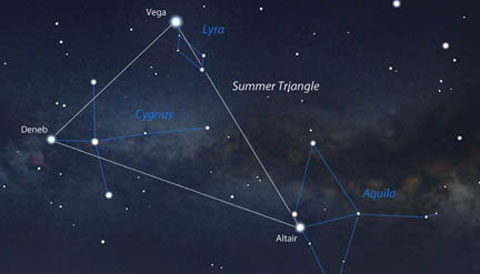
To find Cygnus — which can easily be lost in a massive starry sky — start with Deneb, the Swan’s tail. Deneb is a bright corner of the famous “Summer Triangle” asterism, which also includes bright stars Vega and Altair. The Summer Triangle is by no means a perfect equilateral triangle, but the three members are bright, close together, and make a relatively good signpost to direct you to the rest of Cygnus. The Milky Way runs right through the triangle, so if you can vaguely see the shape of our galaxy’s band, it can also help you home in on the region.
The stars of Cygnus are vividly bright, and the Swan flies high — you might even want a reclining lawn chair to sit back and watch it soar.
About Daniel Johnson
Daniel Johnson is a Wisconsin-based freelance writer and professional photographer and the co-author of over a dozen books. He’s a longtime amateur astronomer and fortunate enough to live in a rural region with excellent seeing conditions. You can view some of Dan’s photography at www.foxhillphoto.com.






Comments
You must be logged in to post a comment.