 SUNSET:

 0
0Two teams of astronomers independently discovered a third giant gas planet orbiting in the famous Beta Pictoris system.
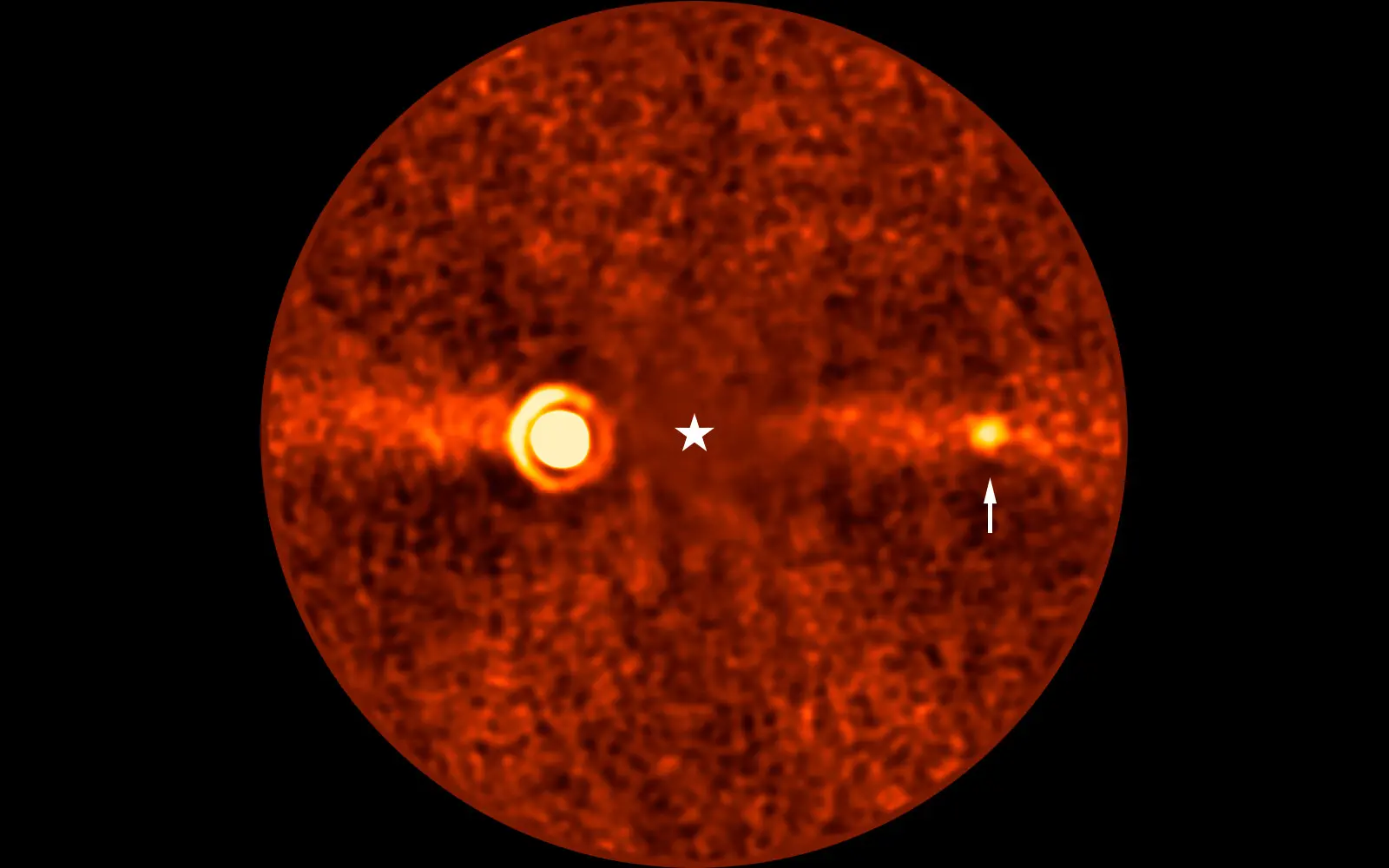
ESO / Sutlieff, M. Bonse et al.
The well-studied Beta Pictoris system has a third giant planet. Like the other two, the new planet is also a gas giant, revealed in imaging by the glow it's emitting, thanks to heat leftover from its formation. But it's 100 times fainter than Beta Pic b, and it's much farther out from the host star than both its planetary siblings.
Two teams made the same discovery independently. One team found the planet serendipitously while imaging the system at near- and later mid-infrared wavelengths using the James Webb Space Telescope; that result was published July 15th in the Astrophysical Journal Letters, led by Aidan Gibbs (University of California, San Diego). Another team, led by Ben Sutlieff (University of Edinburgh, UK), also spotted the planet by accident while looking for variability in the light from brighter Beta Pictoris b. The initial images were taken with the European Southern Observatory's Very Large Telescope. The team then uncovered the planet hiding in other images taken throughout the previous decade. Those results were also published July 15th in the same journal.
“While we see Beta Pictoris d’s full light allowing us to derive its fundamental properties such as temperature and planet mass, Webb’s spectra probe the planet’s atmosphere, revealing methane (CH4), carbon monoxide (CO), and water vapor (H2O),” explains Elisabeth Matthews (Max Planck Institute for Astronomy, Germany).
“Planet d, it seems, has been playing a game of hide-and-seek with us for over a decade," says team member Jayne Birkby (University of Oxford, UK), “and only now can we say ‘found you!’”
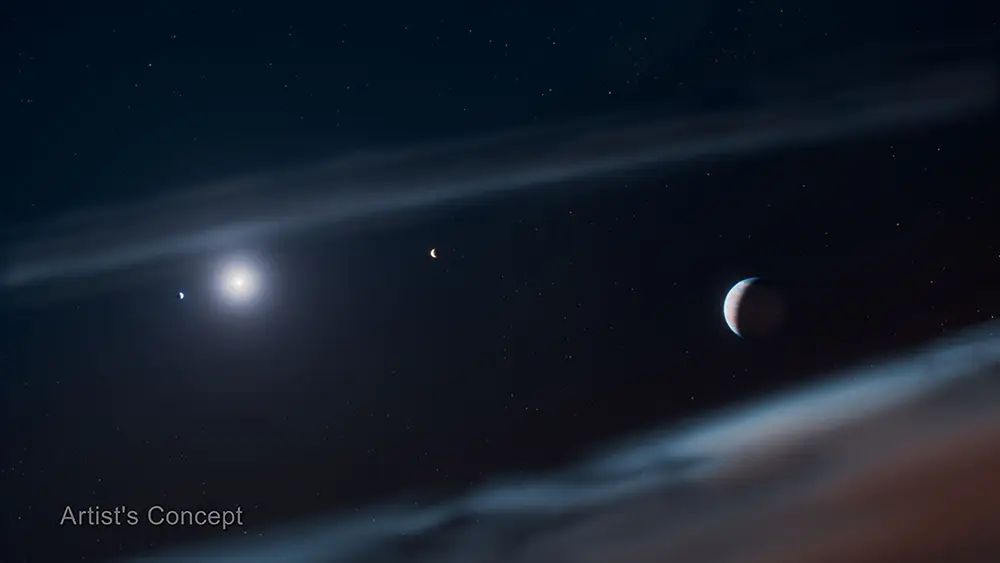
The planets of Beta Pictoris are all more massive than Jupiter — but Beta Pic b and c are both about 8.7 times Jupiter's mass, while Beta Pic d has the heft of just 2.4 Jupiters. That makes it the lightest planet ever captured via direct imaging; most other exoplanets are discovered using other, indirect techniques, like the quick dimmings they cause when they cross the face of their parent stars. Beta Pic d is also orbiting its star much farther out than in other systems (including our own), with a distance of 26 au, slightly less than Neptune's average distance from the Sun.
Because all three planets are imaged by their own light, these observations tell astronomers what giant planets look like when a star system is only 20 million years old, compared to the middle-aged solar system we live in. The conditions around a star so young are messier, but the planets' presence helps clear things out.
In fact, previously astronomers had predicted the presence of at least one planet farther from the star. Now, the discovery of Beta Pic d seems to confirm those predictions — it might well be responsible for carving the inner edge of the debris disk that surrounds Beta Pictoris, clearing away the leftovers of earlier stages of planet formation. Further studies will be necessary to see whether Beta Pictoris formed out there, or whether it migrated outward to its present orbit.
NASA / ESA / CSA / STScI / Ralf Crawford (STScI)
Read more about the discoveries in press releases issued by the European Southern Observatory and NASA.
About Monica Young
Monica Young, a professional astronomer by training, is News Editor of Sky & Telescope.


Comments
You must be logged in to post a comment.