 SUNSET:

 0
0Here’s an observing guide to both familiar and lesser-known deep-sky objects that inhabit our galaxy’s equatorial zone.
Bob King
I've never been to Earth's equator. But I got close many years ago when my wife and I flew twice to Colombia to adopt our daughters. We stayed in the capital Bogotá, situated 4.6° north of the equatorial circle. There were many legal and logistical hurdles to tackle, but we were and still are incredibly grateful for the opportunity to build a family.
Stellarium, with annotations by Bob King
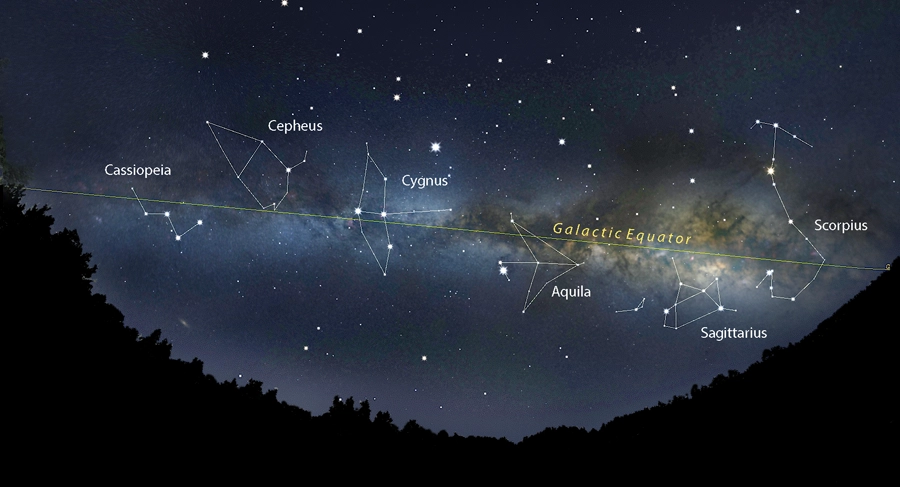
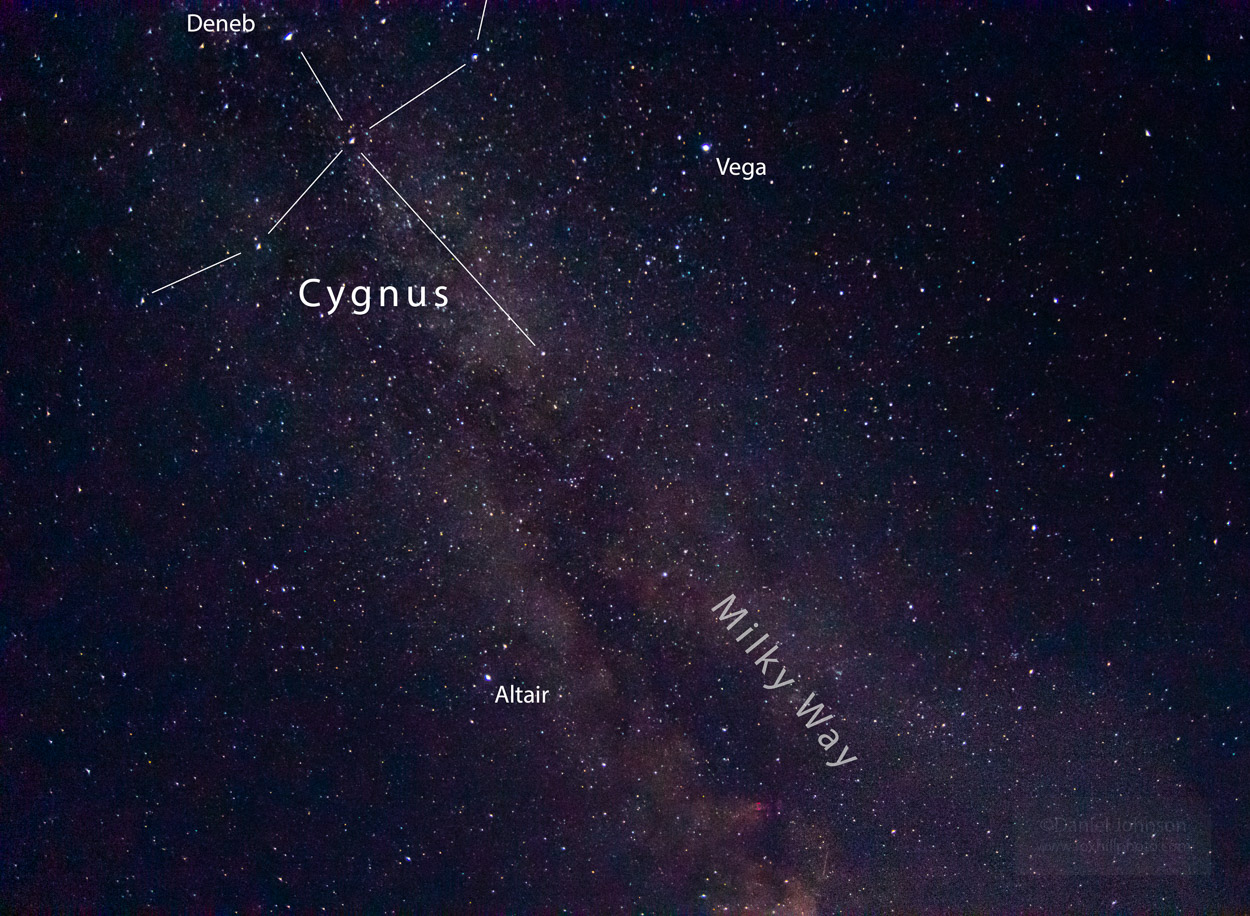
A trip to the galactic equator, in contrast, is easy. No waiting in airports. No calculating exchange rates. You don't even have to use vacation time. To get there requires only a clear night and a pair of binoculars or a telescope. In early summer, the Milky Way's equator, which defines the midplane of our galaxy's flattened disk, extends invisibly from Cassiopeia's W low in the northeastern sky through Cygnus, Aquila, Sagittarius, and Scorpius. The Sun orbits the Milky Way's hub from within this thin disk, which is about 1,000 light-years thick and centered on the galactic plane. In a cosmic year — the time it takes to revolve once around the core — the Sun weaves approximately 250 light-years above and below the plane. Currently, it's about 55 light-years above it.
There's a lot going on in that thin disk. In it you'll find the galaxy's signature spiral arms, adorned with bright, young stars, colorful nebulae, and scintillating open clusters — a Wonka's Chocolate Factory of galactic goodies. It's where you'd want to be on a clear, dark, moonless July night.
Stellarium, with annotations by Bob King
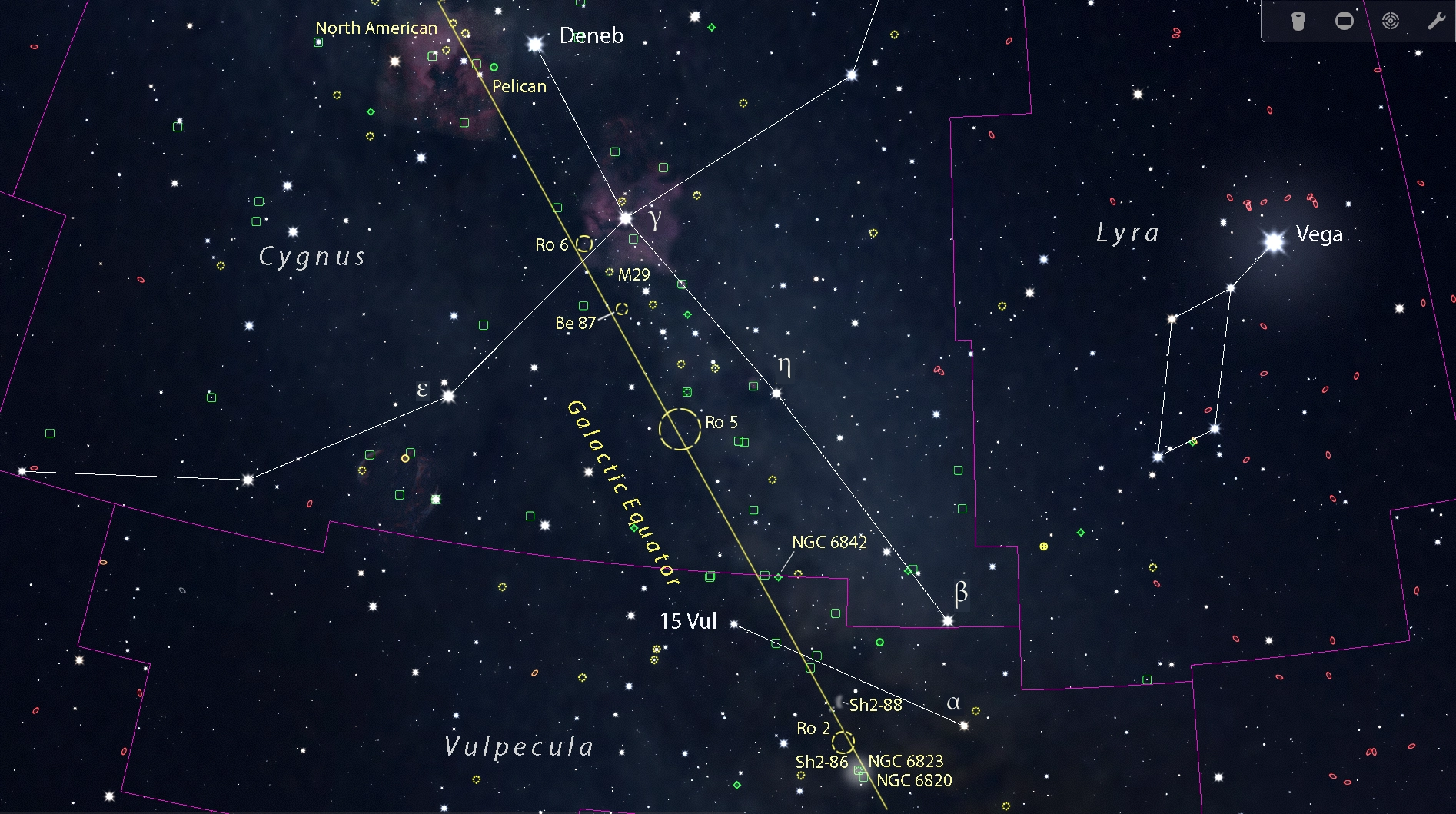
Here's a selection of galactic gobstoppers for you to pick from when in between swatting mosquitoes. They're all located within 0.5° of the galactic equator. I used a combination of 10×50 binoculars and a 15-inch Dobsonian reflector for the observations. Given the sheer number of equatorial wonders, I limited the objects to the swath from northern Cygnus through Vulpecula, beginning with the Pelican Nebula (IC 5070).
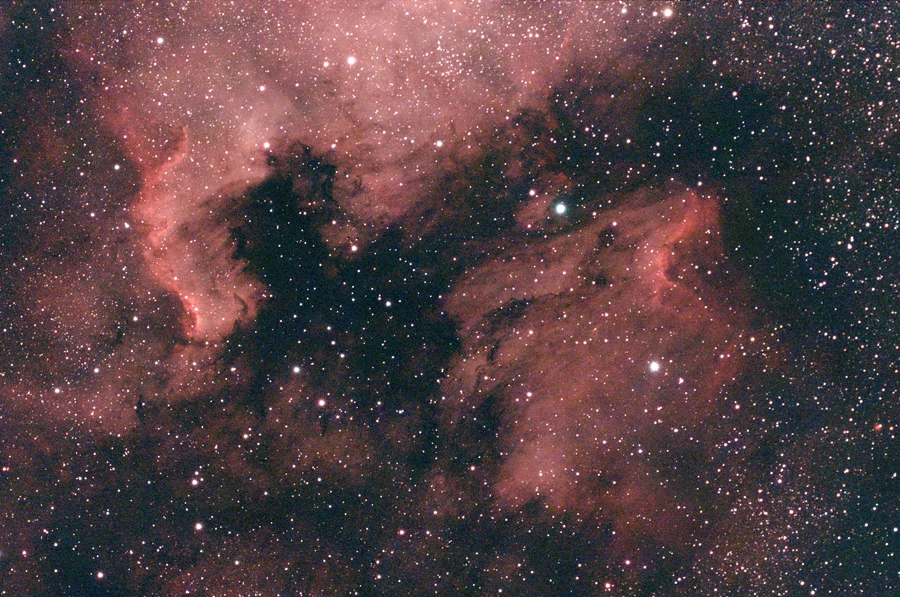
The galactic plane bisects this approximately 40-light-year-wide stellar birth cloud that bears a striking resemblance to its avian namesake. Given its apparent diameter of ~1°, I opted for my lowest magnification of 61× and added an oxygen III (O III) filter to enhance contrast. The Pelican's head and neck stood out straightaway as a diffuse, nebulous arc. Along the bird's east side, two fainter fingers of nebulosity poked out — the beak (north) and its right wing (south). A brighter puff marked the webbed feet. The western Pelican was much more amorphous, but I managed to make out the dim left wing with averted vision.
The dark nebula LDN 935 separates the Pelican from the North America Nebula's Eastern Seaboard and Gulf of Mexico. Within the gap lies a nebulous "Atlantis" tucked between 5th-magnitude 57 Cygni and 7th-magnitude V1794 Cygni. The 13′-long strip popped nicely with the O III filter.
My next stop was Roslund 6, one of seven open clusters discovered by Curt Roslund of Sweden's Lund Observatory. All are found in the summer Milky Way, and most are visible with binoculars from dark skies. Ro 6 at 61× is a large, loose cluster 50′ across. Few stars occupy the center. Instead, the majority of its 30 members form a pretty wreath. The 7th-magnitude star HD 195194, the brightest of the bunch, lies northwest of the center and may be a member. My 10×50 binoculars and finderscope easily revealed the cluster.
Veryoldphotons, CC BY-SA 4.0
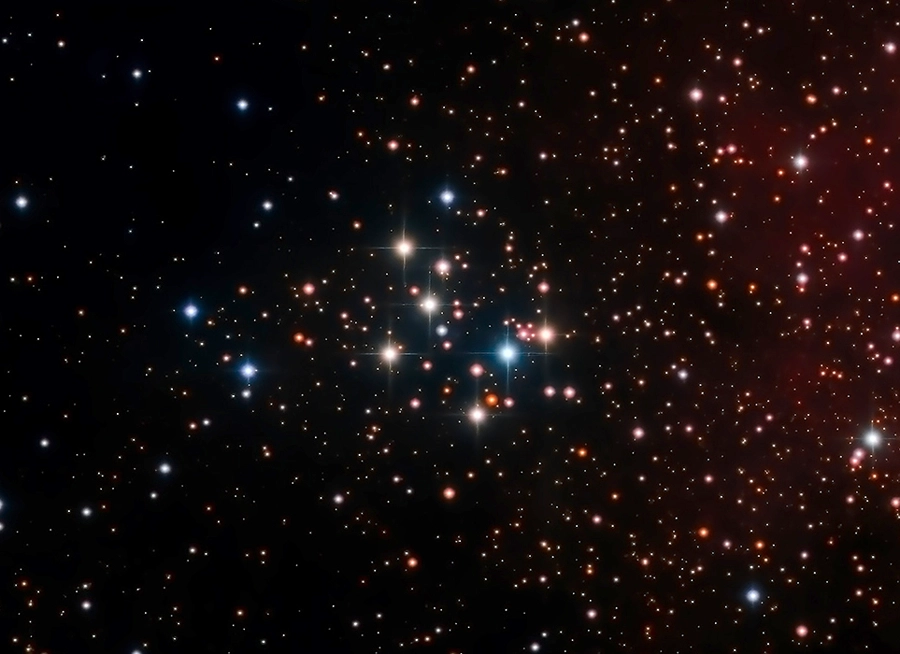
There are so many deep-sky objects lying along the galactic plane that often you can simply object-hop from one to the next. That's how I arrived at the open cluster M29, which is located just 1.2° southwest of Ro 6. Through binoculars, it was a tiny pile of gems that reminded me of the Southern Cross's Jewel Box cluster. Both have similar apparent diameters of around 10′. In my 15-inch, M29's brightest stars (9th and 10th magnitude) form two opposing stellar angle brackets.
Dipping another degree southwest, we arrive at the open cluster Berkeley 87. Many clusters in the Berkeley catalog are faint and obscure, but this was a comparatively splashy and moderately rich grouping with about 30 stars spread across 10′. Observers often see fun and fantastic shapes in star clusters. In my eye, the brightest members depicted a sloppy, Greek letter "pi" in the sky.
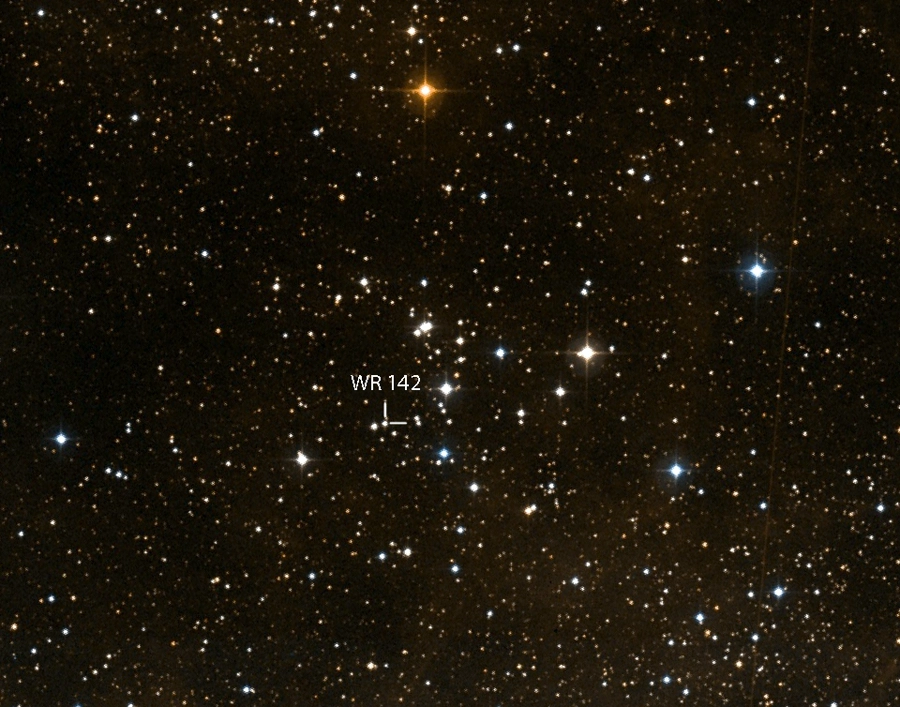
DSS2, Aladin Sky Atlas
Lurking within Be 87's heart is one of the most remarkable stars in the sky. Dubbed WR 142, it's a Wolf-Rayet star some 29 times more massive than the Sun, and it's one of the hottest-known in the universe with a temperature of around 200,000° C (360,000° F). Sizzle! That's 36 times hotter than the Sun. These qualities make WR 142 one of the best candidate suns to undergo supernova explosion in the near future. An 8-inch scope will suffice to see the 13th-magnitude object, which forms a close pair with a similarly bright neighbor. Were it not for the massive amount of intervening stellar dust, which affects the visibility of many of the galactic plane's denizens, this stellar powerhouse would shine at around magnitude 9.
Sliding 4.3° southwest farther along the equator, we arrive next at Ro 5, a large, baggy open cluster roughly 1° across. It's no surprise the object overspilled my scope's 61× field, making it more suited for binoculars. It contains about a dozen 7th- and 8th-magnitude, widely spaced suns with a smattering of fainter members. The brightest stars lodge in the cluster's eastern half.
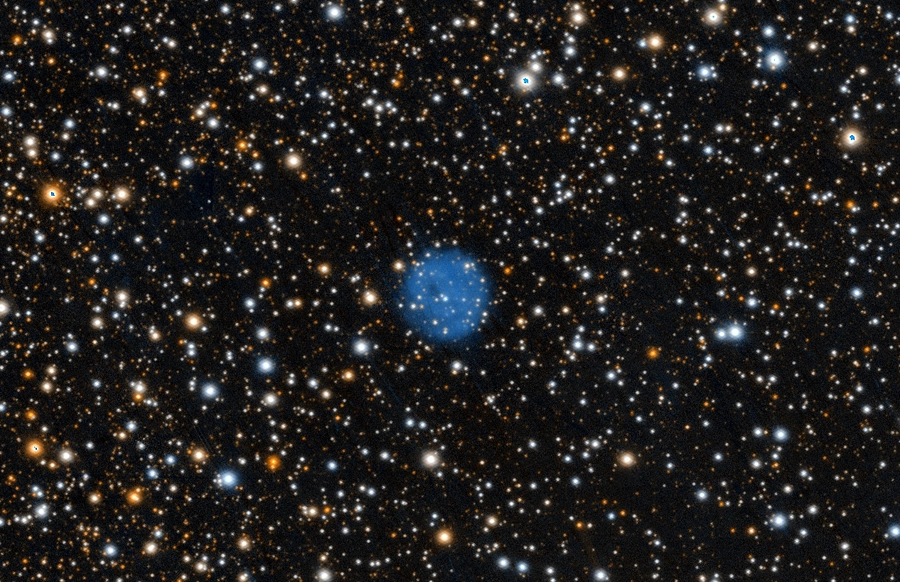
PanSTARRS DR1, Aladin Sky Atlas
We cross from Cygnus into Vulpecula for our next catch, the 13.1-magnitude planetary nebula NGC 6842. At 86× I saw a soft, round, opaque disk 57″ across without using an O III filter. Adding the filter and increasing the magnification to 245× greatly improved the definition and contrast and also revealed a brighter northwestern rim. The planetary's 16th-magnitude central star eluded my gaze.
Sharpless 2-88 is another of many active star-forming regions dotting the galactic midplane. This emission nebula spans about 18′ × 6′ and goes by the name the Face of God. Visually, I detected its brightest portion (God's cheek) as a faint yet distinct hazy patch at 61× with the O III filter. (I've read that the nebula also responds well to a hydrogen-beta filter.) Although I didn't see them at the time, there are two much smaller clouds of ionized hydrogen, or H II regions, designated Sh2-88B1 and Sh2-88B2, located about 15′ southeast of the main nebula and 5′ north of 6.7-magnitude HD 186998.
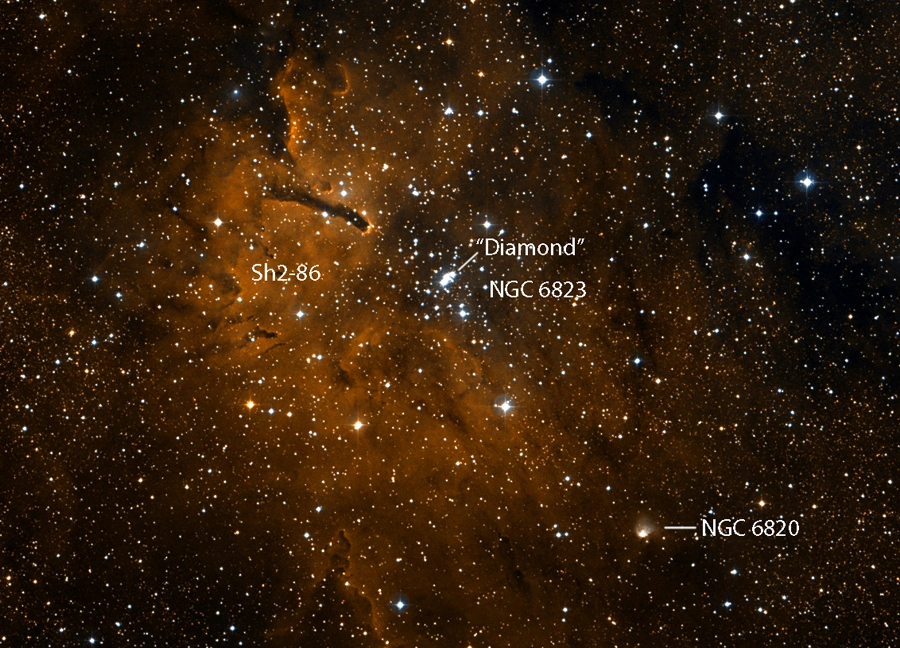
DSS2, Aladin Sky Atlas with annotations by Bob King
Just 1° south of the nebula complex you can refresh your eyes with something less demanding, the open cluster Ro 2. It's 45′across and home to about 20 stars. The brightest members outline a "flying saucer" or hamburger bun top when viewed at low magnification.
We'll go out in style with an intriguing tripartite object comprised of a star cluster and two nebulae located 50′south of Ro 2. The pretty, compact open cluster NGC 6823 first caught my attention, especially a clutch of four stars gathered into a tiny, diamond-shaped asterism in its core. The surrounding emission nebula Sh2-86 was far more challenging. I tried my best with and without the O III filter but only suspected its presence.
Also embedded in the extensive nebula is the curious, comet-like puff NGC 6820, located 16′ southwest of the cluster. This reflection nebula (no O III enhancement) is about 30″ across and 12.5 magnitude in brightness, with a denser, brighter core and a near-stellar point of light at its center. I found it with ease at 86×.
I hope you enjoyed this brief journey to the galactic equator, an area so rich I barely made it through two constellations. Later this summer, we'll explore more. Sagitta, Aquila, and Sagittarius await!
About Bob King
I love the sky (day and night) and have been a skywatcher and amateur astronomer since childhood. I'm also a long-time member of the American Association of Variable Star Observers (AAVSO) and Astronomical League. I pen the Astro Bob blog and have written four books: Night Sky with the Naked Eye (2016); Wonders of the Night Sky You Must See Before You Die (2018) and Urban Legends from Space (2019) and Magnificent Aurora, published in 2024. The universe invites us on an adventure every single night. To accept the invitation, we only need look up.



Comments
You must be logged in to post a comment.