 SUNSET:

 1
1NASA has awarded contracts to three aerospace companies for four lunar landers to launch in 2028.
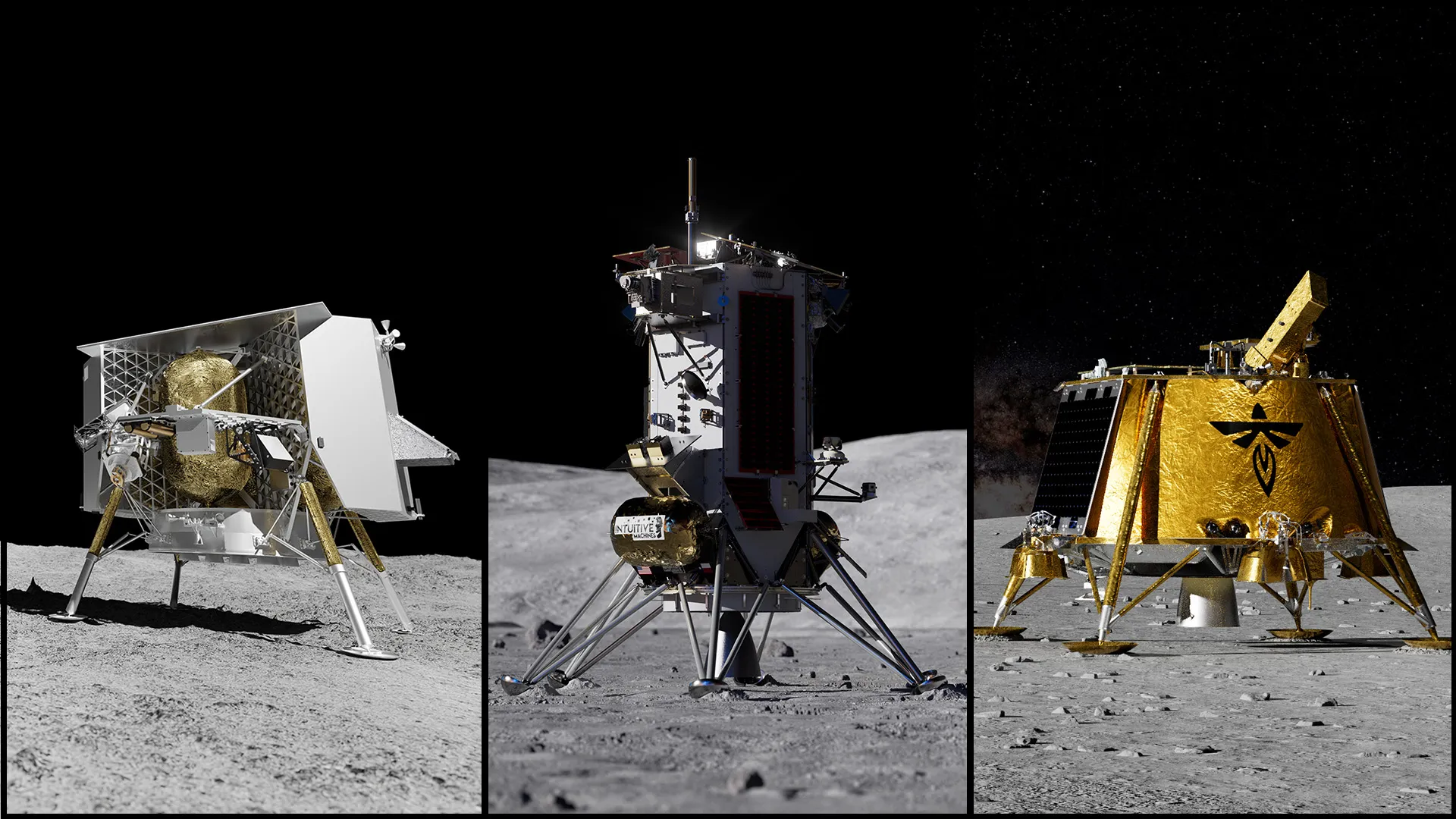
Astrobotic / Firefly / Intuitive Machines
On June 30th, NASA announced additional details about its new plans for the Moon.
The agency announced new contracts at a press conference, delivered as part of NASA's Commercial Lunar Payload Services (CLPS) program: Two awards go to Pittsburgh-based Astrobotic and one award each to Texas-based companies Firefly Aerospace and Intuitive Machines. The contracts, which total $590.4 million, aim to put four landers on the Moon by late 2028.
All of the landers targeting 2028 launch will carry identical instrumentation to study the radiation environment on the way to the Moon and stereo cameras to document the plume of regolith raised up during landing. They will also carry a Laser Retroflector Array for lunar rangefinding. The landers may carry other payloads as well, but those haven't been decided yet.
Isaacman and others also gave updates on several missions that were already part of the CLPS program and are still on track, albeit rebranded as Moon Base missions. Those missions include the following:
- Moon Base 1: Blue Origin’s Endurance lander will target a landing near the lunar south pole. The lander's development is still on schedule, but due to the company's recent loss of a New Glenn rocket (and damage to the launchpad), this mission — originally slated for late 2026 — will likely shift to 2027.
- Moon Base 2: Astrobotic’s Griffin 1, which will include Astrolab's Flex Lunar Innovation Platform rover, will target Mons Mouton, also at the lunar south pole. Launch is still scheduled for late 2026.
- Moon Base 3: Intuitive Machines’ redesigned Nova-C lander, which may also launch in 2026, though there's no firm timeline. It's heading to Reiner Gamma, a geographical feature known as a lunar swirl.
All of these spacecraft will carry experiments to the lunar surface, though some are better characterized as technology demonstrators than scientific missions.
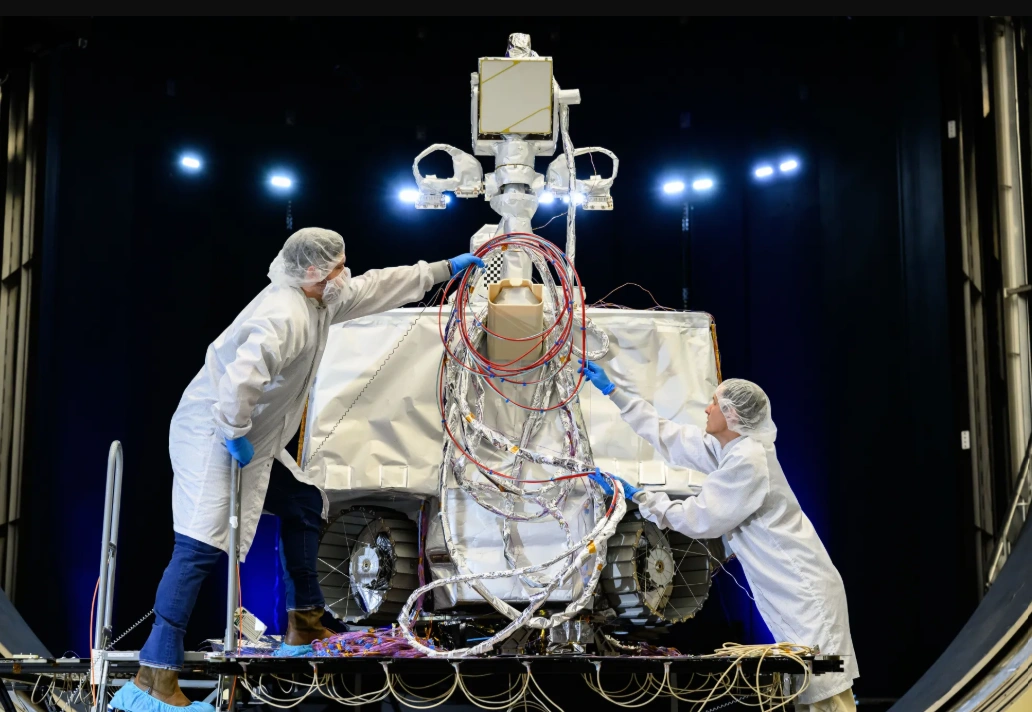
As part of the June 30th announcement, Isaacman also mentioned the possibility of retrofitting the Jet Propulsion Laboratory's full-scale engineering model of the Curiosity and Perseverance rovers, formerly named Optimism. The agency says this rover — which they're renaming Polar Rover for Observation, Mapping and In-Situ Exploration (Promise) — might now head to the Moon. If that happens, Isaacman said it would be outfitted with new instruments.
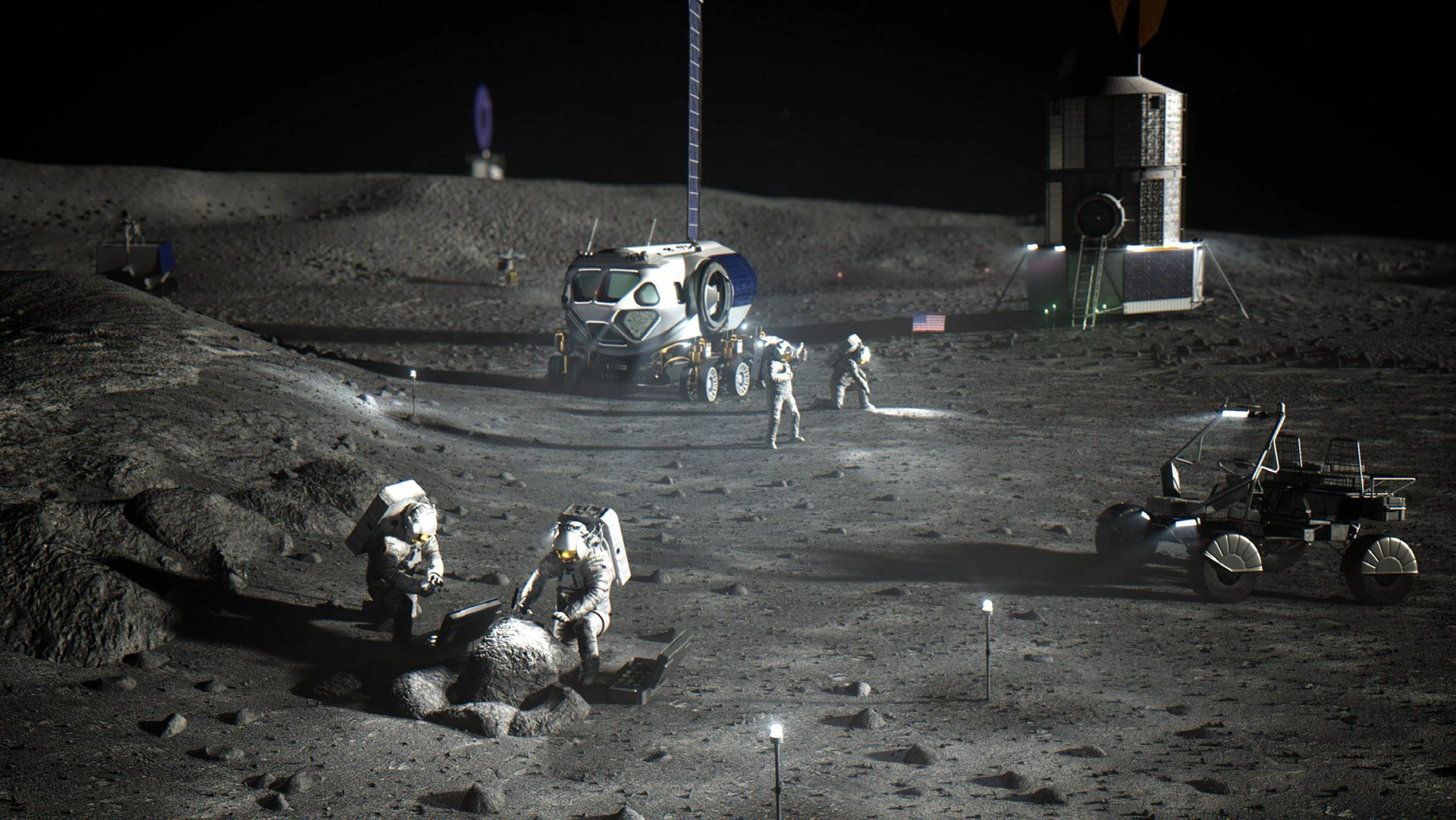
In total, NASA is planning to send 17 landers to the Moon over just a few years. These missions, now part of the Moon Base program, are intended as preparation for crewed Artemis missions, and will ultimately provide a transition from brief expeditions to a permanent settlement. The agency planning for a sprawling Moon Base on the lunar surface by 2030.
“This is drawing on the playbook that worked very well for NASA in the 1960s,” said NASA Administrator Jared Isaacman during the press conference. “We didn’t just jump to Apollo 11.”
Phases to the Moon
The Artemis Initiative features a phased approach: Multiple launches, the most recent being the successful Artemis 2 mission to the Moon and back, are leading up to human bootprints on the lunar surface. The Moon Base missions surrounding the crewed missions of Artemis likewise feature a phased approach, first deploying technology demonstrations, then robotic scouting of landings sites as well as potential resources such as water ice, then development of orbital and surface communications and power sources.
Phase One of the planned Moon Base is currently scheduled to last through 2029, including not only the three Moon Base missions listed above, but also four previously announced Moonfall drones, the already-completed Volatiles Investigating Polar Exploration Rover, as well as lunar satellites for communication. Objectives include scouting out the lunar south pole, testing new technologies, and paving the way for surface operations.
“We're building a proving ground for Moon Base operations,” said Ryan Stephan (NASA CLPS) in a recent press release. Stephan manages the initiative's cargo landers. “Accelerating our Moon mission ordering cadence and launch opportunities enables us to move quickly to learn, iterate, and improve.”
NASA
As part of the June 30th announcement, NASA also announced upcoming solicitations for the development of surface power, in-situ resource utilization, and nano-materials for use on the Moon. The Moon is a harsh environment to live and work in. Challenges will include resupply, creating a stable power source, radiation shielding, establishing communications and working with abrasive lunar dust. And of course, any years-long planning will have to navigate the political and budgetary whims of the current and next administrations.
NASA
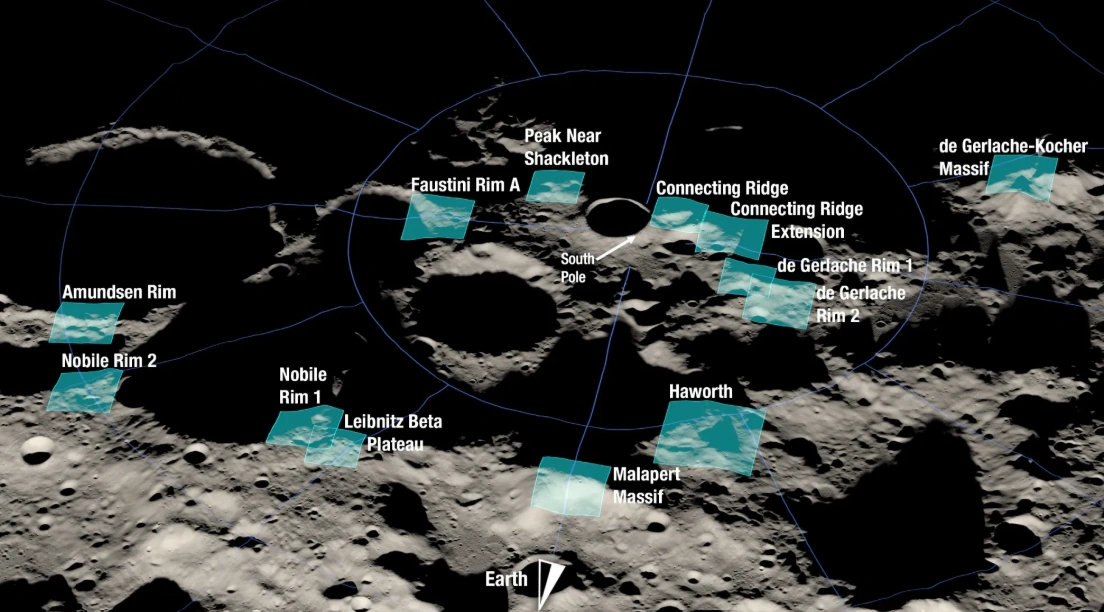
Since 2020, NASA has aimed to establish a base camp in the lunar south pole region, potentially on the ridge that connects Shackleton and de Gerlache craters. Any location the agency chooses would need to offer access to sunlight for power, while also offering access to the shadowed crater floors thought to contain some form of water ice. Surface operations would be powered by a combination of Radioisotope Thermoelectric Generators and solar power.
NASA / Helen Arase Vargas
NASA announced the crew of Artemis 3 in June, which will take the four astronauts into low-Earth orbit to rehearse docking and other maneuvers needed for a successful landing with Artemis 4. Wet dress rehearsal for Artemis 3 is still set for the end of 2026, with a launch in 2027.
To be sure, NASA's plans for the Moon are pretty ambitious. We’ll see what the coming years bring as NASA heads back to the Moon.
About David Dickinson
David Dickinson is a freelance science writer, high school science teacher, retired enlisted U.S. Air Force veteran and avid stargazer. He currently resides with his wife Myscha in Bristol, Tennessee. David also writes science fiction in his spare time. He posts as @AstroDave on BlueSky about space news and sky-watching worldwide.


Comments
Anthony Barreiro
July 3, 2026 at 12:09 am
Sending JPL's Curiosity / Perseverance engineering model to the Moon seems like a really dumb idea.
Mars is far away. JPL have done some very creative engineering to keep Curiosity running and doing science for almost 14 years, way longer than its two year nominal mission. Perseverance is going strong after five years, but like any old machine it will start having problems as it ages. It's good insurance to have a working model to test fixes before executing them from an average distance of 13 light minutes away.
If NASA wants a "Moon Science Laboratory" they should build one, rather than pilfering from the remarkably successful Mars rover missions.
Here's an interesting recent interview with JPL Curiosity engineer Alexandra Holloway in IEEE Spectrum:
https://spectrum.ieee.org/curiosity-rover-jpl-mars-science
You must be logged in to post a comment.
You must be logged in to post a comment.