 SUNSET:

 3
3On June 17th, much of North America can watch the Moon occult Venus in the daytime sky. All you need are binoculars.
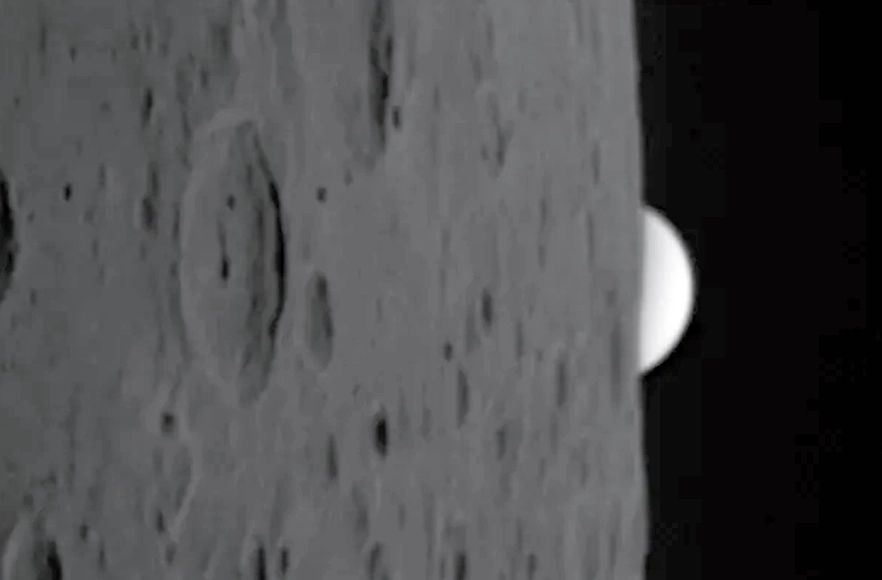
Pete Lawrence
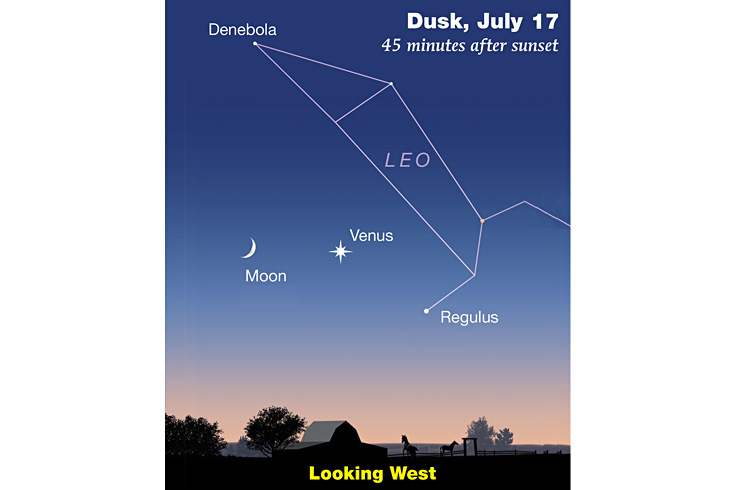
Fresh from its dance with Jupiter earlier this month, Venus finds itself at the center of attention again. On Wednesday, June 17th, the waxing crescent Moon will occult the radiant planet in daytime for observers in the contiguous 48 states, much of Canada, and parts of a half-dozen countries in northeastern South America.
Planetary occultations are uncommon and not-to-miss events even when the Sun is shining. At the time, the Moon will be 3.1 days old and 11% illuminated. Fortunately, its solar elongation will be 38°, far enough from the Sun to comfortably observe without fear of glare or potential eye damage. Since the lunar crescent will be relatively thin, you may need to search a moment to find it. Try to find a location where the Sun is blocked by a building or tree. Not only will it be easier to find the Moon this way, but you'll also get to enjoy the occultation in the shade.
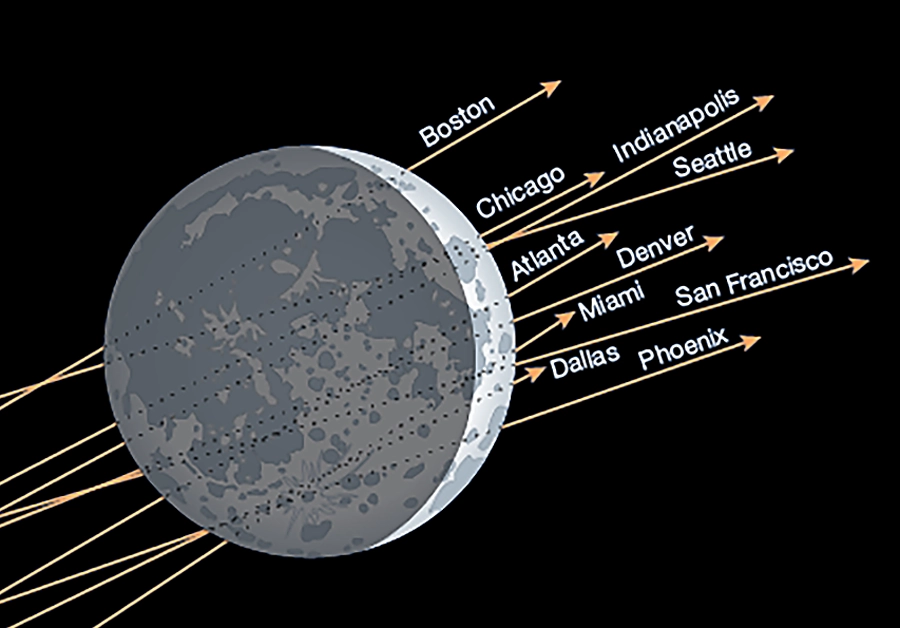
Sky & Telescope diagram
Under a cloudless sky, Venus is relatively easy to spot without optical aid as long as you know exactly where to look. In this instance, given its proximity to the Moon, it will be much easier. Find the Moon and look just to its left for a spark of white light glimmering against the blue sky. Or if you'd prefer, pull out a pair of binoculars and point it at the Moon. For an hour or two of either side of the occultation, Venus will shine close to the Moon in the same field of view.
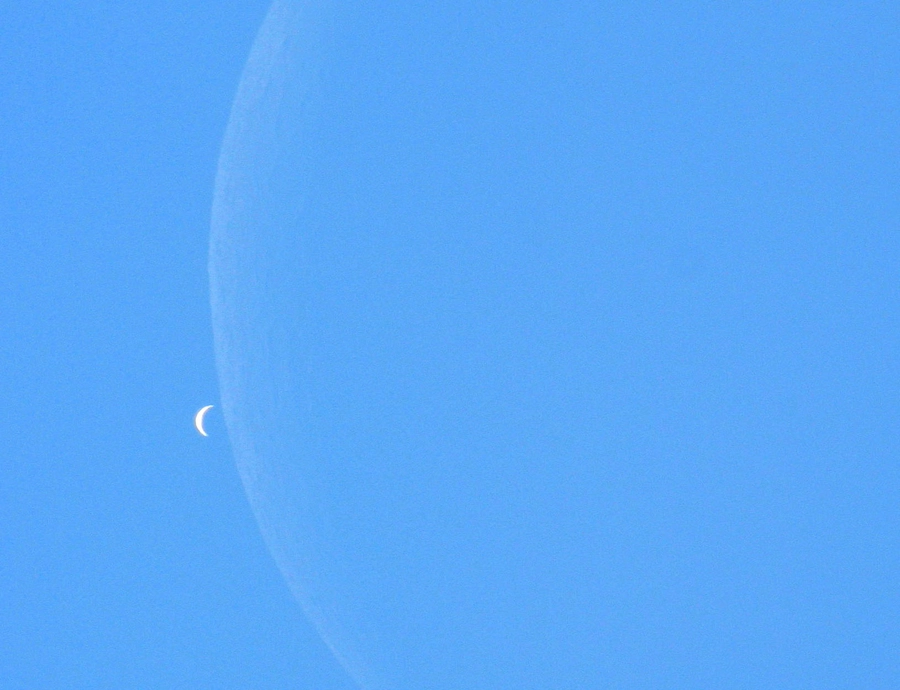
James Schaff
Venus also shows a phase. It's currently a 74% waning gibbous and 14.1″ across — 142 times smaller than the Moon. If you're photographing the pair, you'll want to use a small telescope magnifying at least 50× to clearly show the planet's phase. What the hot-house planet lacks in apparent size it makes up for in brilliance. Blanketed in thick clouds, Venus reflects about 75% of the light it receives from the Sun. Compare that to the rocky, cloudless Moon, which reflects just 12% of sunlight. Eons of space weathering and micrometeorite impacts have substantially darkened its surface. Moreover, Venus is of course closer to the Sun and thus is more powerfully sunlit than the Moon is. The difference in surface brightness between the two bodies is dramatic and very apparent in binoculars and telescopes.
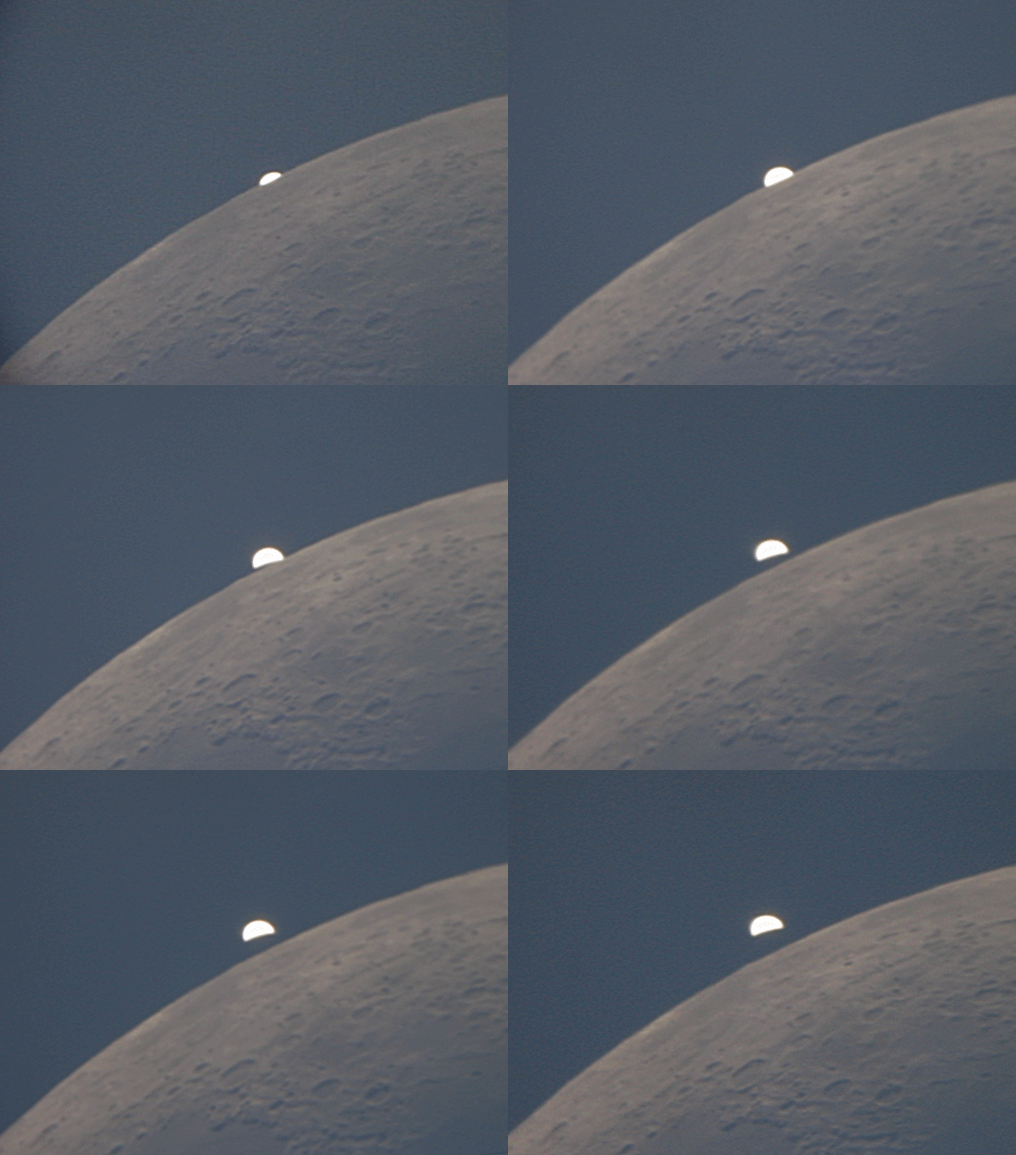
Michael Vlasov
The occultation begins at the Moon's dark limb, which will be invisible in the bright sky. Through a telescope you'll see "blue sky" slowly gnaw its way across the gibbous Venus from west to east. For viewers in Chicago, the limb touches the planet at 2:24 p.m. local time and takes some 27 seconds to completely cover the illuminated portion. More than an hour later at 3:50 p.m., Venus will appear to "rise" at the Moon's bright limb, much like the Earth did in Apollo 8 astronaut Bill Anders's iconic Earthrise photo taken from lunar orbit in 1968. Use the highest magnification that sky conditions would allow to sharpen the scene's drama. It's not often we get to see one solar-system body hovering closely above the limb of another.
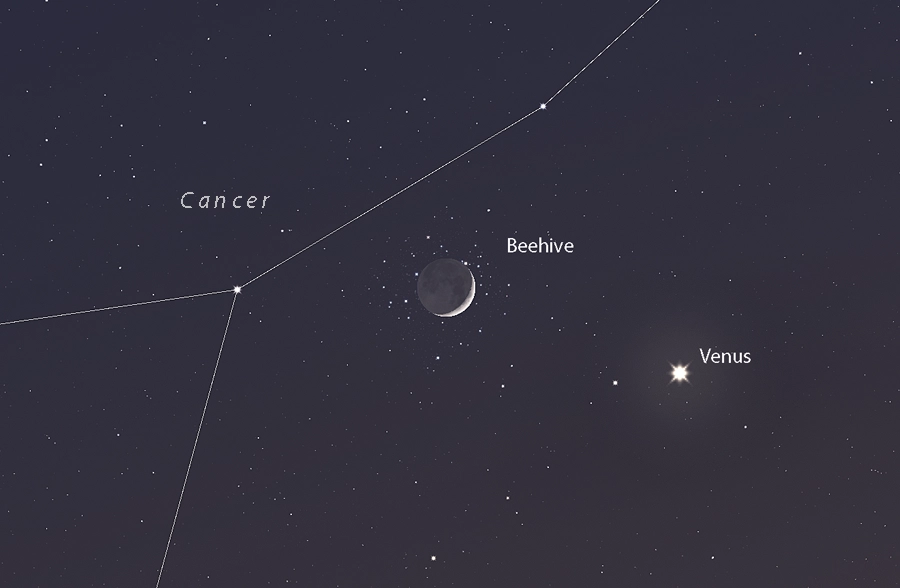
Stellarium
The International Occultation Timing Association (IOTA) has created a special page for the event that includes a visibility map and times of the planet's disappearance and reappearance for various cities. Times shown there are in Universal Time (UT). Subtract 4 hours to convert UT to EDT, 5 to CDT, 6 to MDT, and 7 to PDT.
If you've been dragging a little lately, I guarantee that seeing Venus and the Moon slowly meet up and part ways in real time will get you on your feet and put your eyes in the sky, where there's no end to wonder.
About Bob King
I love the sky (day and night) and have been a skywatcher and amateur astronomer since childhood. I'm also a long-time member of the American Association of Variable Star Observers (AAVSO) and Astronomical League. I pen the Astro Bob blog and have written four books: Night Sky with the Naked Eye (2016); Wonders of the Night Sky You Must See Before You Die (2018) and Urban Legends from Space (2019) and Magnificent Aurora, published in 2024. The universe invites us on an adventure every single night. To accept the invitation, we only need look up.


Comments
Frank-ReedNavigation.com
June 17, 2026 at 3:54 pm
Blue skies with just a little wispy cirrus here earlier today, and I spotted that faint crescent moon "naked eye". And then in binoculars, there's the pearly-white "dot" of Venus! I showed two neighbors, and they were delighted. 🙂
Alas, as we approach the "hour of the occult", a thicker layer of clouds has moved in.
Frank Reed
Clockwork Mapping / ReedNavigation.com
Conanicut Island USA
You must be logged in to post a comment.
Alexander Vasenin
June 17, 2026 at 4:58 pm
I just saw it in Cancún! Coincidentally, it was the first time I saw Venus less than 1/3° from zenith!
You must be logged in to post a comment.
Anthony Barreiro
June 17, 2026 at 5:09 pm
Thank you for the heads up and detailed observing guide, Bob.
From the Mission district in San Francisco the disappearance of Venus behind the Moon was hidden by clouds. The reappearance was visible through hazy cirrus with a 60 mm f/5.5 refractor at 35x. It took several seconds for Venus to fully reappear, and about 30 seconds for there to be a sliver of blue sky between Venus and the Moon's bright limb (you're right, the "bright" limb didn't look bright compared to Venus!). Venus' gibbous phase was visible. 12 minutes after reappearance I could see Venus naked eye by the Moon.
You must be logged in to post a comment.
You must be logged in to post a comment.