 SUNSET:

 0
0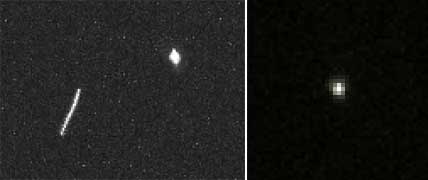
On March 16, 2004, the Hubble Space Telescope photographed distant minor planet 2003 VB12, provisionally named Sedna. The view at left shows the trail of Sedna due to Hubble's motion around the Earth. The background star to the upper right is stationary. The image at right is a single frame of the 35 the telescope took.
Courtesy NASA, ESA, and M. Brown (Caltech).
The newly discovered planetoid Sedna (2003 VB12) far beyond Pluto lacks any sizeable moon, as these Hubble Space Telescope images released yesterday reveal. The orbiting observatory snapped 35 images of Sedna on March 16th.
Sedna's co-discoverer Michael E. Brown (Caltech) suggested that the minor planet might have a satellite because of its remarkably slow rotation period of 40 days. A large moon can slow a body's rotation by tidal friction — though Alan W. Harris (Space Science Institute, Colorado) notes that no satellite could work a body like Sedna into synchronous rotation if the satellite ended up so far away that it has a 40-day orbital period. In any case, the cause of Sedna's slow rotation remains a mystery — unless it was just a fluke of how the body happened to fall together when it formed.
The Hubble observations also set a slightly improved upper limit for Sedna's diameter. The object is now at most 1,600 kilometers across (compared to Pluto's 2,400 km), which sets it closer to the estimated size of 2004 DW, another giant in the outer solar system discovered by Brown and his team.
About Alan MacRobert
Alan M. MacRobert became an avid Sky & Telescope subscriber in 1966 at age 14, joined the editorial staff in 1982, and is now a senior contributing editor, semi-retired. He played a role in practically every part of the magazine and the company's other products for more than a generation, both on the amateur-observing side and the science-reporting side. In 1994 a book collection of his observing how-tos and telescopic sky tours was published as Star Hopping for Backyard Astronomers. He has produced This Week's Sky at a Glance online every week since 1989.


Comments
You must be logged in to post a comment.