 SUNSET:

 1
1A surge of asteroids might have peppered the inner solar system some 800 million years ago, in a short-lived shower that left its mark — literally — on Earth and its neighbors.
Many asteroids belong to families, groups of objects that were once part of a single, larger asteroid that broke up into pieces. Family members travel together in the asteroid belt between Mars and Jupiter, but over time they disperse. Some members can even leave the belt through gravitational escape hatches created by Jupiter’s influence and enter the inner solar system.
One such family is Eulalia. The Eulalia asteroids likely come from a single, now-gone object at least 100 kilometers (60 miles) wide that disrupted some 800 million years ago. Eulalia’s potential offspring include the asteroids Bennu and Ryugu, which scientists have nabbed samples from and returned to Earth for study.
“As soon as I saw this family, I said, ‘Oh, that’s got to do something,’” says asteroid expert Bill Bottke (Southwest Research Institute). He mulled the question over for years.
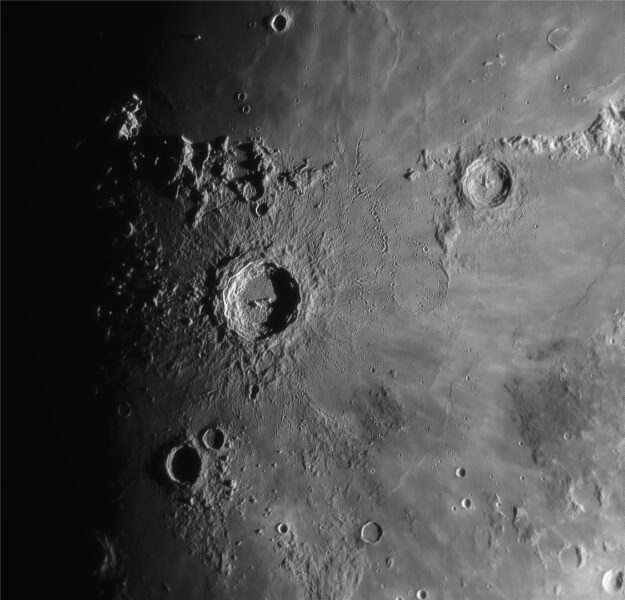
Then in 2020, Kentaro Terada (Osaka University, Japan) and colleagues analyzed large lunar craters and concluded that a spike in impacts occurred on the Moon about 800 million years ago, creating the crater Copernicus and other sizeable pockmarks. This result aligned with previous work by Nicolle Zellner (Albion College) and others, who had analyzed the ages and makeup of impact-made glass beads in Apollo samples and found signs of an uptick around 800 million years ago as well.
Ken Vaughan / S&T Gallery
At the joint Europlanet Science Congress and the Division for Planetary Sciences meeting in Helsinki, Finland, last week, Bottke presented his team’s picture of what all this might have meant for the inner solar system.
The researchers calculated how many big objects made by Eulalia’s demise would have escaped the main belt and hit Earth and its neighbors. Perhaps five asteroids at least 5 km wide pelted our planet, Bottke reported. These would have made craters some 100 km wide, or about the distance between Boston and Providence, Rhode Island. Various smaller asteroids would have rained down, too. The largest impactor to hit Earth might have been about 8 km across, or a little smaller than Chicxulub, the asteroid that helped spell doom for the dinosaurs.
Do we have any evidence of such an event? Maybe.
Earth’s geologic record has various carbon-isotope excursions, in which the normal ratio of carbon-13 to carbon-12 changes abruptly. These changes can come from things like volcanism or shifts in the amount of organisms living and dying. Several isotope excursions occurred between 800 and 500 million years ago, a couple of which match up with major ice ages.
But one, the Bitter Springs event 800 million years ago, doesn’t have a definitive explanation yet. It’s possible — but by no means certain — that the Eulalia shower could be connected.
Andy Knoll (Harvard), an expert in Earth’s environmental history who wasn’t involved with the study, is intrigued by the idea but cautious. There’s no clear connection with biological events on Earth at this time, he notes. But the impact scenario is a testable hypothesis and something to consider with an open mind. “One might search carefully in the field for evidence of impact at the time of the Bitter Springs event,” he says. “The relevant rocks are preserved on several continents, and we know where they are.”
Earth and the Moon would not have been the only inner solar system bodies affected. Other researchers have found geologic hints of a surge of volcanism on Mars about 800 million years ago. The seismic shake of asteroids hitting the surface could conceivably explain it, Bottke says.
However, Bottke is careful to stress that the proposal is tentative. “I can’t prove they’re all associated,” he says. “It’s just that the coincidence is pretty interesting.” He hopes to collaborate with other researchers more familiar with the geologic record to suss out how plausible the connection is.
Reference: William Bottke et al. “An Impact Shower on the Earth, Moon, and Mars from 800 Million Years Ago.” EPSC-DPS 2025 abstract 428. Presented September 8, 2025.
About Camille M. Carlisle
Science Editor Camille M. Carlisle handles science features for Sky & Telescope. She specializes in black holes, Mars, and whatever she happens to be writing about at the time. Frolic with her through the delights of black holes in her blog, The Black Hole Files.


Comments
Wayne Wooten
September 21, 2025 at 9:25 pm
Camille, also consider the far more recent Moung Nong and Pica Comet inpacts in your research about impacts, extinctions, ice ages, climatic changes, etc. I think both probably played roles we are just scratching the surface of.
Moung Nong:
https://skyandtelescope.org/astronomy-news/new-location-proposed-for-australasian-strewn-field-source-crater/
https://phys.org/news/2020-01-evidence-ancient-impact-crater-bolaven.html
https://www.facebook.com/groups/80860174301/permalink/10160687470344302
This event created the indochinites, the most common tektites that cover a quarter of the planet from the impact 900,000 years ago in central Laos. I have many samples of them.
Pica Comet Impact.
https://skyandtelescope.org/astronomy-news/did-a-comet-explode-over-south-america-12000-years-ago/
https://edition.cnn.com/2021/11/03/world/atacama-desert-glass-comet-scn/index.html
This impact was fundamentally a Tunguska over a desert instead of a Siberean forest. Remember Kulik did not arrive at ground zero for 20 years, plenty of time for the glassified surface layer to be covered by shrubbery or even destroyed by biological activty. By contrast, Pica in the Atacama is frozen in time, due to the dry conditions. I think future Sky&Telescope expedtions to Chile, like the one I heading south with on October 12, 2025, should if possible be expanded to include the Pica impact site. With current geopolitics, I see field trips to Tunguska unlikely for the time being! --Dr. Wayne Wooten, Professor Emeritus of Astronomy, University of West Florida, Pensacola State College
You must be logged in to post a comment.
You must be logged in to post a comment.