 SUNSET:

 0
0The close pass of Apophis is nothing to fear. In fact, it’s not too early to think about where to be on Friday, April 13, 2029, to watch this asteroid glide across the sky.
Daniel D. Durda
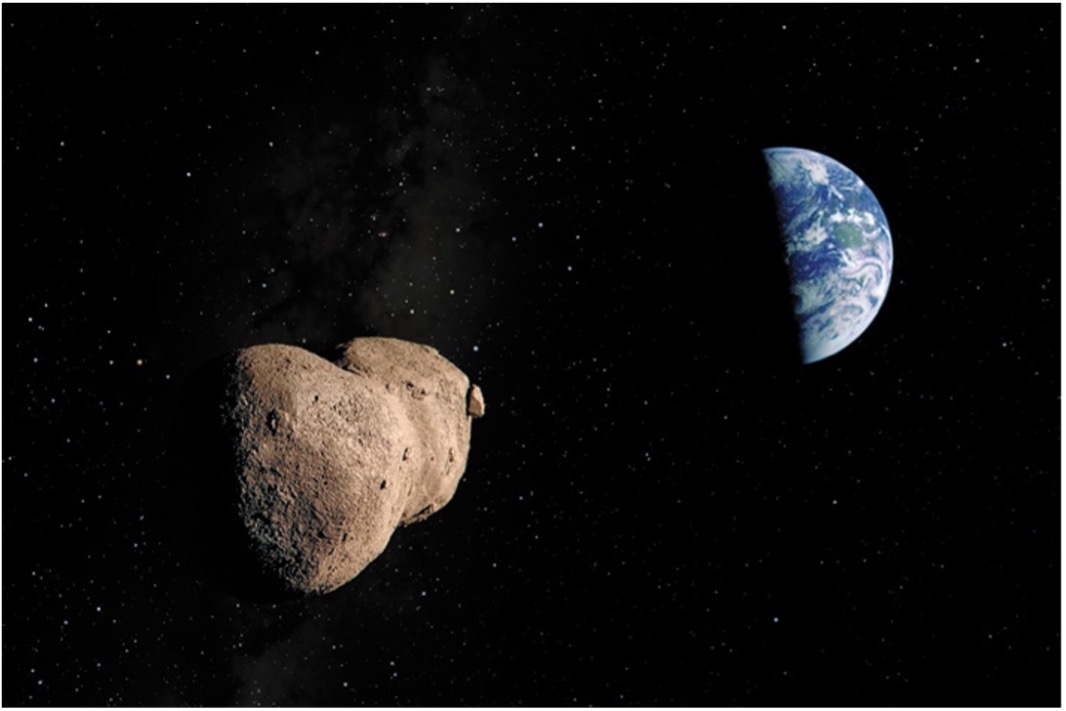
Most stargazers have never seen an asteroid without optical aid. If achieving that feat is on your astronomical bucket list, mark Friday, April 13, 2029, on your calendar. That night, near-Earth asteroid 99942 Apophis will sail past our planet, briefly dipping inside the belt of geosynchronous satellites that hover 22,200 miles (35,800 km) above the equator. The 340-meter (1,100-foot) space rock will brighten to magnitude 2.8, comparable to Cor Caroli, the brightest star in Canes Venatici near the Big Dipper.
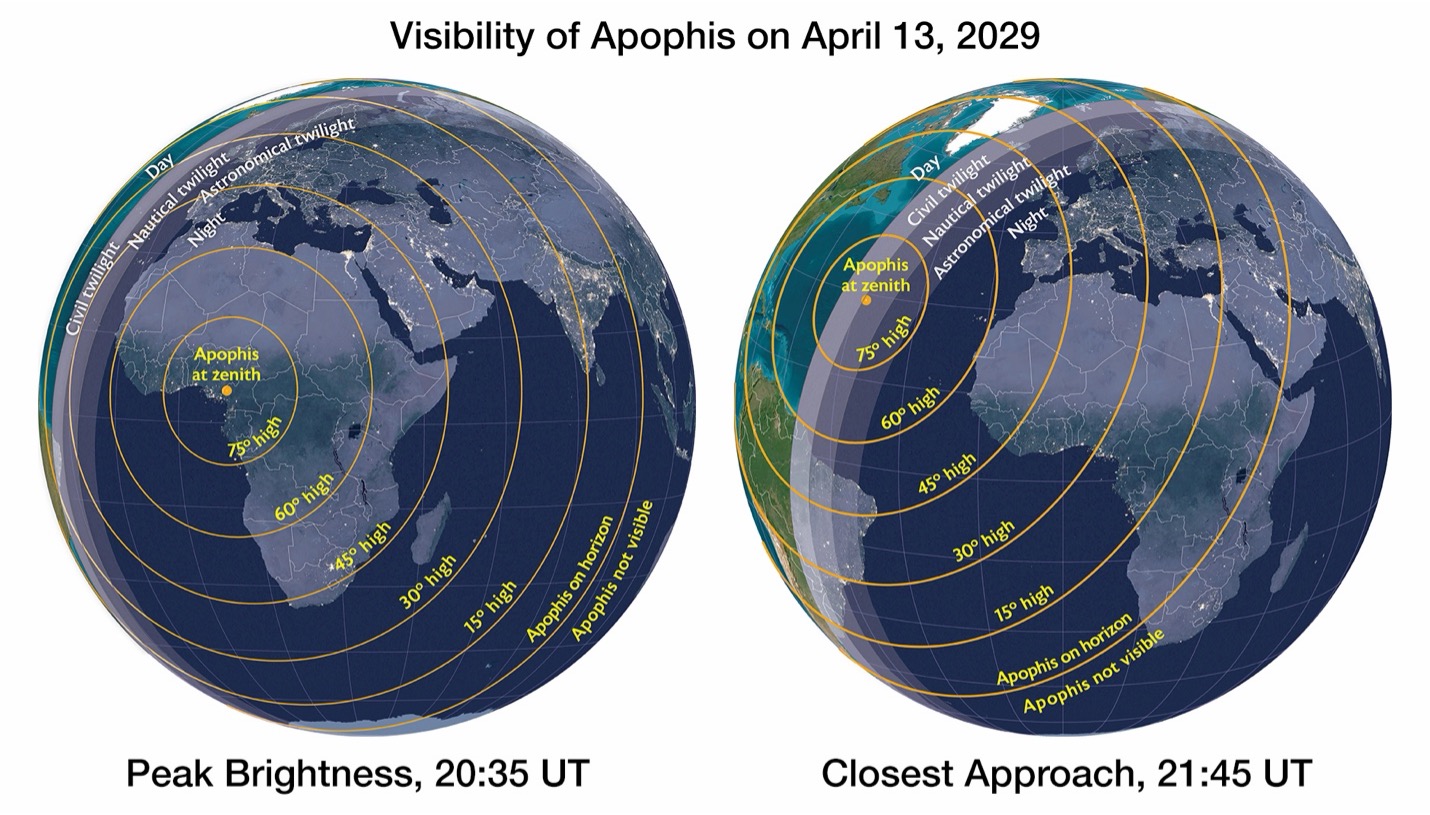
Those of us in the Americas, however, will have to travel if we want to eyeball Apophis, because the flyby occurs at night over Europe, Africa, and western Asia. To determine the optimal locations from which to view Apophis, I contacted Michael Zeiler, the astro-cartographer behind EclipseAtlas.com, and Ernie Wright of the Scientific Visualization Studio at NASA’s Goddard Space Flight Center. Between the asteroid’s orbit data on the NASA/JPL Horizons System, Ernie’s facility with NASA’s SPICE observation-geometry software, and Michael’s cartographic skills, I knew we could create attractive maps depicting where on Earth Apophis will be best seen during its historic visit.
Michael Zeiler
The maps above offer a preview of our results. They show the asteroid’s altitude above the horizon at the times of its peak brightness and closest approach. These events don’t coincide because Apophis’s illuminated side turns away from Earth as the flyby progresses. From our perspective, Apophis will zip westward through the constellations Leo, Sextans, and Cancer during this period. It’ll be moving really fast: about 30 degrees per hour when brightest and more than 45 degrees per hour when closest. Thankfully there will be no interference from the Moon, which is new that night.
Apophis’s apparent width will be around 1.7 arcseconds at peak brightness and up to 2.2 arcsec at closest approach, nearly matching the apparent diameter of Neptune at opposition. Large telescopes at mountaintop observatories in South Africa and the Canary Islands will have unique opportunities to spatially resolve the asteroid and watch for any potential changes caused by Earth’s tidal forces on the body.
Jay Anderson / Eclipsophile.com
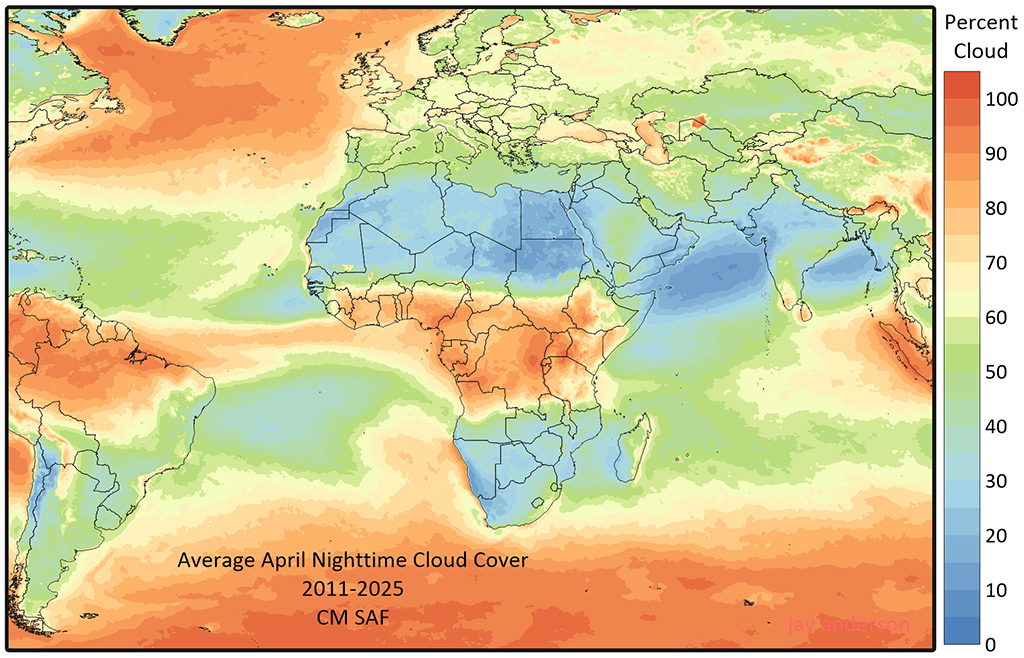
As when planning where to go to see a total solar eclipse, it’s important to consider the weather prospects. As the accompanying map from meteorologist and eclipse-chaser Jay Anderson shows, northern and southern Africa, parts of the Middle East, and parts of West Asia generally have clear nights in April. While the map makes the Canary Islands (off the northwest coast of Africa) look iffy, the observatories atop Tenerife and La Palma sit above an inversion layer that keeps them clear even when the islands’ lower elevations are cloudy. Sadly, Europe has a low likelihood of clear night skies in April.
Upon its discovery in 2004, Apophis looked quite threatening (S&T: November 2006, page 28), but it’s now clear that there’s no chance the asteroid will collide with Earth any time in the next 100 years (S&T: November 2021, page 11). Ordinarily a 3rd-magnitude asteroid would be very bad news, but in this case, it’s no cause for alarm — just a rare chance to cross another celestial observation off your bucket list!
Editorial note (April 17, 2026): We have updated the text to correct the Apophis asteroid's brightness and note its fast motion across the sky.
About Richard Tresch Fienberg
Rick Fienberg served as Sky & Telescope’s Editor in Chief from 2001 to 2008 and continues to support the magazine as Senior Contributing Editor and as Senior Advisor to the CEO of the American Astronomical Society, S&T’s publisher.


Comments
You must be logged in to post a comment.