 SUNSET:

 1
1A new study follows two lines of research to suggest that that Great Red Spot we see today has not, in fact, been going for as long as we thought.

Image data: NASA/JPL-Caltech/SwRI/MSSSImage processing: Navaneeth Krishnan S CC BY
“Jupiter’s Great Red Spot Is Not the Same One Cassini Observed in 1600s,” announces a release written about work recently published in Geophysical Research Letters. How can they possibly know that?
The study, from a team of atmospheric scientists led by Agustín Sanchez-Lavega (University of the Basque Country, Spain), looks at the history of Great Red Spot observations and then models some ways the anticyclone could have formed.

NASA / JPL-Caltech
The two parts of the study are linked by observations over the past few years that the Great Red Spot isn’t so great anymore. It’s been shrinking over time, and is now a fraction of its former size. Even within the last 50 years, it has changed from an enormously wide oval to a faded round spot. It seems on track to shrink to nothing. Is the Great Red Spot about to vanish? How can we predict the answer?
Looking back at the history of astronomy, Jupiter’s Great Red Spot seems to be as fixed a feature as its four moons. It's a commonly reported “fact” that the Great Red Spot has existed for almost 400 years. Giovanni Cassini drew his observations of a “permanent spot” in 1665, and another astronomer, L. Bandtius, reported observing a large oval as early as 1632.
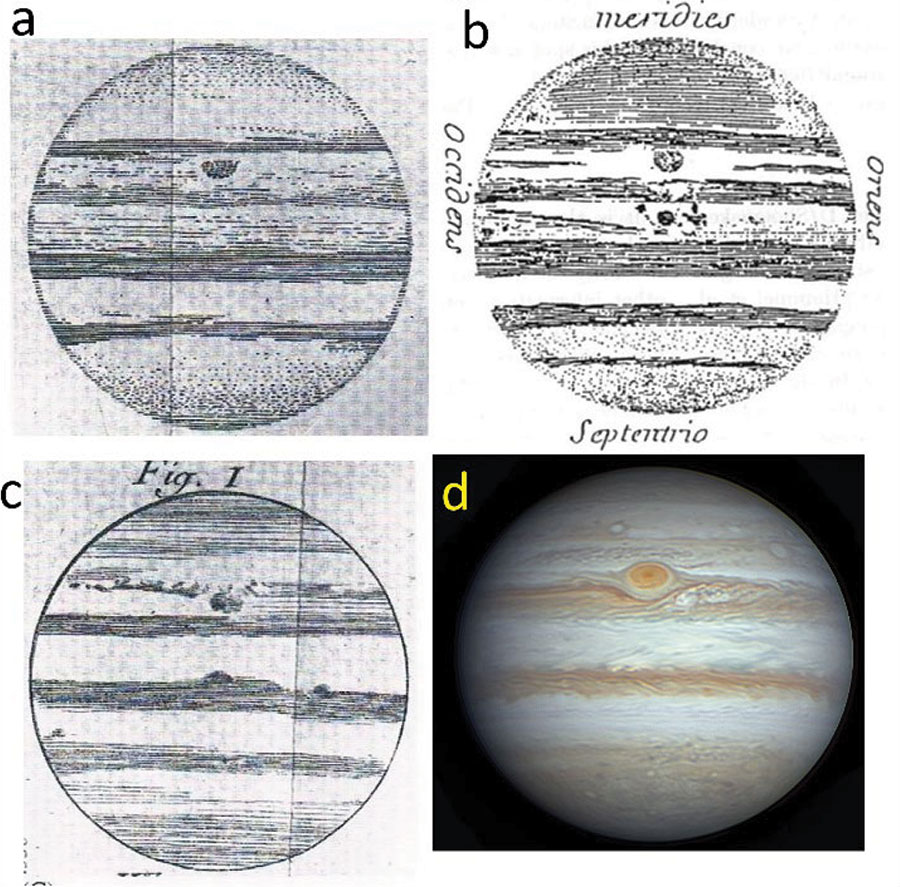
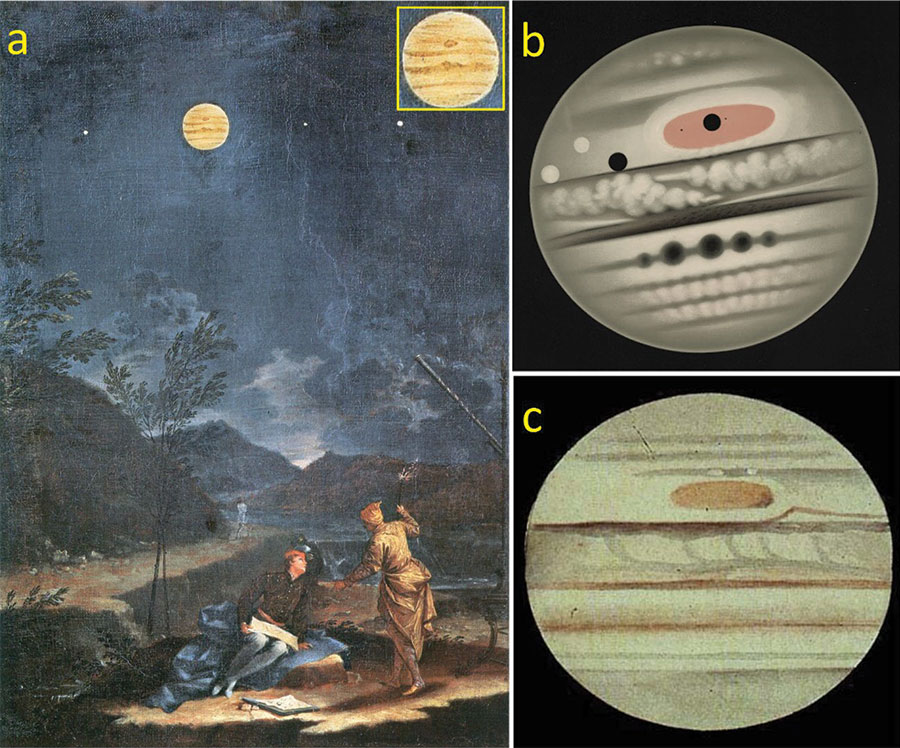
However, there is no evidence for the existence of a Great Red Spot between 1713 and 1831, although such legendary astronomers as Messier and Herschel were observing alongside countless contemporaries. Maybe the Spot isn’t as permanent as we’ve thought? Perhaps the Spot that Cassini and his contemporaries saw had vanished by 1713, and the one we know today formed more than 100 years later?
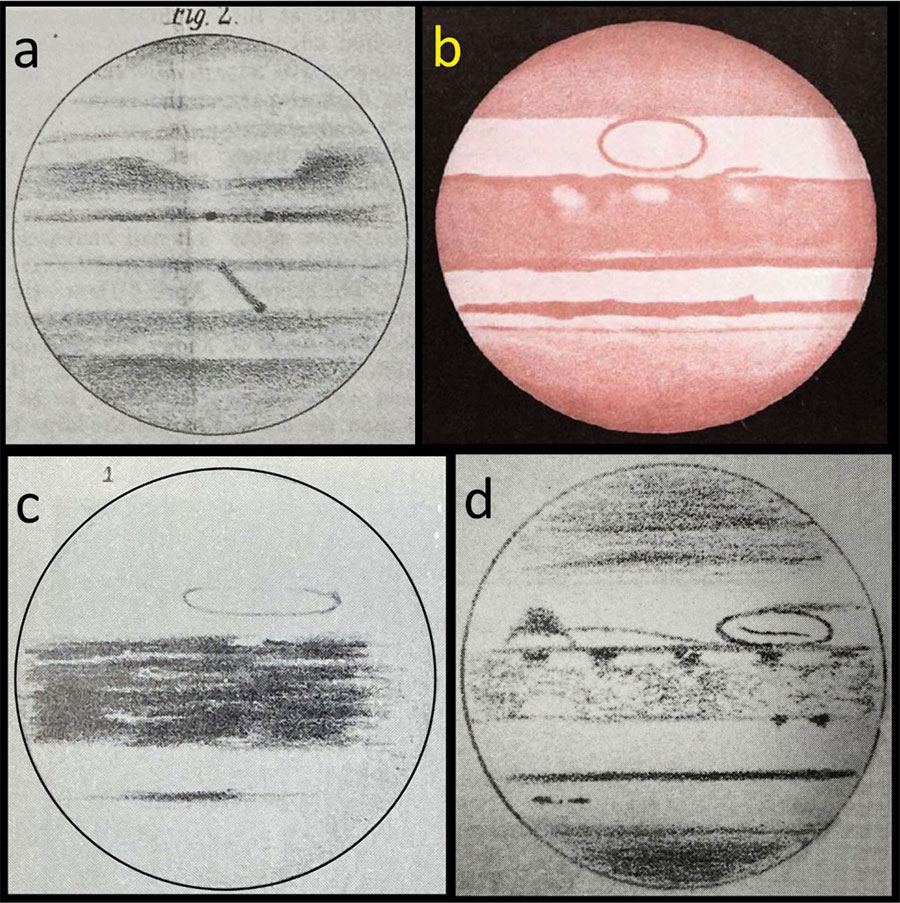
It’s hard to prove a negative, that is, to say with certainty that today’s spot is new since 1831 rather than the same as the one Cassini saw. In such situations, we might ordinarily apply Occam’s Razor, discarding ideas that require too much complexity. But which way does it cut? Is the simpler assumption that there has only been one spot throughout time (and more than 100 years of observers were unfortunate enough not to see it) or that there has been more than one spot (which disappeared and just happened to form at the same latitude and same size as seen before)?
That’s a lot of questions. Sanchez-Lavega and collaborators took two approaches to answering them. First: Look to the past. It’s not a new idea to investigate historical observations, but Sanchez-Lavega took a more quantitative approach, precisely mapping past observations onto a globe and measuring the width and aspect ratio of past spots. They also examined the filters used for imaging, noting the spot’s different appearances in blue versus red filters. Seen through blue filters, any red areas are quite dark; but with red-filtered optics, the red spots become pale, blending into the bands of white clouds that surround them.
The observations from Cassini’s time were of a relatively small, round spot, like today’s. In contrast, the spot observed by 19th-century astronomers was quite wide. Did the spot shrink and grow again? Or did it vanish and a huge new one spontaneously appear?
These questions prompted the researchers’ second line of inquiry: How does a Great Spot form, and does it fit the observed pattern? They turned to simulations based on a few observed mechanisms of storm growth on Jupiter and Saturn.
The best-studied “new” storm is the Great White Spot that formed on Saturn in 2010, as Cassini (the spacecraft) watched. But simulations of a similar event under Jovian conditions failed to produce a storm as large as the one observed on Jupiter in the early 19th century. The ones that did form had wind speeds too fast and never emerged at the latitude of the Great Red Spot.
Another recent storm-forming event was the merger of three smaller white ovals on Jupiter, which made Oval BA. This event took nearly 60 years to complete. If such a multiple merger created the Great Red Spot in the 1800s, then the storms that merged to make it would have been as big as the current Spot. Surely Messier or Herschel would have noticed several Great Spots existing before they merged?
To make a very large spot appear, apparently out of nothing, the researchers simulated another pattern previously observed on Jupiter: a South Tropical Disturbance. In this scenario, a dark-colored belt develops a bulge, which obstructs the flow of the lighter-toned South Tropical Zone below it. If two such disturbances form, they can pinch off a rotating region of South Tropical Zone material as wide as a third of the planet. Closed to external influence, the wide rotating cell consolidates, pulling tighter, becoming more coherent, and spinning faster with time, all behaviors observed with the modern Great Red Spot.
Simulations alone never constitute proof. But they can provide plausible answers to befuddling questions — and produce testable predictions. This study posits that the current Great Red Spot is the second “permanent” Great Spot observed by human astronomers, states that it really is disappearing, and predicts that someday a third, giant spot will emerge.
About Emily Lakdawalla
Sky & Telescope contributing editor Emily Lakdawalla is a freelance planetary scientist, space artist, and author of The Design and Engineering of Curiosity: How the Mars Rover Performs Its Job. Find her on Bluesky at elakdawalla.bsky.social and explore her space-inspired, ultra-nerdy art and jewelry on Etsy.



Comments
Anthony Barreiro
June 25, 2024 at 7:28 pm
The Juno spacecraft took pictures of a south tropical disturbance in Jupiter's atmosphere on 2018 April 1. Here is a time lapse collage:
https://www.jpl.nasa.gov/images/pia22937-jupiters-south-tropical-disturbance
And here is one image that shows detail:
https://www.nasa.gov/image-article/jovian-tapestry/
You must be logged in to post a comment.
You must be logged in to post a comment.