 SUNSET:

 0
0This month’s episode highlights the close pairing of Venus and Jupiter under way in the western sky after sunset. You’ll also learn why astronomers are fixated on a star in Corona Borealis — and how to find a huge but dim constellation that will likely be new to you. So grab curiosity and come along on this month’s Sky Tour.

Listen Here:
Podcast: Play in new window | Download
Subscribe: Apple Podcasts | Spotify | Email | RSS | More
Check out the illustrated version of this podcast on Sky & Telescope’s YouTube channel!
This will be a month with no comets, no strong meteor showers, and no eclipses of the Sun or Moon. But don’t worry, because the early-summer sky is still putting on a show for you. Get all the highlights by downloading our Sky Tour astronomy podcast
Let’s start with a “planet dance” happening soon after sunset. Venus and Jupiter, the two brightest planets, have dominated the evening sky recently. They’ve also been drawing closer to each other, with Jupiter higher up, but slowly sinking, and Venus climbing upward from the western horizon. And on June 9th they come together in dramatic fashion. On that evening they’ll appear just 1½° apart — close enough to cover both with your thumb extended on an outstretched arm.
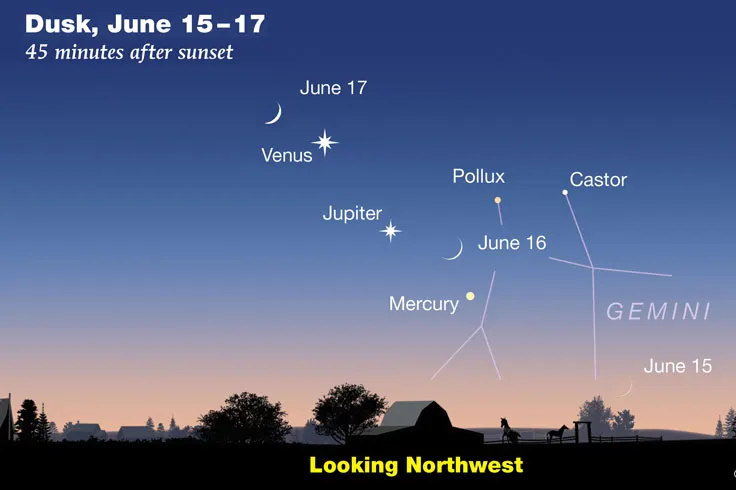
As Venus and Jupiter continue their dance, a third planet— Mercury — will be lurking nearby until mid-June. To spot it, just follow an imaginary line connecting Venus and Jupiter to the lower right, close to the horizon. This will be your best chance of spotting Mercury after sunset for the rest of the year, so don’t pass up this easy opportunity.
Sky & Telescope
Now look almost overhead at nightfall, and you’ll see a really dazzling star. It ranks as the fourth brightest star in the nighttime sky. Sirius is the brightest, but it has dropped out of sight until later this year. And #2 and #3 on the list are Canopus and Alpha Centauri, which can’t be seen from the mid-northern latitudes. So this is the brightest star you’ll see all summer. And what’s the name of this bright beacon? Listen to the Sky Tour podcast to find out!
Not far away, also nearly overhead on June evenings, is a compact star pattern in the shape of a “U”. This broken ring is a the constellation Corona Borealis, the Northern Crown. In Greek mythology, it represented a jeweled crown worn by Ariadne during her marriage to Dionysus. After the ceremony, Dionysus placed the crown in the heavens to commemorate their wedding. If you have dark skies, it’s a pretty grouping of stars surrounding Alphecca, its alpha star.
Astronomers have been watching this little constellation a lot lately. Well, actually they’re watching a faint star just off the crown’s lower-left corner. Would like to find out why? Listen to Sky Tour to find out!
This month’s 13-minute-long episode is full of fun, informative tidbits about the night sky that you can see by eye. If you’ve never listened before, why not give it a try?
About J. Kelly Beatty
J. Kelly Beatty, S&T Senior Editor, joined the staff of Sky Publishing in 1974 and specializes in planetary science and space exploration. Learn more about him here.


Comments
You must be logged in to post a comment.