 SUNSET:

 0
0Astronomers have discovered three still-growing galaxy clusters in the early universe that point to a faster track of evolution than expected.
Galaxy clusters are the universe’s most massive bound structures. The nearby Coma Cluster, for example, spans some 20 million light-years and contains more than 1,000 galaxies. But such a cosmic metropolis isn’t built in a day.
Astronomers have discovered three protoclusters — clusters under construction in the early universe — that are, respectively, the farthest, heaviest, and most furiously star-forming known. The extremes this trio represents show three phases of galaxy cluster evolution.
Early Assembly
NASA’s James Webb Space Telescope and Chandra X-ray Observatory teamed up for the discovery of JADES-ID1. The farthest protocluster known, JADES-ID1 existed when the universe was only 1 billion years old. Yet it’s already surprisingly massive, equivalent to the total mass of 20 Milky Ways.
To find JADES-ID1, one team first used Webb (specifically, its JWST Advanced Deep Extragalactic Survey, or JADES) to trawl the distant universe for regions of space rich in galaxies. They found six candidate protoclusters, and homed in on the most likely of these. The kicker came from Chandra observations, which picked up the faint blush of hot gas — the smoking gun of a forming cluster. Those results, led by Ákos Bogdán (Center for Astrophysics, Harvard & Smithsonian), are published in the January 29th Nature.
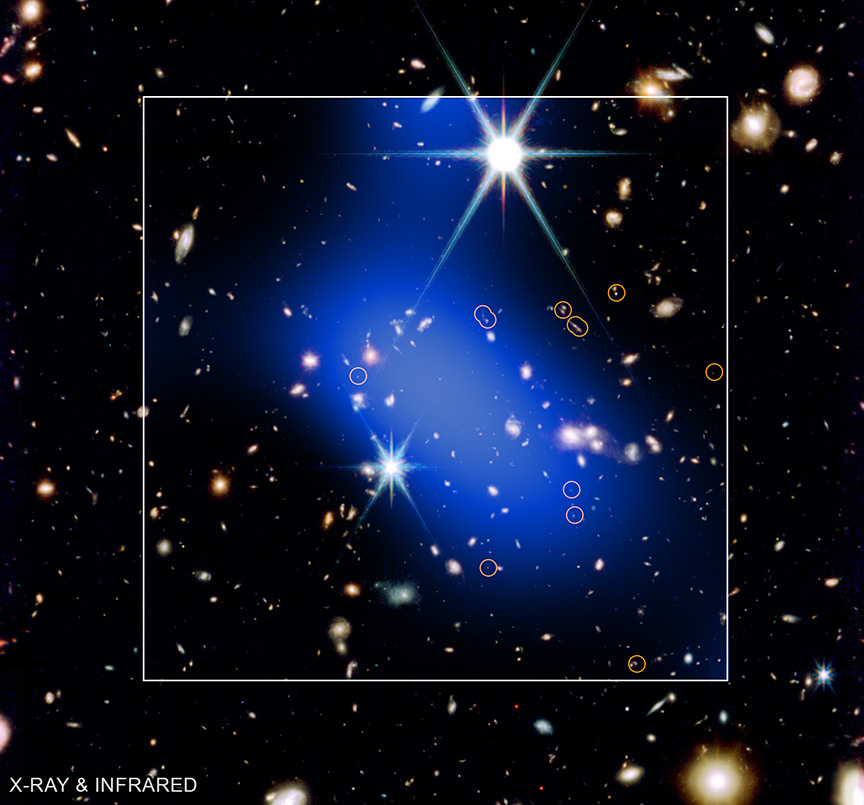
X-ray: NASA / CXC / CfA / Á Bogdán; Infrared: NASA / ESA / CSA / STScI; Image Processing: NASA / CXC / SAO / P. Edmonds and L. Frattare
JADES-ID1 boasts 66 galaxies, but they’re just the most visible aspect of this structure. Clusters are primarily made of dark matter, which acts like the unseen foundation on which skyscrapers are built. Gas and galaxies assemble on that foundation.
While the dark foundation isn’t directly visible, gas is. (Galaxies are too, of course, but they make up only a small fraction of a cluster’s mass.) As gas atoms race across the cluster, collisions heat them to tens of millions of degrees, until they’re so hot that the thermal glow rises to X-ray energies. (For reference, an iron glowing dull-red in the forge is some 10,000 times cooler.)
Gauging the heft of the protocluster’s based on its X-ray smog shows it to be unexpectedly massive, especially given how little time it had to come together. Bogdán’s team finds that, under our current understanding of cosmology, finding that amount of matter clustered within the tiny volume that Webb was surveying in the early universe is pretty unlikely — a 1 in 5 million chance.
“JADES-ID1 is giving us new evidence that the universe was in a huge hurry to grow up,” Bogdán says.
Rogier Windhorst (Arizona State University), who wasn’t involved in the JADES study, agrees with the team’s assessment. “You can't really argue with the mass much,” he says. “It's quite substantial, and it is undoubtedly still growing.” But he doesn’t think cosmology is broken, just that we might not fully understand all the mechanisms by which clusters first form in the early universe.
Clumpy Clusters
Which brings us to another record-breaker: COSMOS-z3.1A, discovered as part of the One-hundred-deg^2 Dark Energy Camera Imaging in Narrowbands (ODIN) survey. With 5,000 Milky Ways’ worth of dark matter, gas, and galaxies, this is the most massive protocluster known. But unlike JADES-ID1, its tremendous mass doesn’t have any implications for cosmology — as long as it’s the only one of its kind the team discovers within the volume that ODIN surveyed.
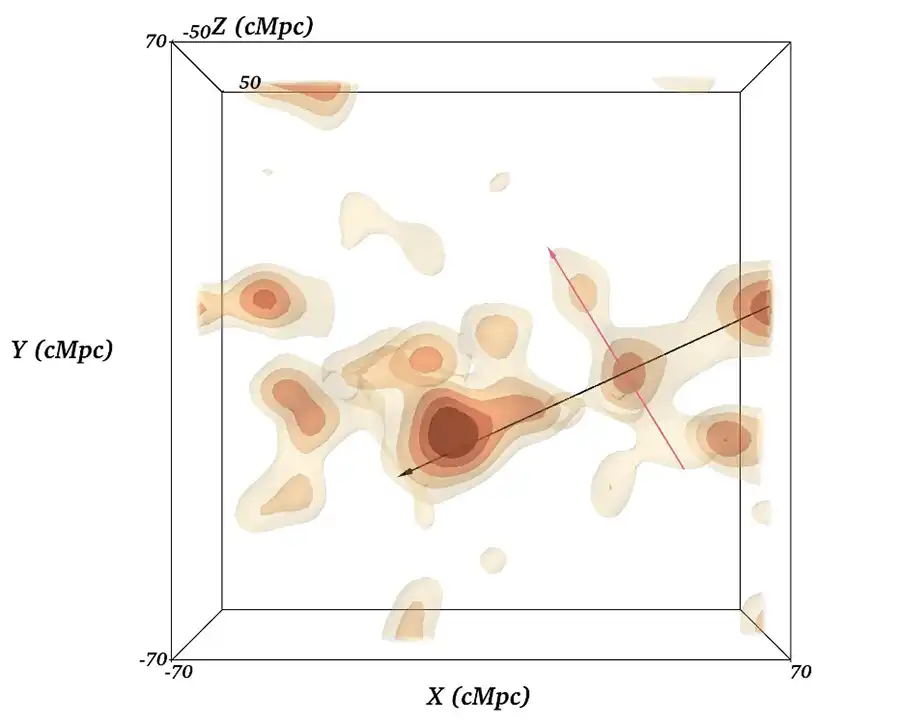
V. Ramakrishnan
This protocluster resides 2 billion years after the Big Bang and, with more time to grow, it’s not surprising that it’s more massive than JADES-ID1. But it’s also so massive because it’s clumpy, like a city with more than one downtown area.
Vandana Ramakrishnan (Purdue University), who has posted results on the astronomy arXiv preprint server, said at the 247th meeting of the American Astronomical Society (AAS) that she and colleagues have found 10 clumps within this protocluster. Some of these could evolve into galaxy clusters in their own right. This isn’t unusual: The Milky Way, which belongs to the Local Group of galaxies, is part of the Laniakea Supercluster, which also contains Virgo and other nearby groups and clusters.
The discovery of this protocluster is expected, Ramakrishnan says, based on our most “vanilla” understanding of cosmology. “It's just an extremely rare object within the standard model,” she adds. Nevertheless, its clumpy structure shows how clusters of all kinds come together.
Cosmic Noon
Then there’s a protocluster known as J0846, which is providing astronomers a somewhat later view of cluster growth some 2.5 billion years after the Big Bang. At this time, clusters were more common and stars were forming in a frenzy. Cosmic circumstances have aligned to give us unprecedented views of the galaxies in J0846, each of which is a fury of starbirth.
Nicholas Foo (Arizona State University), a graduate student working with Windhorst, presented submillimeter-wavelength observations from the Atacama Large Millimeter/submillimeter Array (ALMA) at the same AAS meeting as Ramakrishnan, with results also appearing in the Astrophysical Journal. Foo notes that their image of J0846 is like visiting Times Square in Manhattan — they can see 11 galaxies that are the heart of a much larger structure, which could have more than 50 galaxies. (A Webb image of this same cluster is coming soon, Foo says.)
The core is more easily visible because an intervening cluster’s mass has acted as a lens to gravitationally magnify its light. From that magnified view, the team finds that the core galaxies are forging stars at a rate of 5,000 solar masses per year.
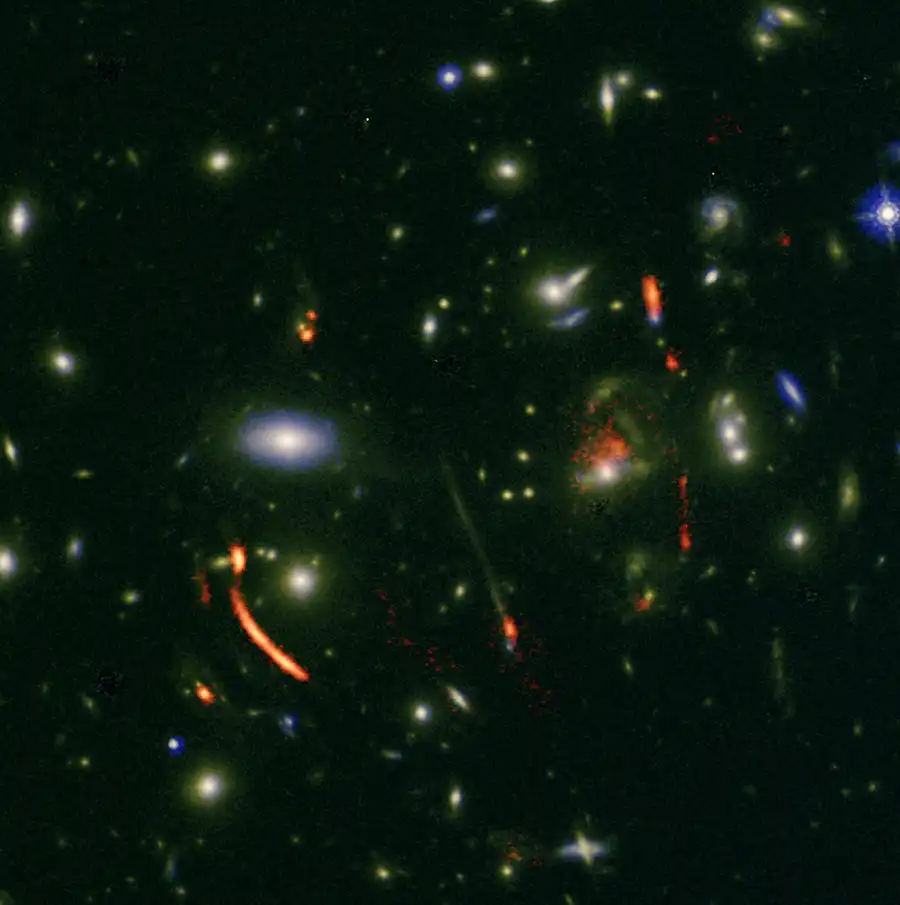
NSF / AUI / NSF NRAO / B. Saxton; NSF / NOIRLab
That frenetic rate can’t continue forever, so the question is, what happens next? Mergers can tank up galaxies with star-forming gas, but only two of the 11 show signs of recent mergers. Instead, most of the core galaxies are disk-shaped, like the Milky Way (albeit not necessarily with spiral arms but with orderly rotation). It could be these galaxies are refueling more regularly as they move through the cluster gas. Understanding the source of the fuel is key to determining the galaxies' — and the clusters' — future.
Ultimately, while individual protoclusters provide snapshots of cluster origins and evolution, surveys of infant clusters across cosmic time would provide a more continuous movie, showing the evolution of the most massive structures in the universe.
About Monica Young
Monica Young, a professional astronomer by training, is News Editor of Sky & Telescope.


Comments
You must be logged in to post a comment.