 SUNSET:

 0
0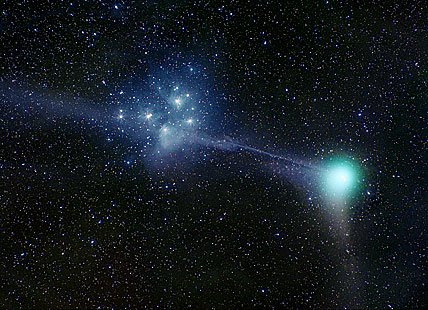
Comet Machholz was passing the Pleiades cluster when Stefan Seip at Oberjoch, Germany, photographed it on the evening of January 7th. He used a 300mm lens on an SBIG STL 11000M CCD camera to take multiple exposures through color filters, then combined them to make the true-color image here. The processing emphasizes the comet's brightness compared to that of the pinpoint stars.
Photo by Stefan Seip.
Its days of glory long past, Comet Machholz continues to fade as it moves farther from Earth and Sun. But it's still in reach of telescopes. As of early May 2005 it was 9th magnitude near the bowl of the Big Dipper. It should fade to magnitude 10 by May's end. Find it using the chart below (click the chart for full view).

The path of Comet Machholz during February, March, and April 2005. Comet symbols show its position at 0:00 Universal Time on the dates indicated (which is on the evening of the previous date local time in North America).
S&T: Gregg Dinderman
Don Machholz of Colfax, California, discovered the comet last August 27th, when he swept up a dim, 11th-magnitude smudge in Eridanus while using a vintage 6-inch f/8 Criterion Dynascope reflector (see "Machholz Discovers His 10th Comet"). Its orbit lies entirely outside Earth’s; perihelion on January 24th found the comet 1.2 a.u. from the Sun.
About Alan MacRobert
Alan M. MacRobert became an avid Sky & Telescope subscriber in 1966 at age 14, joined the editorial staff in 1982, and is now a senior contributing editor, semi-retired. He played a role in practically every part of the magazine and the company's other products for more than a generation, both on the amateur-observing side and the science-reporting side. In 1994 a book collection of his observing how-tos and telescopic sky tours was published as Star Hopping for Backyard Astronomers. He has produced This Week's Sky at a Glance online every week since 1989.


Comments
You must be logged in to post a comment.