 SUNSET:

 0
0Seen each year in early May, the Eta Aquariid meteors are spawned by none other than Halley's Comet. This shower is best seen before dawn's first light.
| Update May 7th: Watch the progress of the shower in near real time, as meteor counters around the world report their results to the International Meteor Organization. Looking good so far! |
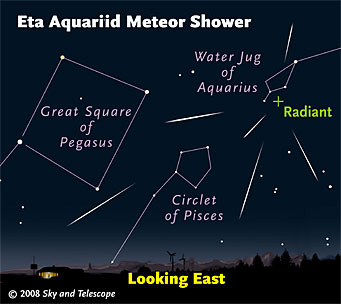
The Eta Aquariid's radiant as seen from latitude +30° (Houston, Cairo, Shanghai) 90 minutes before sunrise. Farther north, the radiant is lower when the sky starts to get light.
S&T illustration
The big meteor excitement in May is the possible strong shower on the morning of the 24th visible from the U.S. and Canada. But a more predictable shower, best for southerly skywatchers worldwide, should be at its peak activity before the dawns of May 5th, 6th, and 7th.
The Eta Aquariid shower is often the year's best for the Southern Hemisphere, with a zenithal hourly rate (that is, when viewed under optimal conditions) of about 60, and the show lasts for several days. Few of its meteors are seen from above latitude 40° north, since dawn begins earlier the farther north you go at this time of year. That doesn't give the shower's radiant in Aquarius time to rise very high.
However, the few Eta Aquariids that northerners do spot are long, graceful "earthgrazers" skimming the upper atmosphere far across the sky. They'll be coming out of the east-southeast, from the direction of the Water Jar in Aquarius.
The Eta Aquariids are, like the Orionids of October, bits of debris shed long ago by Halley's Comet. Earth intersects this same broad meteoroid stream at two different places in our orbit around the Sun.
About Alan MacRobert
Alan M. MacRobert became an avid Sky & Telescope subscriber in 1966 at age 14, joined the editorial staff in 1982, and is now a senior contributing editor, semi-retired. He played a role in practically every part of the magazine and the company's other products for more than a generation, both on the amateur-observing side and the science-reporting side. In 1994 a book collection of his observing how-tos and telescopic sky tours was published as Star Hopping for Backyard Astronomers. He has produced This Week's Sky at a Glance online every week since 1989.


Comments
You must be logged in to post a comment.