 SUNSET:

 4
4Mysterious threads dangle in the Milky Way center, and a pulsar has punched through one of them — providing fresh perspective on the threads’ origins.
Four decades ago, radio observations turned up mysterious magnetic threads in the center of the Milky Way, chaotic stitches that wend their way back and forth across the galactic plane. Astronomers have since proposed more than a few ideas to explain the filaments’ origins, but consensus has remained out of reach.

Ian Heywood (Oxford Univ.), SARAO; Color Processing, Juan Carlos Munoz-Mateos(ESO)
Now, unique circumstances provide a fresh perspective: Astronomers have recently spotted a pulsar that crashed through one especially long filament at between 500 and 1,000 kilometers per second (1 million to 2 million mph). Farhad Yusef-Zadeh (Northwestern University) and colleagues have published the finding in the Monthly Notices of the Royal Astronomical Society.
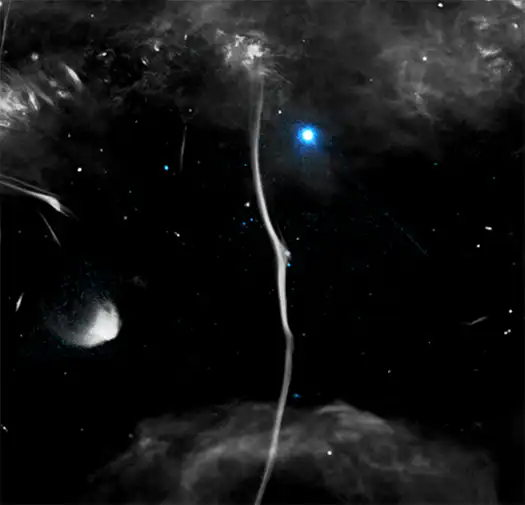
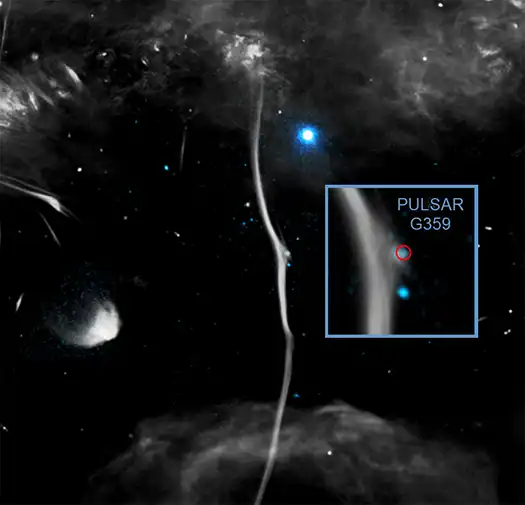
Dubbed the Snake for its unusual undulations (most filaments are ramrod straight), this thread is 230 light-years long but only 1 light-year thick. Its ionized hydrogen gas is held together by strong magnetic fields. But a pulsar on a serendipitous path punched through the filament, pulling on it like a finger might pull on a guitar string. The event sent tremors up and down along the thread.
Yusef-Zadeh’s team pieced this story together using archival images from the Chandra X-ray Observatory taken of the same region recently surveyed at radio wavelengths by the Karl G. Jansky Very Large Array in New Mexico and the MeerKAT radio telescope in South Africa. They found an object near one of the Snake’s undulations is emitting both radio waves and X-rays, indicative of a pulsar, and a fast-moving one at that.
The pulsar’s motion probably comes from its birth — massive stars often end their lives in asymmetric explosions that can give the newborn pulsar a kick, punting it away from the system where it spent its stellar life.
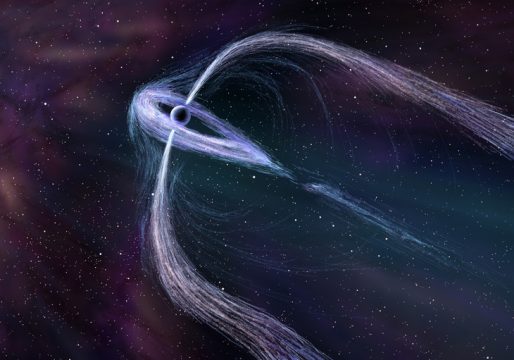
Nahks TrEhnl
The radio images are sharp enough to show a comet-like shape around the pulsar: Charged particles swirling around the pulsar follow paths that are squished at the front and elongated into a tale behind it as it charges through space. The X-ray images don’t show the same level of detail, because even with Chandra's sharp telescopic eye it’s much harder to resolve images at shorter wavelengths. But the shape of the X-rays are consistent with the same comet-like form.
While astronomers may have caught this pulsar at a fortuitous time after a coincidental event, it’s possible that we might be witnessing an origin scenario for these magnetic filaments. Yusef-Zadeh and colleagues write about one such scenario that was previously proposed, in which pulsars, trailing charged particles as they travel through space, feed into pre-existing magnetic structures. Sensitive future radio and X-ray observations, they add, would “provide insights on the origin of one of the the most remarkable radio filaments in the galactic center.”
Still, consensus is hard to come by. Gopal Krishna (Tata Institute of Fundamental Research, India) and Peter Biermann (Max Planck Institute for Radio Astronomy, Germany) think that, as unusual as the Snake's kinks may be, they may not be related to the nearby pulsar. They instead see similarities between the Snake's form and the jets of plasma emitted by rotating black holes, pointing to similar bends in the jets generated by supermassive black holes at the center of far-away galaxies.
"Jets emitted by rotating black holes can turn into cylindrical filaments with an electric current," Biermann explains. "If the source [that is, the black hole] moves relative to the jets already sent out, then the filaments can get kinks." He acknowledges, however, that quantitative tests are needed to see whether this alternative scenario would work to explain the kinks in the smaller Milky Way thread.
The pulsar near the Snake may have given us an important clue to its orgins, but it's fair to say the 40-year-old mystery of the Milky Way's magnetic threads remains unsolved.
About Monica Young
Monica Young, a professional astronomer by training, is News Editor of Sky & Telescope.


Comments
Mike
May 20, 2025 at 7:53 pm
Let's think about a structure "230 light-years long but only 1 light-year thick". MEERKAT is radio emission data: have these 'threads' been spectroscopically confirmed as ionized hydrogen?
The threads 'align' perpendicular to the galactic plane of rotation. At what distance from the SMB do the threads cease to manifest?
Do the threads correspond to emission in other wavelengths?
And 2hat object can begin to generate and orchestrate manifestations in those dimensions of size? And independent of surrounding gas rotation in the plane?
You must be logged in to post a comment.
Mike
May 20, 2025 at 7:54 pm
Typo "what object can .. "
You must be logged in to post a comment.
Mike
May 20, 2025 at 8:25 pm
You'd think a magnetic field of those enormous dimensions would brake gas flow, create localized emissions that'd signal its interactions?
Through the Looking Glass we see only .. MEERKAT's filaments.
4 decades later, how has that image changed?
You must be logged in to post a comment.
Lou
May 21, 2025 at 5:26 am
Now this is why I love S&T! I had read this article elsewhere last week but they had just regurgitated the original press-release, and as such, I was not aware of the idea of pulsars filling-up the filaments! Cheers!
You must be logged in to post a comment.
You must be logged in to post a comment.