 SUNSET:

 1
1Space debris are contaminating our atmosphere at very high altitudes – and we don’t yet understand the effects.
Gerd Baumgarten
Amateur astronomers already know how Starlink satellites affect astronomy — almost 10,000 satellites in low-Earth orbit streak across astro images and interfere with astronomical research. It turns out their delivery system, SpaceX Falcon 9 rockets, pollute the sky at a different level: Earth’s upper atmosphere.
Using a laser system in northern Germany, scientists have detected an expanding plume of vaporized lithium, linking it to a Falcon 9 upper rocket stage that disintegrated upon reentry just 20 hour earlier. This is the first time scientists have linked atmospheric contamination back to a specific piece of space debris. The result highlights the need to understand exactly how reentries of rocket stages and retired satellites affect Earth’s atmosphere, the researchers suggest in Communications Earth & Environment.
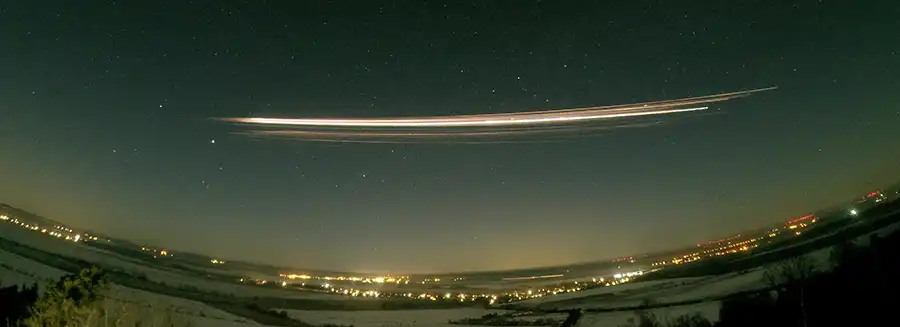
Everything started with a routine launch of yet another group of Starlink satellites. Right after launch on February 1, 2025, the 3.9-ton Falcon 9 upper stage failed to de-orbit over the Pacific Ocean as intended. When it finally came down three weeks later over the west coast of Ireland, its uncontrolled descent created a spectacular fireball, observed widely across northern Europe in the early morning hours of February 19th. Some rocket pieces even made it to the ground and were later recovered in Poland, according to media reports.
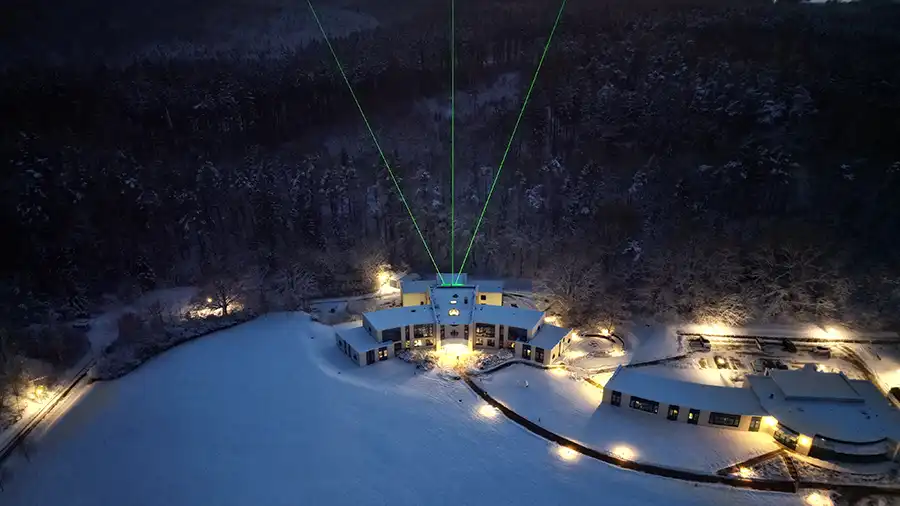
At the Leibnitz Institute of Atmospheric Physics (IAP) in Kühlungsborn, Germany, a group of researchers also took notice. “We had observed the uncontrolled re-entry with our camera in Saxony,” recalls team leader Robin Wing. The sky was predicted clear for the next night, so Wing and his team got to work: They tuned their Light Detection and Ranging (LIDAR) system to 670.8 nanometers, a wavelength emitted by the element lithium when it’s energized, and waited for sunset.
R. Wing et al. / Communications Earth & Environment 2026
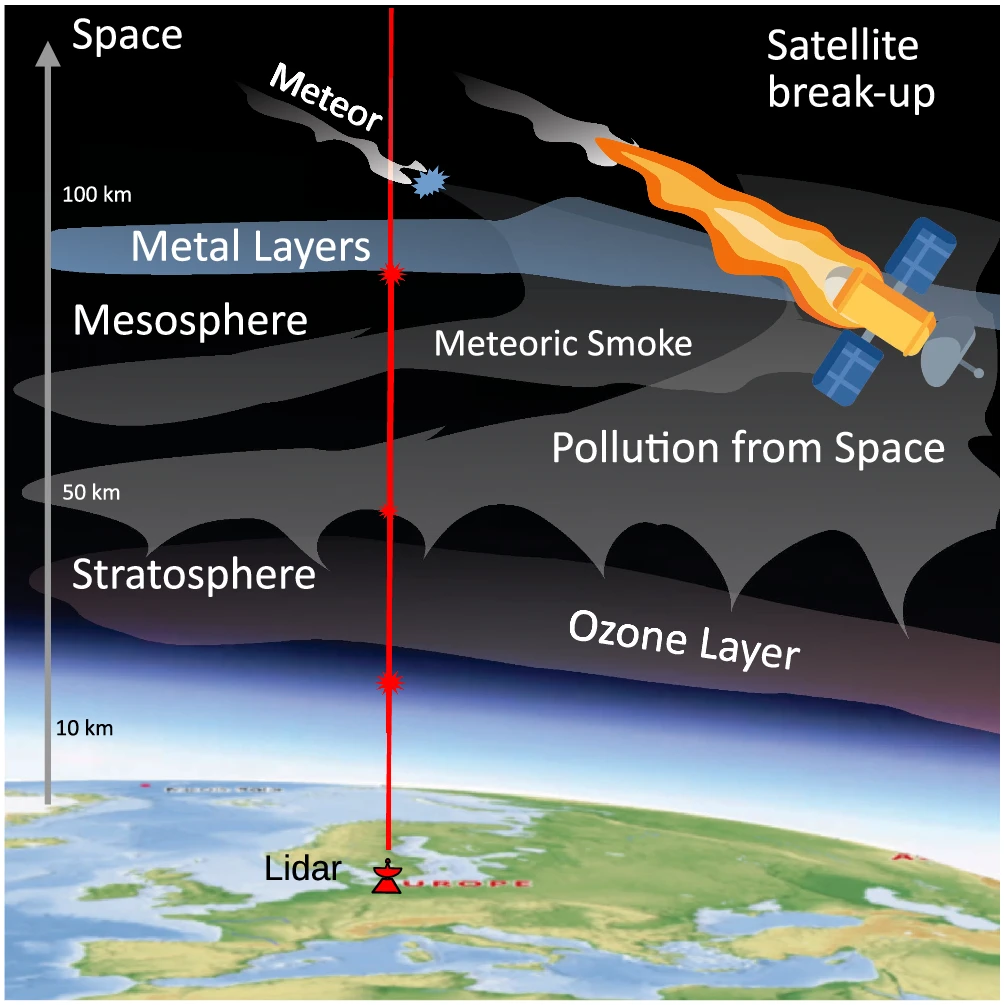
IAP’s LIDAR instrument is designed to probe the chemistry of the upper atmosphere without having to go there: A laser illuminates atoms and molecules at almost 100 kilometers (60 miles) above the ground through a process called resonance scattering. “The scattered light is then reflected back 180 degrees, where we capture it with a telescope and measure the signal,” Wing explains. By tuning the laser’s wavelength to specific spectral lines, the researches can differentiate between atomic species.
The team chose to search for lithium because it’s a light metal widely used in the hull plating of spacecraft. When an object burns up on entering the upper atmosphere, lithium vaporizes quickly together with other metals, leaving behind a cloud of atomic debris. At the same time, the only natural source for metals at high altitudes – meteorites – contain only traces of lithium, making the metal a good tracer for artificially introduced material.
Up to now, no direct attempt to investigate the aftermath of a large reentry using LIDAR has been successful, mostly because most spacecraft are deliberately steered to de-orbit over unpopulated places. The unplanned crash over Europe thus presented a unique opportunity.
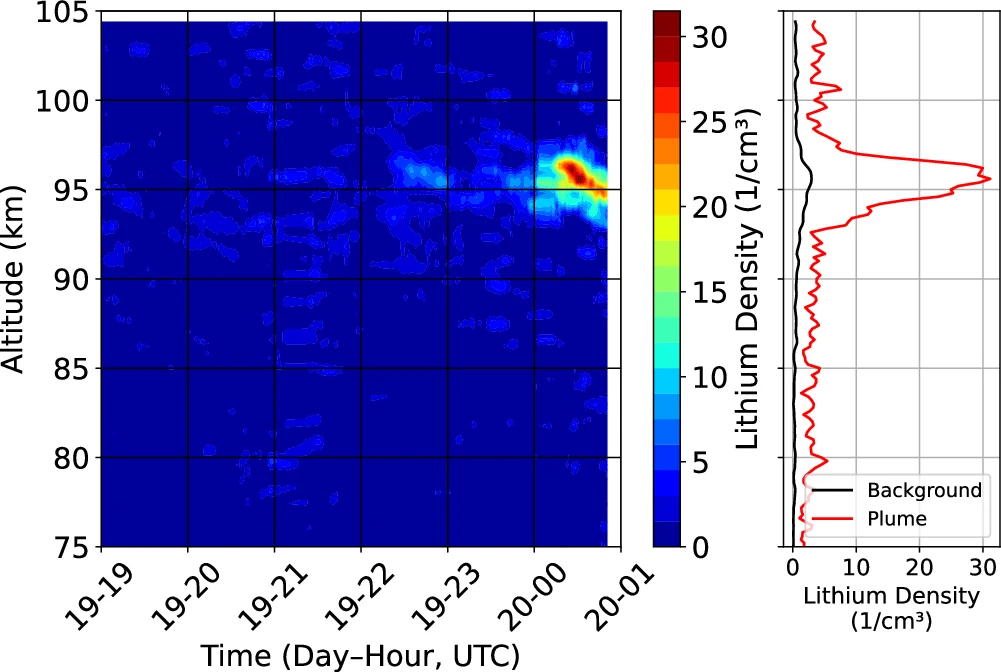
And it worked out: The laser illuminated a spot in the upper atmosphere that was 100 meters (300 feet) wide, and the LIDAR in turn detected a weak lithium signal, corresponding to about 3 atoms per cubic centimeter. But shortly after 20:00 UTC, this value suddenly jumped to more than 30 atoms. The signal remained that bright for the rest of the night.
R. Wing et al. / Communications Earth & Environment 2026
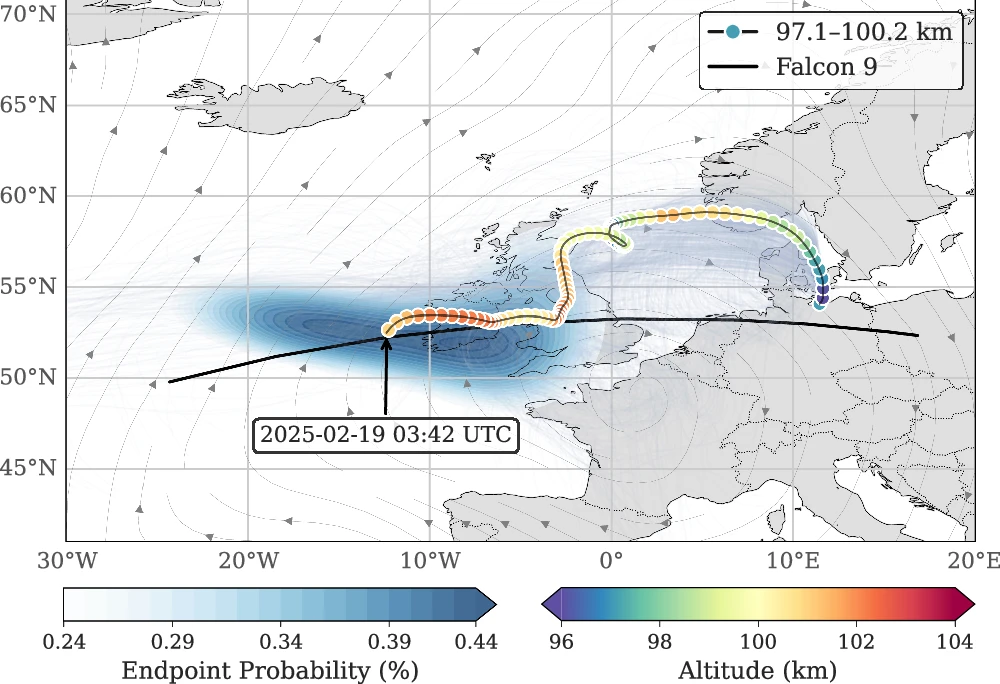
Because IAP’s LIDAR is located 1,500 kilometers east of where the Falcon 9 had reentered the atmosphere, the team had to use a global air circulation model to check whether high altitude winds could have moved the cloud from Ireland to Germany in the 20 hours between reentry and measurement. The analysis came back positive, and since no other natural source exists, Wing and his colleagues conclude that the lithium must have come from the Falcon 9.
R. Wing et al. / Communications Earth & Environment 2026
Most commercial satellites operate at low-Earth orbits, and intentional de-orbits and reentries are necessary to keep those orbits from overcrowding. In fact, many space operators have adopted a “design to demise” principle, under which burned-out rocket stages and retired satellites have to be de-orbited within five years. Megaconstellations, such as Starlink, are designed so that satellites are constantly being replaced to make room for new ones. Even once their vast fleets of tens of thousands of satellites are completed, they’ll still require dozens of satellites to be launched and de-orbited every day.
But space trash doesn’t disappear into thin air. That replacement rate would deposit more than 8,000 tons of metals per year into our upper atmosphere, far exceeding what meteorites naturally inject.
On top of that, elements such as aluminum, copper, lithium, titanium, lead, and others commonly used in spacecraft aren’t abundant in meteorites. The “New Space Age” will not only elevate the amount of atmospheric metals, but it will also change the atmosphere’s chemical composition. “It is still unclear what direct effects elements like lithium have on the atmosphere,” Wing adds.
Gerd Baumgarten
Astronomers, already plagued from light pollution by satellites in orbit, also fear rising metal atmospheric pollution may increase the opacity of Earth’s atmosphere. The metals in the stratosphere might even create more airglow, a normally faint natural light emitted by molecules in the upper atmosphere at night. Both pollution and airglow would further hinder observations from ground-based telescopes.
That’s not to mention the effects on Earth’s climate. Some studies suggest that certain chemicals can further deplete the ozone layer, a layer of molecules around 30 to 40 km above the ground that absorbs harmful ultraviolet rays from space, protecting plants, animals, and humans from radiation damage. Atmospheric aluminum oxides, for example, which almost entirely come from reentries, may act as catalysts to speed up ozone depletion when combined with other chemicals.
Research flights over Alaska showed that 10% of stratospheric sulfuric acid particles in the stratosphere already contain aluminum particles. Most worryingly, these particles were introduced long before megaconstellations were a thing. One study suggests that it takes around 30 years for aluminum particles to descend from the upper atmosphere down to 40 km, where they enter the ozone layer. The full consequences of today’s actions may not be apparent for another generation or so — and the same is true for any countermeasures.
Wing and his team stress that more research is needed to understand the possible effects of this kind of pollution. They’re in in line with a call by the American Astronomical Society, which urges funding for more research to understand this new and rapidly developing threat to astronomy.


Comments
Tony
February 22, 2026 at 3:27 pm
Our use of the lower troposphere as a garbage can has had grave consequences at times, with thousands of early deaths in some cases. As ascent is made through the layers above, each layer -- stratosphere, mesosphere, then thermosphere -- has much thinner air than the one below and consequently is far less able to dilute a given mass of pollutants. Depositing exotic metals, especially ones with great reducing potential (lithium!) and therefore most antagonistic to oxidizing molecules (ozone!), has the potential to produce rapid, serious trouble.
You must be logged in to post a comment.
You must be logged in to post a comment.