 SUNSET:

 6
6The International Astronomical Union has recommended brightness limits for satellites, but companies aren’t abiding by them.
T-Mobile
Bright spacecraft spoil aesthetic appreciation of the night sky for amateur astronomers and interfere with professional research. But there are already several thousand spacecraft in orbit and that number is expected to grow to tens of thousands in the coming years: Industries and governments are launching six major “constellations” of communication satellites: Starlink, BlueBird, Qianfan, Guowang, OneWeb and Kuiper.
In response to this problem, the International Astronomical Union created a Centre for the Protection of the Dark and Quiet Sky from Satellite Constellation Interference (IAU CPS). The IAU CPS recently recommended brightness limits for constellation satellites. Those limits are designed to ensure that satellites in operational orbits are never visible to the unaided eye. But I (Anthony Mallama) and my colleague Richard Cole have found that companies aren’t abiding by these limits.
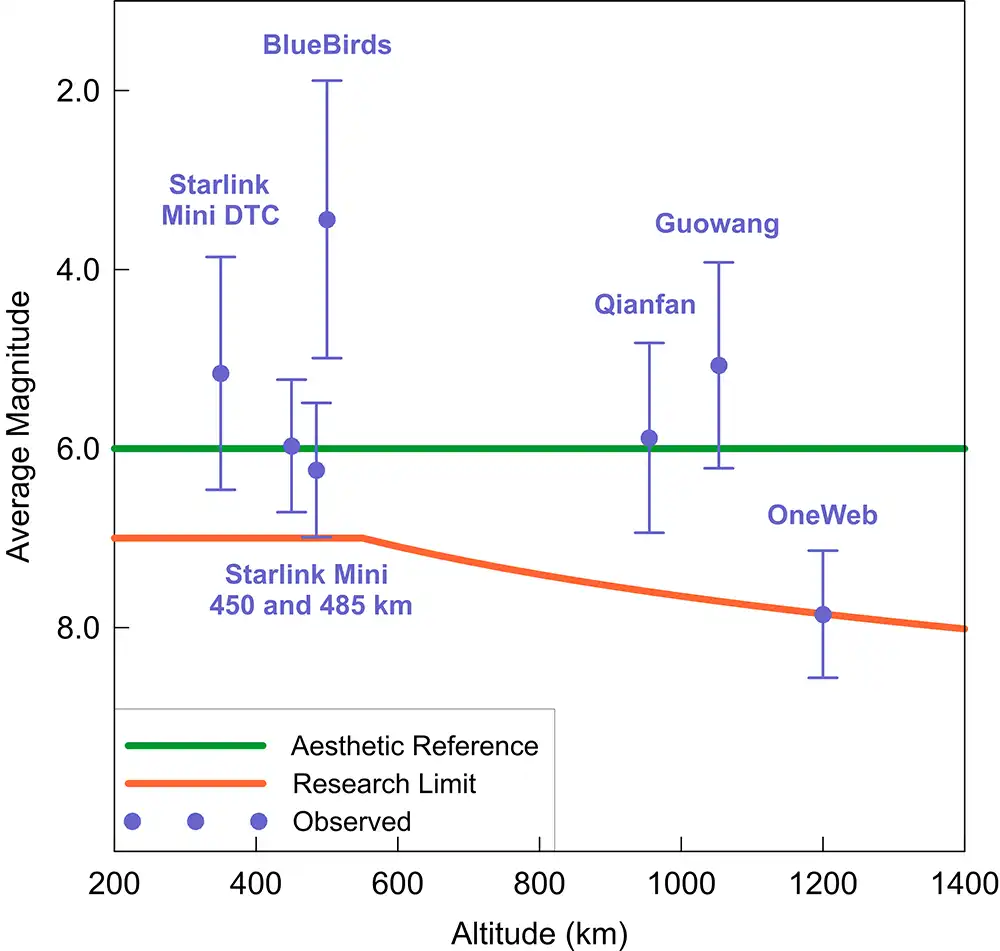
In dark-sky locations, people can see objects of visual magnitude 6, which I refer to as the aesthetic limit. For professional astronomers, the research limit is magnitude 7 for satellites at altitudes up to 550 km and it gradually becomes fainter at higher elevations.
To study the brightness of large satellite constellations, Cole and I combine visual magnitude estimates made by amateur observers with data recorded electronically by professionals. We have already published results for Starlink, BlueBird, Qianfan, and OneWeb spacecraft. Research is currently underway on the Guowang and Kuiper constellations.
Source: Mallama and Cole 2025
Except for two satellite types — OneWeb and Starlink Mini satellites at 485 km — all of the satellites are brighter than the aesthetic limit. And every satellite constellation except OneWeb exceeds the research limit.
The BlueBird satellites operated by AST SpaceMobile are the brightest of the bunch, but their number is far smaller than the constellations.
SpaceX’s Starlink V2 Mini satellites are about the same brightness as the (now discontinued) first-generation versions — even though the V2 Minis (despite their name) have more than four times the surface area. That accomplishment illustrates the success of the company’s brightness mitigation efforts.
Meanwhile, the Chinese constellations, Qianfan and Guowang, are too bright even at their current high orbits around 1,000 km. (We have sufficient data to characterize Guowang brightness, so it is included here, but the results are not yet published.) Later launches will aim for orbits in the 300 to 500 km range, which would make the spacecraft 1 to 2 magnitudes brighter than they are now.
The Kuiper spacecraft from Amazon are the newest constellation. Amazon has applied brightness mitigation, and we are currently collecting data to assess its effectiveness.
These results and future findings will be published on a new website: satmags.netlify.app. Meanwhile, amateur observers are invited to participate by recording satellite magnitudes. This paper explains how.


Comments
russlucas
July 30, 2025 at 12:36 pm
Soon th majority of cutting edge astronomy will be done in space. I know we have some big telescopes coming online, but still the future of astronomy is in space.
When I was imaging about a decade ago, I remember that there was at least one software package that would remove "artifacts". One was PixInsight
You must be logged in to post a comment.
Anthony-Mallama
July 31, 2025 at 11:58 am
Software can help but information cannot be recovered from pixels that are saturated. The ‘research limit’ magnitude corresponds to pixel saturation.
You must be logged in to post a comment.
Enrico the Great
July 30, 2025 at 5:16 pm
These satellite constellations seem to be kludges----overly complicated solutions to a problem. We need viable and doable alternatives to all this, and quick. There has to be a better way to get porno to some dude in the boondocks. Sorry about the image---I realize that other much more serious purposes are served by these---emergency services and the like---but we need the night sky as well. Plus, I foresee possible bad effects on migrating birds and the like.
You must be logged in to post a comment.
Chris-Schur
August 2, 2025 at 6:56 pm
From astroimagers point of view, nearly every 5 minute subframe with my 10 inch has at least one, sometimes up to 4 starlink trails when shooting before midnight. For larger stacks of say a dozen or more luminance images, the trails are pretty much gone with sigma reject. The problem is when you shoot the color data, say a few frames of each color, there is not enough data to remove any sat trails. And then it takes hours to photoshop out all the mess. One tool that I havent tried yet is a free ware app by Seti Astro which uses AI to color all the trails in the subframes black. Then when you stack it is a bit more rejection.
You must be logged in to post a comment.
Sandy82579
August 6, 2025 at 12:07 pm
Frankly this nonsense should be illegal. Wired and wireless options are already in place on the ground. This is just rich people and countries who want to make money and destroy the wired and wireless options. "Internet for the world" is a joke. Everyone who wants it already has it. Those that have no internet, don't even know what it is.
You must be logged in to post a comment.
Andrew James
August 7, 2025 at 5:02 am
"This is just rich people and countries who want to make money and destroy the wired and wireless options."
Nope. It is the FCC and the American Government and administration that is doing this and letting companies get away with this. Blaming other countries is ridiculous because America is imposing it will on the rest of the world. Other countries have no say in the oppression.
You must be logged in to post a comment.
You must be logged in to post a comment.