 SUNSET:

 4
4The aurora may be visible across much of the U.S. tonight in the wake of dual solar blasts.
Want more? Check out our aurora page, our "How to See the Aurora" video, and Bob King's new book, Magnificent Aurora.

Bob King
"There's a storm blowin' up, a whopper!" That quote from an opening scene from the movie The Wizard of Oz applies equally well to a pair of massive solar blasts that occurred on October 7th and 8th that arrived earlier today at Earth. A potent X2-class solar flare launched the first salvo, a maelstrom of solar plasma called a coronal mass ejection, or CME, followed hours later by an erupting filament. Filaments are dark, snake-shaped ribbons of plasma that appear as prominences when they rotate to the Sun's limb. Both are entangled with solar magnetic fields. Under the right circumstances — happening now! — those fields can couple with Earth's magnetic field and begin the process that sets the sky aflame with aurora.
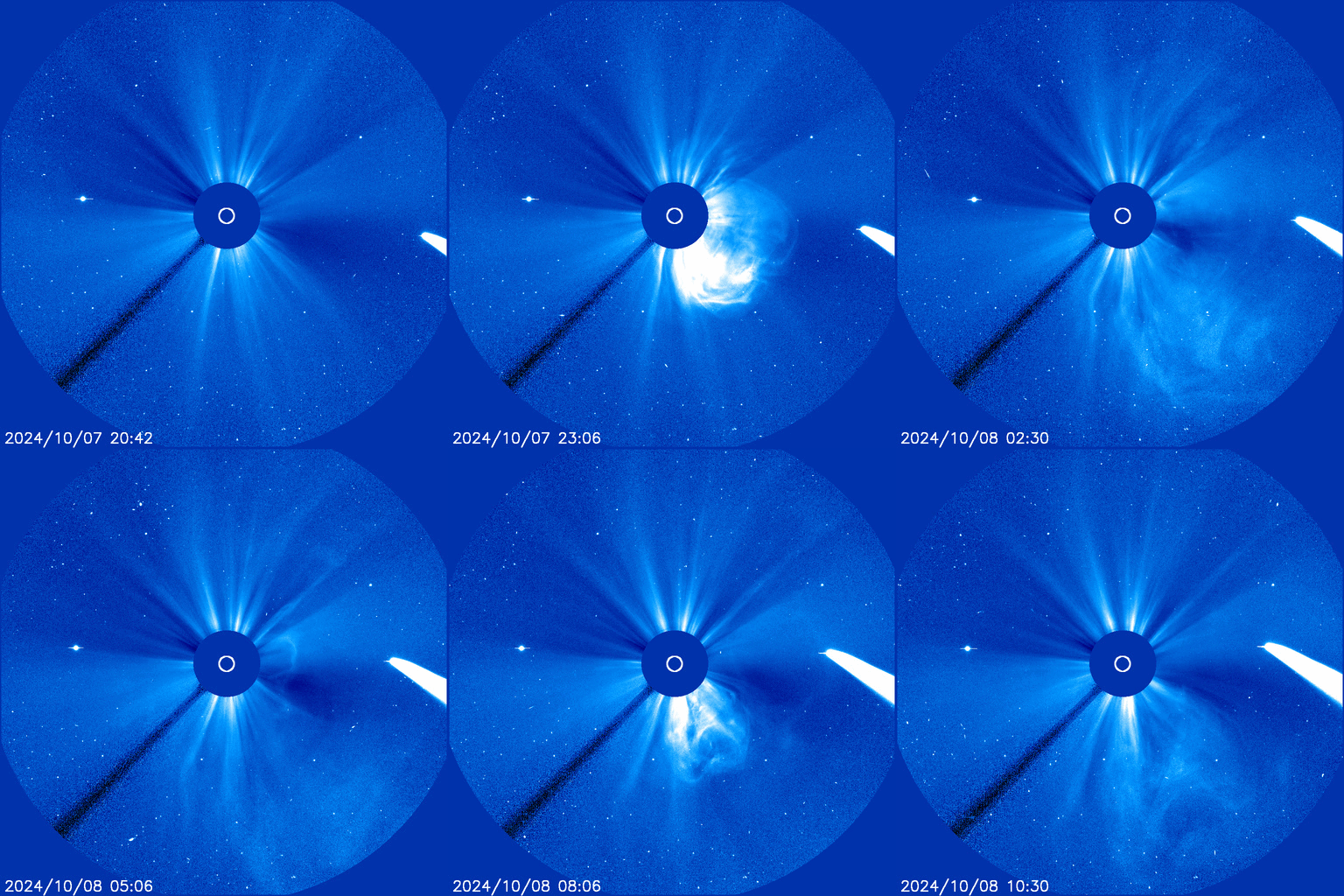
ESA / NASA / Dr. Tony Phillips, spaceweather.com
By Thursday afternoon, October 10th, the predicted expected severe geomagnetic storm — G4 on a scale from G1 (minor) to G5 (extreme) — was already underway with expansive auroras spilling across Russia and the Nordic countries. The NOAA space weather forecast calls for the storm to continue throughout the day and well into the wee hours of Friday morning, with auroras blooming in unfamiliar places like northern California and Alabama.
Even observers as far south as southern California, Texas, and even Arizona may detect a faint glow visually at the northern horizon Thursday night through Friday morning. If you don't see anything don't give up. Try taking a time exposure using a digital camera. Because the camera accumulates light it can reveal these subvisual red glows at the bottom of the sky. High-speed electrons from solar storms (and other in-situ sources) funneled to Earth's upper atmosphere bombard and energize the gases there, which then emit that surplus energy as red, blue, purple, and green light.
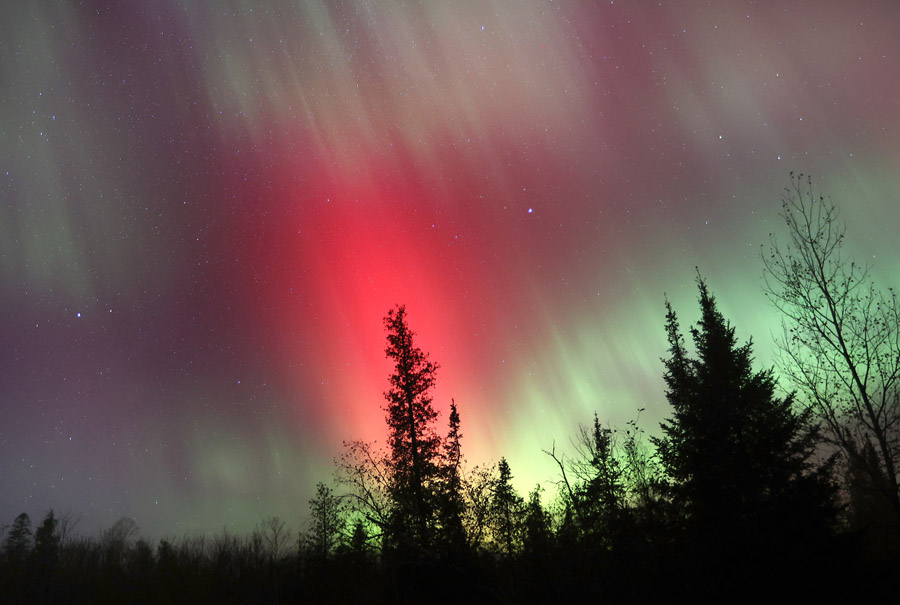
Bob King
Oxygen at an altitude of around 120 kilometers (75 miles) spits out green photons, while its counterpart at 300 kilometers (186 miles) and higher up pumps out red light. The latter's much greater altitude expands the red aurora's visibility well into the southern U.S. — like seeing a mountaintop from a great distance. Meanwhile, observers in the northern part of the country, located closer to the expanding doughnut-shaped ring of active aurora (below), see the entire "mountain" in all of its colors.
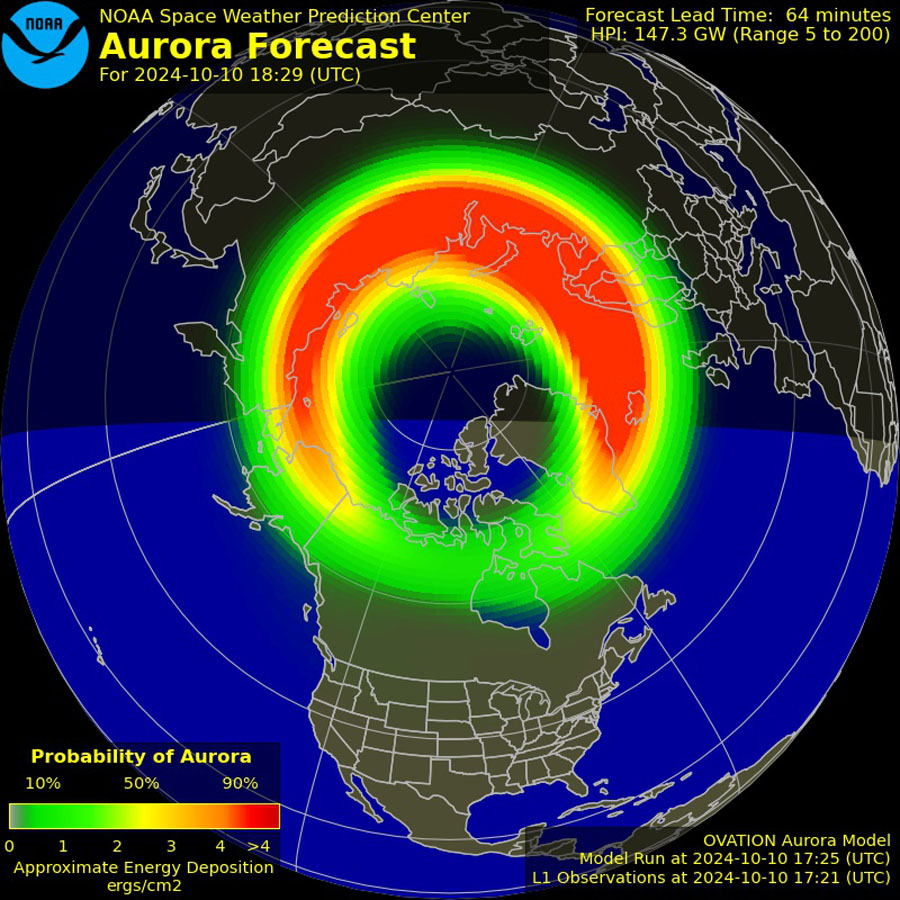
NOAA
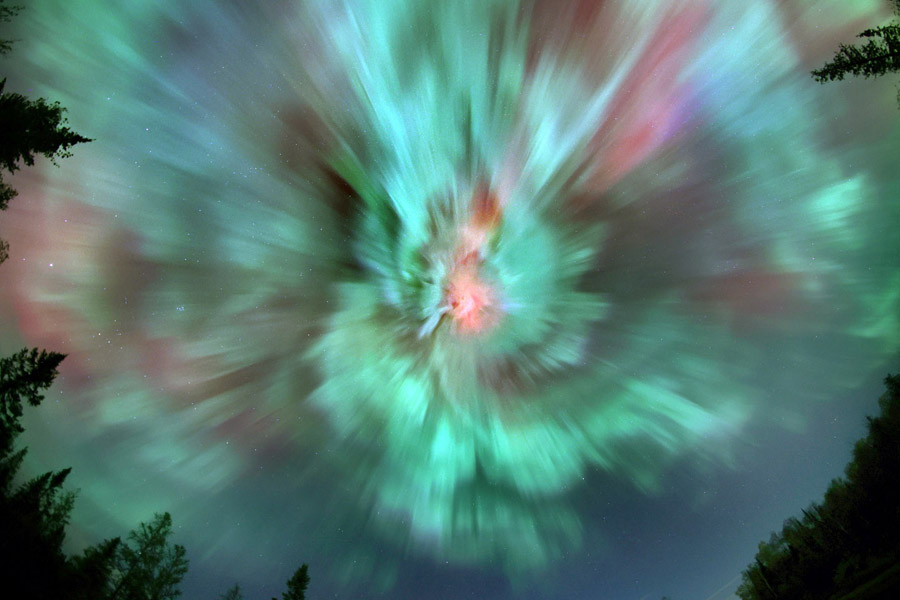
Assuming the current storm persists as forecast, observers in North America should start looking as soon as mid-twilight on Thursday evening. The northern sky is the best place to start since most auroras at mid-latitudes use that as their play space. Generally, as the night goes on and your longitude passes under the greatest extent of the the northern (or southern) oval the aurora intensifies, often peaking with a massive coronal display — beams appearing to converge, pulsate, and dart nearly overhead — around local midnight. But there's no strict rule. Sometimes this happens around 10 p.m. then repeats a couple hours later. Or we get a modest coronal display around 11 p.m. or midnight, only to see the entire sky "break open" at 2 a.m.
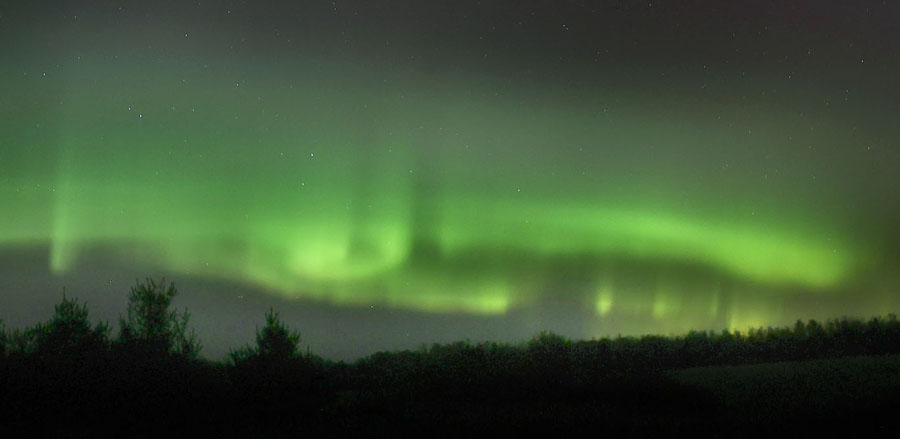
Bob King
Watch for trends. As a general rule, if a low, green auroral arc grows brighter or higher, don't leave the scene. Stay out because it's a good indicator that activity is intensifying, and the best is yet to come. That brings us to the proper dress. A warm coat and lined boots (yes, even in fall) are best because you might get caught under the aurora's spell for hours. During the G2 storm on October 7–8 the display was so compelling and ever-evolving that I stayed out from 8:30 p.m. to 2 a.m. Bring a chair to rest your feet and a snack to keep your juices flowing.
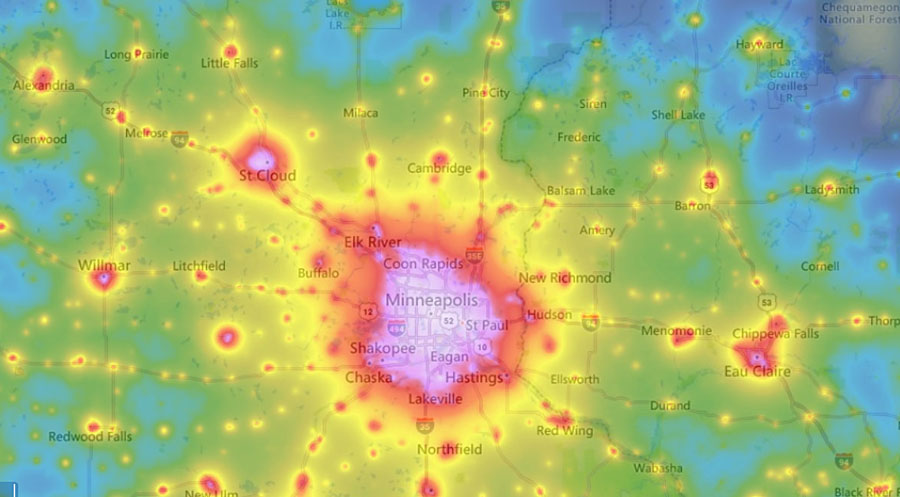
Jurij Stare, www.lightpollutionmap.info
Location is crucial. If you're in a city, get out of Dodge. Drive north, west, or east so that the city is either behind you to the south or off "to the side" so as to avoid as much light pollution as possible. Your goal is a northern sky that's as dark as possible. To find a dark place, consult the interactive light-pollution map at lightpollutionmap.info. Zooming in, you can identify what route you need to take to get to the map's blue and gray areas where skies are darkest.
Photography is simple. Handheld smartphones are capable of exposures up to 10 seconds — plenty enough to record even a modest aurora. Phone cameras will also reveal colors much better than the human eye can pick out, again because the camera gathers light while the eye takes in the scene nearly instantaneously. Be alert for potential aurora sounds. Although I've never heard them despite years of trying, others have. They describe crackling, swishing, pops, and more. Finally, don't be surprised if our hoped-for aurora suddenly dries up or otherwise doesn't meet expectations. Surprise is a key facet of the natural world and the driver behind the questions that help us better understand a phenomenon.
Bob King
I'll be monitoring the storm and will provide updates on my Facebook page. You can also monitor the progress of the aurora at the sites listed below. Good luck and I hope it's a happy night. Oh, and please do share your photos with us!
- Current NOAA space weather forecast Geomagnetic storm levels are shown every 3-hours.
- Current predicted extent of the aurora ovals
- SpaceWeatherLive app. Free download for aurora alerts and storm information for your location
- Real-time solar wind for live data from the ACE and DSCOVR satellites. Watch the red curve marked Bz, the north-south direction of the interplanetary magnetic field generated by the Sun. If it drops below the centerline (goes "south") and stays there for hours the aurora is active.
About Bob King
I love the sky (day and night) and have been a skywatcher and amateur astronomer since childhood. I'm also a long-time member of the American Association of Variable Star Observers (AAVSO) and Astronomical League. I pen the Astro Bob blog and have written four books: Night Sky with the Naked Eye (2016); Wonders of the Night Sky You Must See Before You Die (2018) and Urban Legends from Space (2019) and Magnificent Aurora, published in 2024. The universe invites us on an adventure every single night. To accept the invitation, we only need look up.


Comments
Michael
October 11, 2024 at 1:10 am
Central Texas: Red aurora shows up easily in handheld iPhone images. Not visible naked eye, at least not with the Moon still up.
You must be logged in to post a comment.
Bob KingPost Author
October 11, 2024 at 10:08 am
Thanks for the report, Michael! I've heard other reports and have seen photos of red aurora from the southern states including Mississippi and Arizona.
You must be logged in to post a comment.
Rod
October 11, 2024 at 7:24 pm
Bob King, here is a view from last night at Salisbury MD. A friend sent me the pic 🙂
https://www.youtube.com/channel/UCN037NurHvHu7wpWp9XPtaA/community?lb=UgkxyhuIlxaLfVK3ofmgGLC1hT5kb98yuVry
You must be logged in to post a comment.
Bob KingPost Author
October 12, 2024 at 10:44 pm
Thanks, Rod. Wow, what a night that was!
You must be logged in to post a comment.
You must be logged in to post a comment.