 SUNSET:

 0
0Download this month's Sky Tour podcast for a guided tour of the evening sky's changing planetary scene and some constellations that might be new to you.
 This episode is sponsored by Celestron, manufacturer of high-quality telescopes and an industry leader in developing exciting optical products with revolutionary technologies. This episode is sponsored by Celestron, manufacturer of high-quality telescopes and an industry leader in developing exciting optical products with revolutionary technologies. |
LISTEN HERE:
Podcast: Play in new window | Download
Subscribe: Apple Podcasts | Spotify | Email | RSS | More
For a fascinating naked-eye tour of the major sky sights in November evening skies, play or download this month's Sky Tour episode.
November marks the changing of our clocks — an hour backward to standard time in the U.S. and Canada — and a changing of the guard in the southwestern sky after sunset.
Sky & Telescope
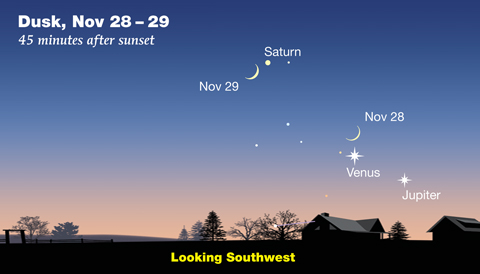
Early in the month, look for Jupiter low in the southwest soon after sunset. It’s bright and still relatively easy to spot. But with each passing night it edges a little closer to the horizon and becomes harder to spot.
Meanwhile, Venus has started to emerge from the Sun’s glare and will gradually rise higher in the evening twilight throughout November. By month’s end, Venus will set nearly 2 hours after the Sun goes down.
Saturn is still hanging around as well. Look for it higher up, to the upper left of Jupiter by about twice the width of your clenched fist on an outstretched arm.
This month's podcast also introduces you to some constellations that might not be familiar to you:Pegasus, the flying (but upside-down) Horse; Pisces, the Fish; Sagitta, the Arrow; and Piscis Austrinus, the Southern FIsh.
About J. Kelly Beatty
J. Kelly Beatty, S&T Senior Editor, joined the staff of Sky Publishing in 1974 and specializes in planetary science and space exploration. Learn more about him here.


Comments
You must be logged in to post a comment.