 SUNSET:

 0
0In this month’s Sky Tour astronomy podcast, we’ll watch two sets of shooting stars, spot some bright planets, point out a few late-autumn constellations, and put a spotlight on five interesting stars.

Listen Here:
Podcast: Play in new window | Download
Subscribe: Apple Podcasts | Spotify | Email | RSS | More
Check out the illustrated version of this podcast on Sky & Telescope’s YouTube channel!
November is the month when those of us in the U.S. and Canada adjust our clocks to “fall back” an hour to standard time. That takes place before dawn on November 2nd in the U.S. and Canada, a week later than our friends in Europe do. Mexico and tropical countries don’t make the change at all, nor does China or Russia.
The return to standard time means that most of us are still heading home from work as evening’s twilight sets in. That’s just fine, though, because you can sneak in a little stargazing before dinnertime.
Among the bright planets, only Saturn continues to grace the evening sky. Trailing well behind Saturn is brilliant Jupiter. As darkness falls it’s nowhere to be seen, but it pops over the eastern horizon by 10 p.m. early in November and by 8 p.m. at month’s end. By early January, it’ll rise into view by twilight and remain in view all night.
Sky & Telescope
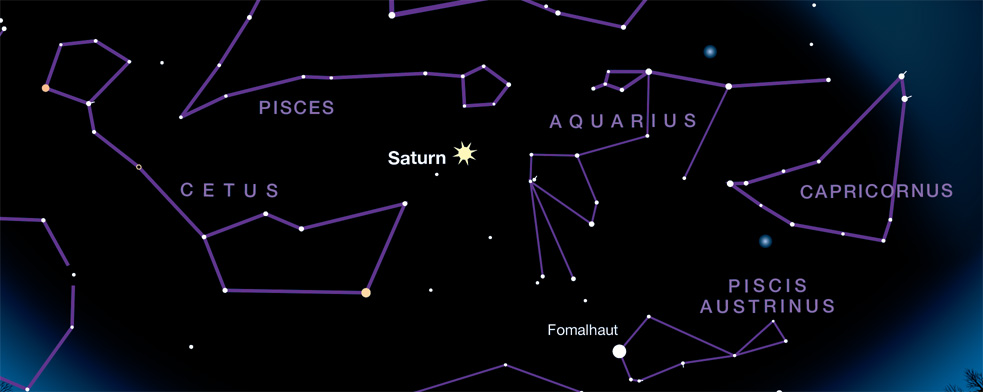
Saturn current sits in a large area of sky with few bright stars. The only one nearby if Fomalhaut, in the southern constellation Piscis Austrinus, the Southern Fish. (Do you know this star’s nickname? Listen to this month’s Sky Tour podcast to find out!) The stars that frame Piscis Austrinus — along with those for Pisces, Cetus, Aquarius, Capricornus, and Sculptor — are difficult to pick out unless your sky is very dark.
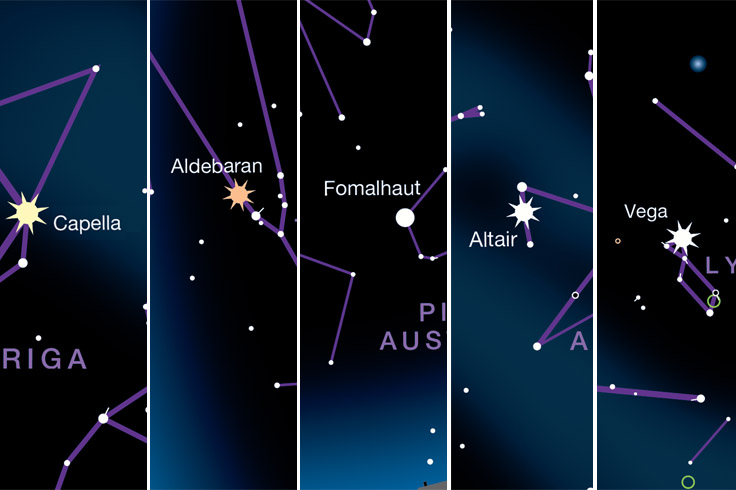
But don’t fret over the dearth of bright planets and dazzling constellations on these November evenings. This month’s Sky Tour introduces you to five bright stars, all easily visible throughout the month, that have interesting characteristics. One is a quadruple-star system, while another is a triple star. Two have very rapid rotation rates, and another has at least one planet in orbit around it. All five are pictured below. Do you know which of these descriptions apply to which stars? Listen to the podcast for the answers!
Sky & Telescope
November also features not one but two meteor showers: the Taurids and the Leonids. Both are relatively weak, but one of them is rich in fireballs — and might even deliver more fireballs than average this year. Which of the two is it? Yep, you guessed it: Listen to Sky Tour to find out!
Created monthly since 2006 by the editors of Sky & Telescope, Sky Tour is a fund and informative way to find your way around the night sky. No equipment or stargazing experience is needed. Just find a comfortable viewing location, look up, and take this 15-minute guided tour of the starry sky above you.
About J. Kelly Beatty
J. Kelly Beatty, S&T Senior Editor, joined the staff of Sky Publishing in 1974 and specializes in planetary science and space exploration. Learn more about him here.


Comments
You must be logged in to post a comment.