 SUNSET:

 11
11The imminent lunar impact of a SpaceX Falcon 9 rocket booster highlights the growing amount of space debris near the Moon.

SpaceX
Things are getting crowded up there, even beyond low-Earth orbit: On August 5th, a discarded SpaceX Falcon 9 upper stage is expected to strike the Moon. Bill Gray at Project Pluto announced the imminent impact and maintains an extensive page on the event.
The booster was part of SpaceX’s January 15, 2025, launch, the one that sent Firefly Aerospace’s Blue Ghost and iSpace’s Hakuto-R2 landers to the Moon. Blue Ghost successfully landed on March 2, 2025, and carried out two weeks of surface operations, including the capture of the first solar eclipse from the lunar surface. Hakuto-R2’s Resilience lander fell silent before “litho-braking,” landing hard on the Moon on June 5, 2025.
“This object has spent almost all of its time at distances similar to that of the Moon,” says Bill Gray (Project Pluto) in his post on the object and the event. “Generally speaking, such objects are very poorly tracked.” He notes that the U.S. military mostly tracks objects using radar, which tracks low-orbiting junk pretty well. But radar can't track objects near the Moon so easily. Out there, 400 times farther away than low-Earth orbit, radar signals are about 25.6 million times fainter. (The booster does have some tracking, though, and is given the ID 2025-010D or NORAD 62719.)
Measuring 13.8 meters (45 feet) long and 3.7 meters in diameter, the booster is almost the size of a semi-truck trailer. Gray predicts it will impact the Moon at 2:44 a.m. EDT (6:44 UT), at a time when the Moon is in the waning gibbous phase, more than half-illuminated. The Moon will be above the horizon in the early morning skies for the Americas.
Unfortunately, visibility prospects aren’t good. The impact is expected to occur on the illuminated side of the Moon, near Einstein Crater. This crater is near the lunar limb and only occasionally visible from Earth due to the Moon's wobble, or libration. Even previous impacts that have occurred on the unlit portion of the Moon haven't been visible, so it's doubtful this one will be.
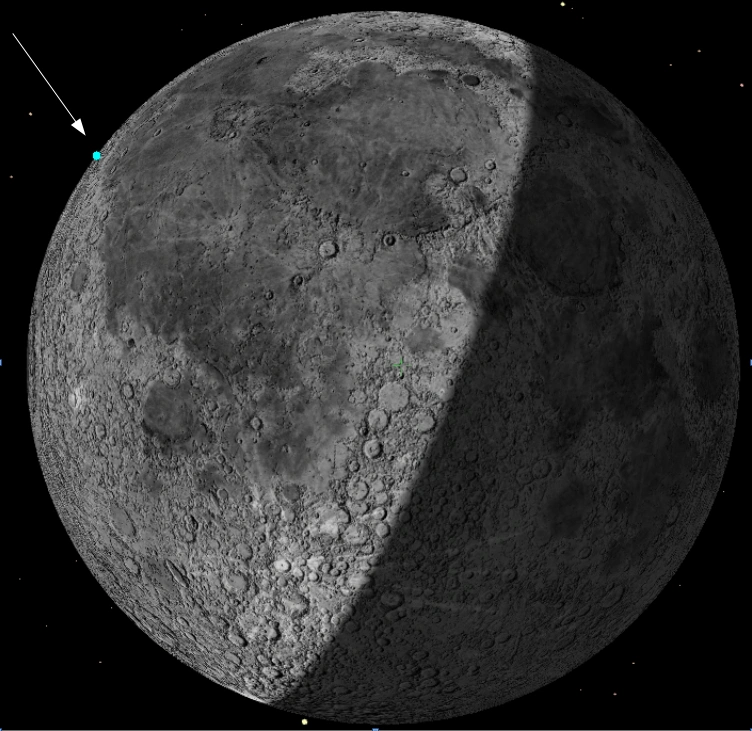
Bill Gray / Project Pluto
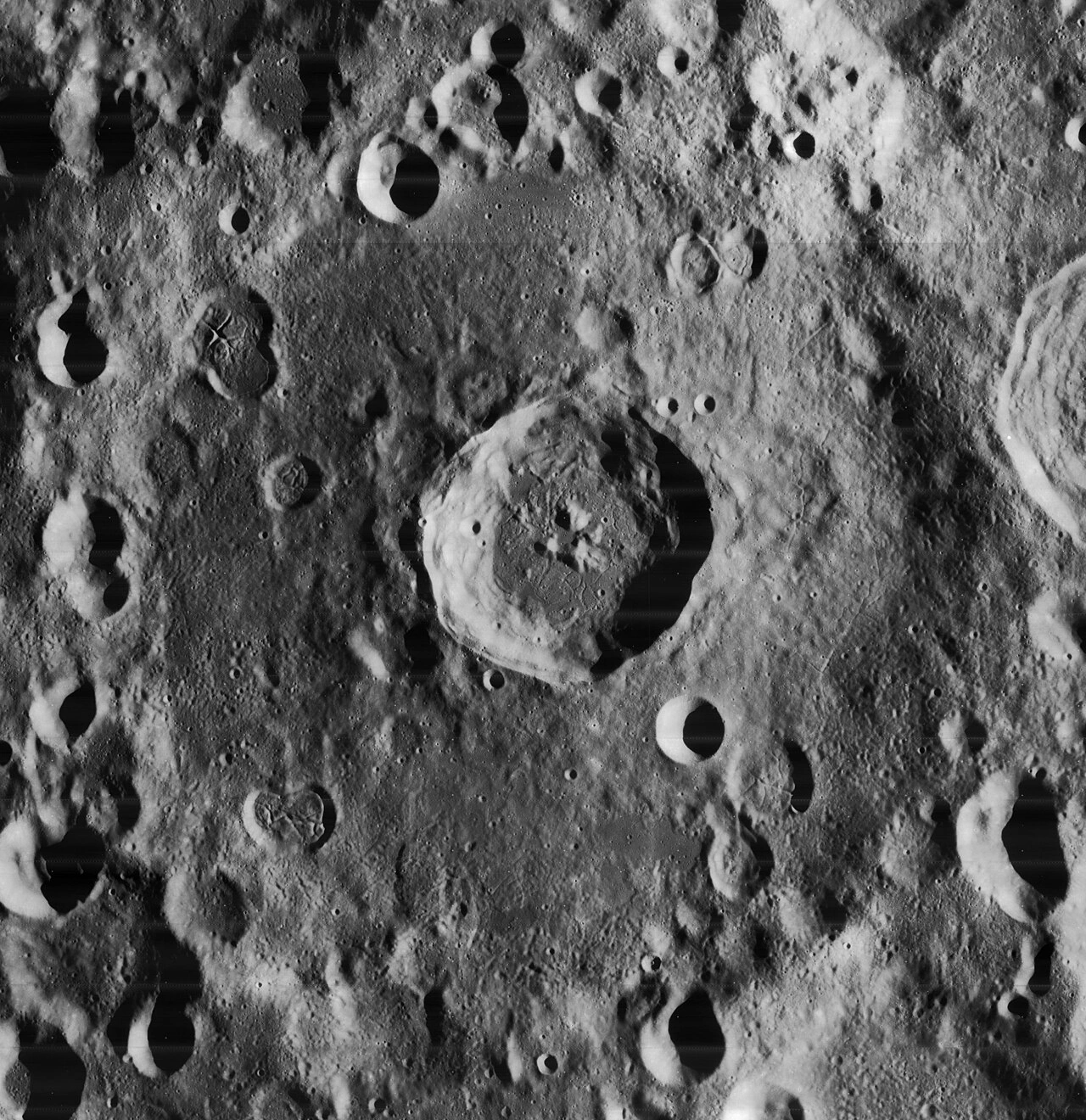
NASA
Lunar Impacts Since 1959
The first human-made object to strike the Moon was the Soviet Union’s Luna 2 in 1959. Most of NASA's Apollo-era hardware eventually struck the Moon as well, with impacts recorded by seismology experiments left on the lunar surface.
In 2009, NASA's Lunar Crater Observation and Sensing Satellite (LCROSS) deliberately struck the Moon near Cabeus Crater, in an effort to search for water in the resulting debris plume. Amateur astronomers tried but weren't able to see this event.
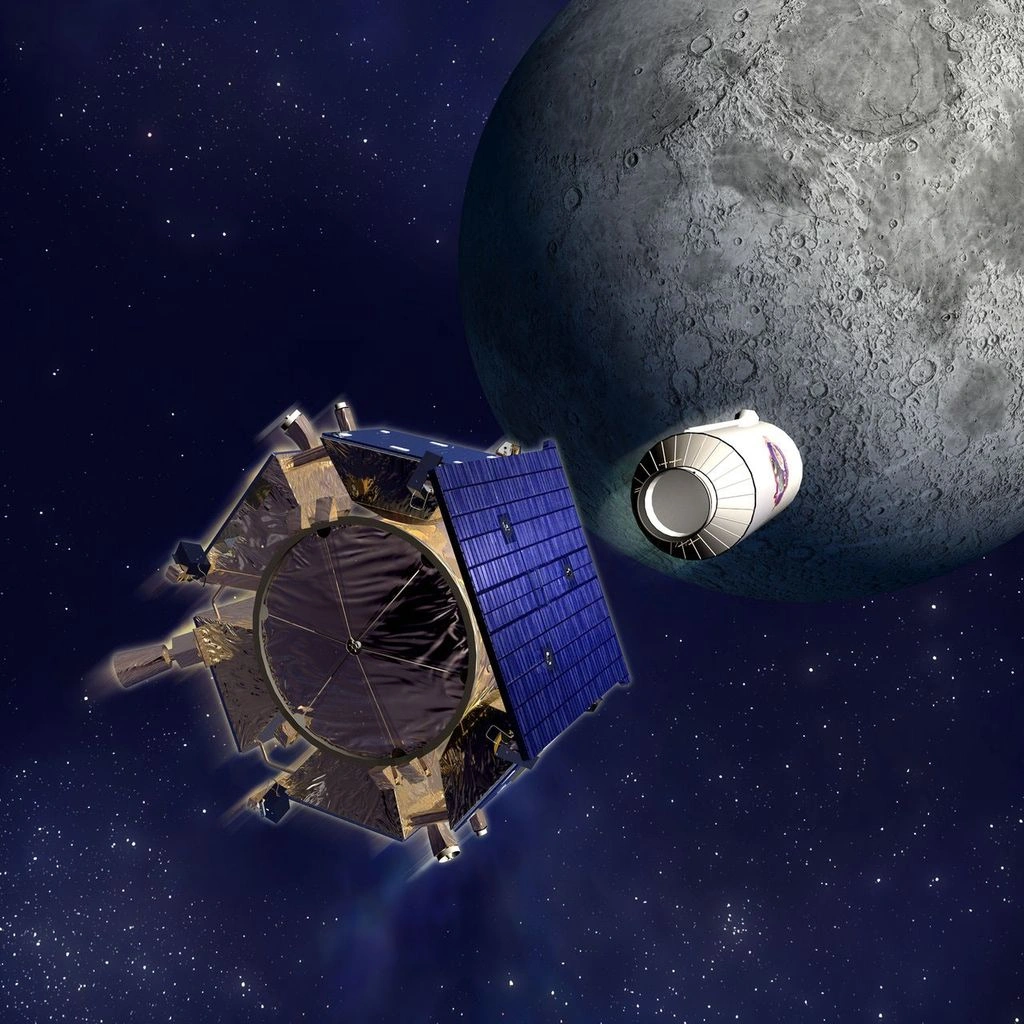
NASA
Another similar event occurred in 2022, when an object approached the Moon for impact. Initially, it was suspected to be another Falcon 9 S2, but it turned out to be a Long March 3C booster from China’s Chang’e 5 T1 lunar mission. NASA’s Lunar Reconnaissance Orbiter (LRO) imaged the resulting crater, and will likely document this August’s impact as well.
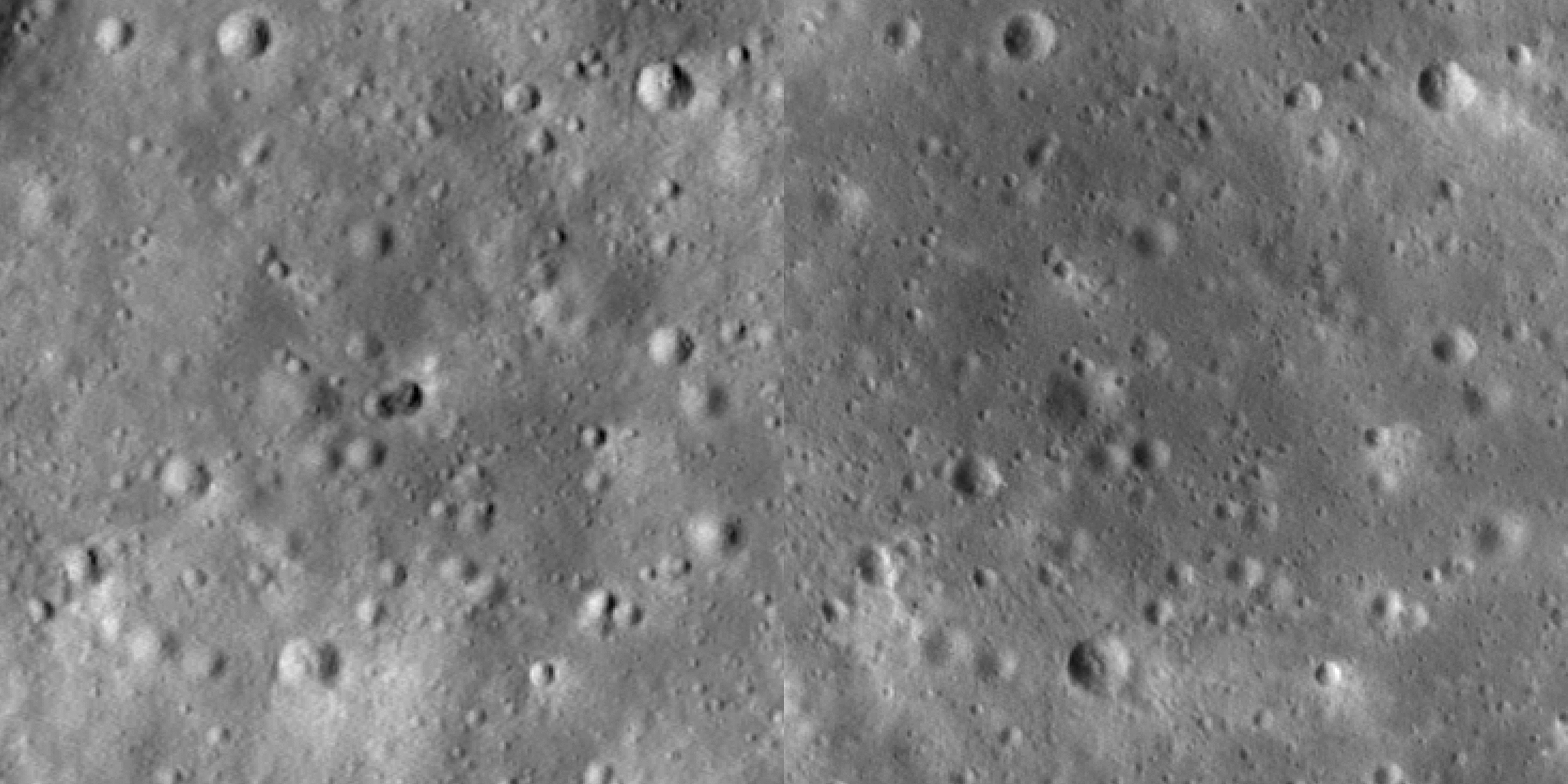
NASA/LRO
Though the impact poses no danger, it highlights the growing issue of debris in the space around the Moon. Though the amount of satellites and space junk in low-Earth orbit is growing exponentially, it’s at least tracked by NORAD, ESA, and other agencies. The same cannot be said for objects in high-Earth orbit and beyond.
“Cis-lunar space debris is difficult to track,” agrees Marco Langbroek (Delft University of Technology, The Netherlands). “There currently is no dedicated tracking network for these objects: All tracking data comes from chance detections by near-Earth asteroid surveys.” Even then, detected objects are often lost. When some are“rediscovered” in near-Earth asteroid surveys, it takes time to figure out they are actually returning space junk. Effects such as solar radiation pressure compound the tracking problem.
“This is not easy to model,” Langbroek says. “We are currently working on improving orbital integration models and our grip on all the orbit-disturbing effects at play in order to increase our abilities to predict the evolution of such cis-lunar orbits into the future.”
The Moon and the space around it is becoming busier, as NASA, China, and the European Space Agencies along with related commercial interests head to the Moon. While no humans are on the Moon now, the aim is to put them there, as well as scientific equipment. Since the Moon has no protective atmosphere, even small, high-velocity pieces of space debris could pose a hazard.
“These impacts are also a potential threat to heritage sites on the Moon, for example, the Apollo 11 landing site and other sites of great historic significance on the Moon,” says Langbroek. “Imagine losing Neil Armstrong's first footprints on the Moon: That would be a true historic loss.”
ESA’s Space Debris Office proposed a solution back in 2015: Boosters should enter orbit around the Sun once their associated lunar missions are complete. This is probably a worthy solution, at least until we fill up the inner solar system as well. (Remember the Tesla Roadster SpaceX put out in orbit around the Sun in 2018?)
It’s a strange new sky, watching all the new, artificial stars that populate dawn and dusk. The same may soon be true for the Moon, as we grapple with the growing issue of space debris.
About David Dickinson
David Dickinson is a freelance science writer, high school science teacher, retired enlisted U.S. Air Force veteran and avid stargazer. He currently resides with his wife Myscha in Bristol, Tennessee. David also writes science fiction in his spare time. He posts as @AstroDave on BlueSky about space news and sky-watching worldwide.


Comments
Warren-Odom
May 9, 2026 at 8:39 pm
"Out there, 400 times farther away than low-Earth orbit, radar signals are about 256 million times fainter."
Well, don't radar signals obey the standard inverse-square law, that all radiation (and gravity) follows? 400 time farther, squared, means the signal should be 160,000 times fainter. Or if you're quoting the round-trip distance of 800 miles, 800 squared is 640,000 times fainter.
So where do you get 256 million?
You must be logged in to post a comment.
David DickinsonPost Author
May 10, 2026 at 12:08 pm
Good point; that's as per Bill Gray's website on the impact. I can query him and see if he responds.
You must be logged in to post a comment.
Bill Gray
May 11, 2026 at 12:59 pm
(Got a nudge from Dave about this... thanks, Dave!)
Radar does operate with an inverse-fourth-power law. The reason is that if your target is (say) 400 times further away, only 1/400^2 as much of the radar pulse gets to it in the first place. And then, because you're 400 times further away, only 1/400^2 of _that_ comes back to you. The inverse-square hits you both coming and going.
It's one reason why the "planetary defense" radar at Goldstone tends to ping nearby asteroids. The returned signal just drops off too quickly to go after really distant ones. (The other reason is that they are, after all, interested in "planetary defense" : they want to get data on objects close enough that they might hit us.)
You must be logged in to post a comment.
Warren-Odom
May 11, 2026 at 5:57 pm
OK, I think I see what you mean. You WERE quoting the round trip, but only a small fraction of the energy beamed out, starts the return trip; so that's why 800 squared isn't the right formula.
I actually did consider a 4th power solution, but it didn't match the article either. Instead of 256 million, 400 to the 4th power is 25.6 billion. So I figured I was barking up the wrong tree with an inverse-fourth-power formula.
So given that, we're back to (sort of) the same question: How do you get 256 million, instead of 25.6 billion?
You must be logged in to post a comment.
Bill Gray
May 12, 2026 at 1:30 pm
"...How do you get 256 million?"
Easy. You square 400 and get 16,000 instead of 160,000. Square again, and you lose another zero. (Forehead slap)
Thanks for pointing this out. I've modified the commentary in my article accordingly.
You must be logged in to post a comment.
David DickinsonPost Author
May 13, 2026 at 8:10 am
Thanks Bill... decimal point: added.
You must be logged in to post a comment.
Warren-Odom
May 14, 2026 at 2:10 am
Uh, David, it's not just the decimal point (which, by itself, reduces the number, not increases it) -- it's also a change from millions to billions.
You must be logged in to post a comment.
Warren-Odom
May 23, 2026 at 1:07 am
David, maybe you didn't see my earlier reply -- it needs to be 26.5 BILLION.
Bill Gray's post says 256 million is 100 times too SMALL. But just adding a decimal point makes it 10 times smaller still.
You must be logged in to post a comment.
John Borden
May 11, 2026 at 6:46 pm
I wonder if it's that simple. Wouldn't the return signal depend not only on the distance to the object, but on how the object reflects the radar signal? For example, what if the reflectivity is less than 100%, perhaps far less? Or, influencing it the opposite way, what if the signal isn't scattered evenly, but the object acts like a crude retro-reflector, making the return signal stronger than it would otherwise be? (I don't know enough about radar theory to evaluate either of these possibilities, so maybe someone out there could enlighten me about this.)
You must be logged in to post a comment.
Bill Gray
May 12, 2026 at 1:43 pm
"I wonder if it's that simple..."
You're right, it isn't. (Warning : I mostly know the following only because of asking the planetary radar people some questions, so that my software could predict signal/noise ratios for radar observations of asteroids.)
The whole formula to determine how much returned signal you can expect, with some color commentary, is at
https://github.com/Bill-Gray/find_orb/blob/master/ephem0.cpp#L943
(don't panic, it's simpler than it may at first appear.)
First, you have some factors due to your radar setup : power transmitted, gain, detector temperature. These fall into the "all else being equal" category. I basically just have a table saying what to expect each radar station to have for those parameters.
Second, you have the distance to the target (which is indeed inverse-fourth-power), radar albedo (rocks don't reflect nearly as much as metal does), object size, integration time, and how fast the object is rotating.
It occurs to me that that last is going to matter if you observe the way planetary radar does (you already have a good idea of the object's orbit) and perhaps less so for the way military satellite detecting works (you're looking without knowing much in advance about the target). But your overall comment is correct : the characteristics of the target matter a lot.
You must be logged in to post a comment.
Warren-Odom
May 12, 2026 at 12:57 pm
Wikipedia, in its "Radar" article, has the complete formula, and yes it does also depend on other things like reflectivity and radar cross section, but, John, I think there are two (related) answers to your point:
1. This is kind of an "all else being equal" question; and
2. The distance (especially in this very distant case), because of being raised to the 4th power, tends to "swamp" all the other variables. This is similar to the theory of computation, where "big O" notation like O(log n) means an algorithm is proportional to "on the order of" the log of the number of inputs "n", and this swamps other less-important contributors to the running time of the algorithm.
You must be logged in to post a comment.
You must be logged in to post a comment.