 SUNSET:

 2
2Firefly Aerospace’s Blue Ghost mission on the Moon has captured a total solar eclipse — but from a lunar perspective.

Firefly Aerospace
While most of us here on Earth were watching a ‘Pi Day’ total lunar eclipse early Friday morning, a robotic explorer found itself in an enviable position to see something human eyes have yet to witness: a total solar eclipse from the Moon.
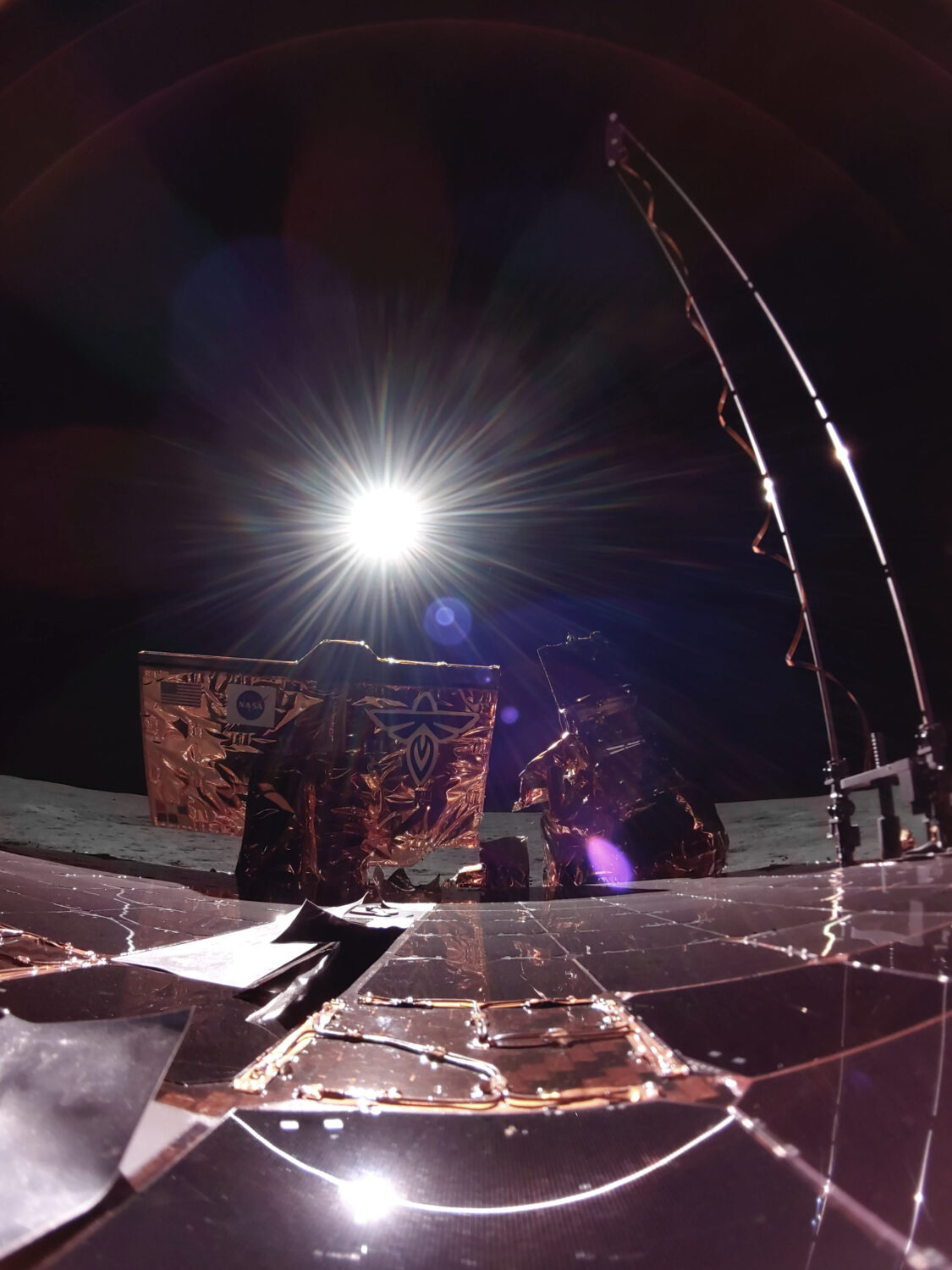
Firefly Aerospace’s Blue Ghost lander managed to catch the eclipse with its wide lens camera, mounted on the lander’s top deck. While the optics weren’t ideal for the situation, they did provide a memorable view.
The first view released shows the glowing ring of a partial solar eclipse, reflected in the lander’s solar panel. Also visible in the foreground are three instruments: the Lunar Magnetotelluric Sounder, the Lunar Environment heliospheric X-ray Imager, and the main X-band antenna.
Firefly Aerospace
“Capturing this footage requires Blue Ghost to rely on its batteries for power rather than its solar panels,” Firefly Aerospace said in a recent update leading up to the eclipse. “So it will be a challenge to image during the darkness of the eclipse, but we hope to capture this incredible phenomenon and share it with the world.” But the solar-powered lander managed to run on battery power during totality, taking an image of a
The solar-powered lander managed it, and the team soon released an image of totality as seen from the Moon. What’s striking is just how much it resembles solar totality seen here on Earth, complete with the "diamond ring" effect, as beads of sunlight shine through valleys on Earth's surface.
Unlike the near-perfect fit with which the Moon covers the Sun as seen from the Earth in our current epoch, the apparent size of Earth from the Moon is three times that of the Sun. This means that, while most of the enigmatic corona is blocked out by our planet's bulk, totality is a more leisurely affair. From its Mare Crisium vantage point, Blue Ghost saw a five-hour long solar eclipse, with totality itself lasting 2 hours and 16 minute.
Almost at the start of totality... @firefly-aerospace.bsky.social's Blue Ghost lander is watching a solar eclipse from Mare Crisium, the dark patch visible on the limb...
— David Dickinson (@astrodave.bsky.social) March 14, 2025 at 2:15 AM
Also visible from the Moon was the "ring of fire," as sunlight from a thousand twilights on Earth streamed thorough our atmosphere. Our air refracted the redder wavelengths of that light into Earth's dark umbral shadow cone. This refraction effect is what provides the Moon with its ruddy hue seen during the total lunar eclipse seen Earthside.
You can see the moonscape take on a crimson tint in this short timelapse taken from Blue Ghost during the eclipse:
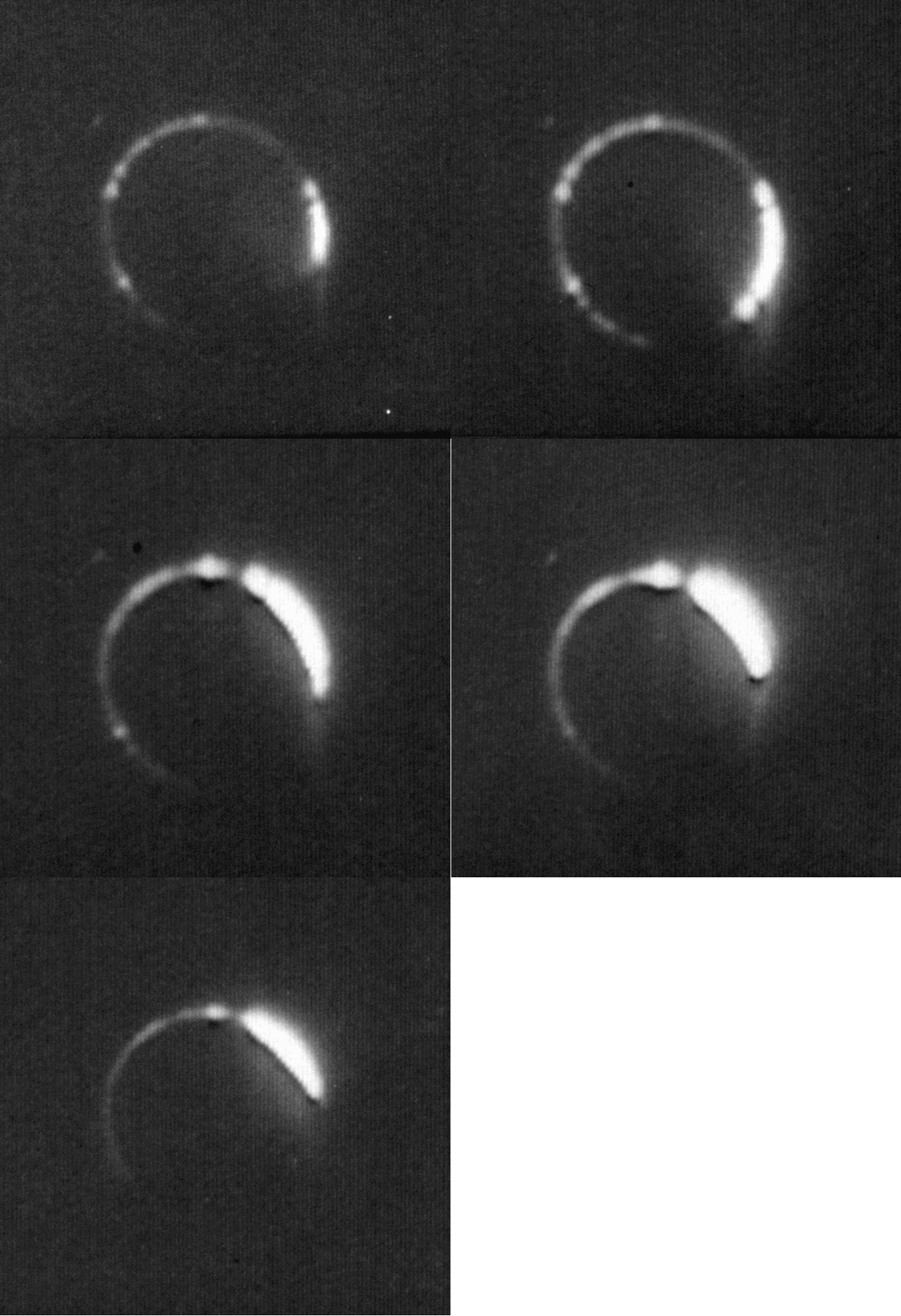
This isn’t the first time a spacecraft has imaged a total solar eclipse from the Moon. NASA’s Surveyor 3 lunar lander was on hand to witness the April 24, 1967, eclipse from its Ocean of Storms landing site. That experiment, though, resulted in only a fuzzy image:
NASA
Mission Update
The eclipse marks the midpoint of Blue Ghost's two weeks of operations on the Moon, and the mission team has been busy. In the past week, all payloads have been successfully deployed. Highlights include the Lunar Instrumentation for Subsurface Thermal Exploration with Rapidity (LISTER), a drill that demonstrated surface operations:
Lunar PlanetVac, a vacuum cleaner-like sample collector, also showed its stuff on the Moon's surface. An instrument similar to Lunar PlanetVac called P Sampler will launch aboard Japan's Mars Moon Exploration (MMX) mission next year. MMX will bring samples back from the Martian moon Phobos, and Lunar PlanetVac could help make it happen.
Perhaps on day, human astronauts will stand on the Moon and witness solar totality in person. At the very least, clouds won’t be an issue.
About David Dickinson
David Dickinson is a freelance science writer, high school science teacher, retired enlisted U.S. Air Force veteran and avid stargazer. He currently resides with his wife Myscha in Bristol, Tennessee. David also writes science fiction in his spare time. He posts as @AstroDave on BlueSky about space news and sky-watching worldwide.








Comments
Rod
March 14, 2025 at 2:41 pm
Outstanding here! I mention viewing Mare Crisium with my telescope in this report when I viewed the lunar eclipse early this morning. The lunar spacecraft and I were looking at each other, how cool is that folks 🙂
https://skyandtelescope.org/astronomy-news/catch-a-spectacular-total-lunar-eclipse-on-march-13-14/
"...The area of Mare Crisium covered by Earth's shadow as total lunar eclipse time approached."
You must be logged in to post a comment.
Mike Howard
March 15, 2025 at 5:59 pm
Total Solar Eclipse—from the Moon.
Several news agencies are reporting an amazing photo taken from the Moon by the rover Blue Ghost that shows an eclipse of the sun complete with the diamond ring effect. The “diamond” is the sun peeking out, but many people are commenting on what makes the “ring”, noting that the earth is nearly 4 times as big as the moon.
The ring we see from earth during solar eclipses is because the moon and sun are both about 0.5° in apparent size. The fit is so close that the surface of the sun is blocked out and we can see the corona and solar prominences all around the moon. But the apparent size of the earth from the moon is about 2°. So this eclipse is more like a half dollar covering a dime. Clearly, the difference is that the earth has an atmosphere and the moon does not.
It is interesting to consider that the atmosphere both scatters light and refracts (bends) light. Scattered light explains things like the brightness and color of the sky, particularly at sunset. In this sense, the ring is like all the sunsets around the world at that moment.
The refraction of light causes an apparent shift in the position of objects, particularly near the horizon. Sailors avoided using stars within 20° of the horizon because the error was unacceptable. At the horizon the bend can be slightly over 0.5°, about the apparent size of the sun or moon. So when their position first goes below the horizon we still see them as just touching the horizon. In this sense, the atmosphere is like a giant convex lens that magnifies the sun. Since the light traveling to the moon would make two trips through the atmosphere, the bending could be even more, allowing the sun to “peek” out from well below the horizon.
So I think that the “diamond” is a persistent feature of solar eclipses on the moon. Perhaps any time the dime is even slightly closer to one edge of the half dollar.
You must be logged in to post a comment.
You must be logged in to post a comment.