 SUNSET:

 0
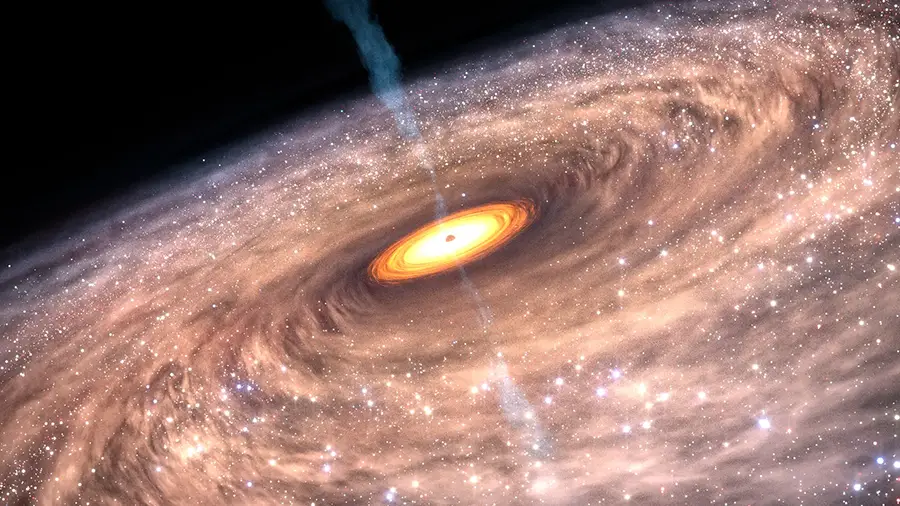
0Astronomers have released the newest list of gravitational-wave detections, almost doubling the number of known signals from colliding black holes.
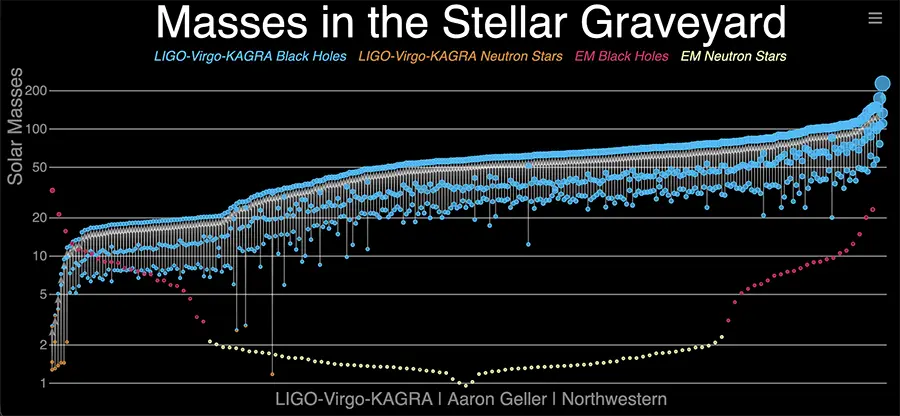
LIGO-Virgo-KAGRA / Aaron Geller / Northwestern
Astronomers have released the newest list of gravitational-wave detections, almost doubling the number of known events in the process. Some 161 new sources are detailed in the recently released Gravitational Wave Transient Catalogue-5.0 (GWTC-5.0), including several record-breakers.
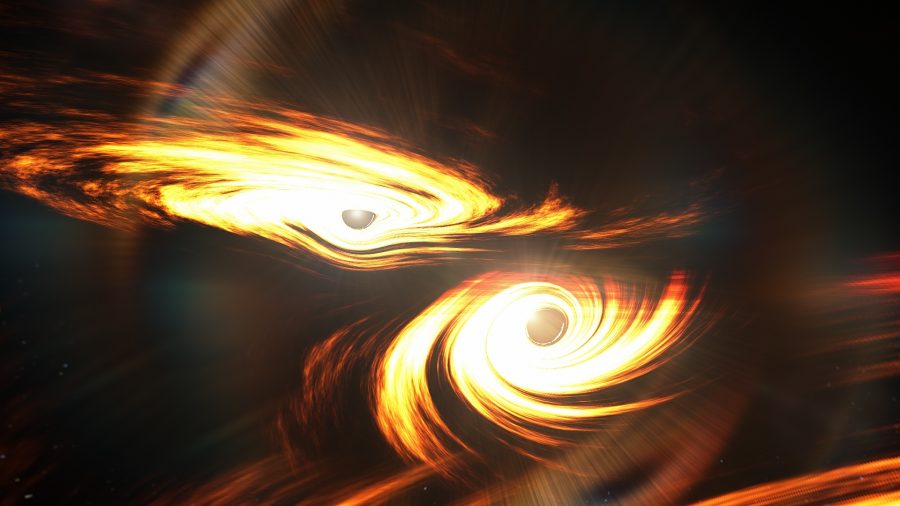
It has been more than a decade since astronomers first detected gravitational waves, ripples in spacetime produced by some of the most violent events in the cosmos. More often than not, the source of such events is colliding black holes, and indeed, so it is for all of the new entries in this catalog. Astronomers captured the signals between April 2024 and January 2025 using the Laser Interferometer Gravitational-Wave Observatory (LIGO) in the United States, the Virgo interferometer in Italy, and the Kamioka Gravitational-Wave Detector (KAGRA) in Japan. The latest results are on the astronomy arXiv preprint server (paper 1 and paper 2).
“We’re now detecting so many of these signals that we're not just learning about individual collisions; it's the astronomical equivalent of uncovering an ancient civilisation,” says team member Daniel Williams (University of Glasgow, UK). “[The] new results are like finding a previously undiscovered hoard, revealing not just individual lives, but the structure of an entire lost world."
For Ian Harry (University of Portsmouth, UK), who was not directly involved in the catalog’s release, there are gems hidden in the new data. “There is a fraction of binary black hole systems where at least one of the black holes appears to have formed from a previous merger of two smaller black holes, as opposed to being formed directly with that mass after a supernova,” he says. This new catalogue provides some of the strongest data yet on these “second-generation” black holes.
LIGO / Caltech / MIT / R. Hurt (IPAC)
Among the technological achievements in this latest data release is the most precisely located gravitational-wave source ever detected. An event known as GW240615 was traced to a patch of sky just six square degrees across - an impressive feat for a signal originating more than 3 billion light years away. Such precision makes it easier for astronomers to identify the galaxies that host these cosmic collisions.
Researchers also reported the first measurement of three distinct vibrational modes of a newly merged black hole, much like the different notes produced by a ringing bell. These vibrations offer a new way to test whether black holes behave exactly as Einstein's general theory of relativity predicts.
“We've also been able to carry out some of the most precise tests of general relativity to date,” says Harry. “We don't yet see any deviations from Einstein's theory, but who knows what the next decade will bring.”
Having so many detections to analyze also means astronomers can utilize gravitational waves to make precise cosmological measurements. “Together, these improvements help us measure the Hubble constant more precisely than ever before, bringing us closer to understanding one of modern physics’ most important open questions,” says Alex Papadopoulos (also University of Glasgow).
The Hubble constant is a measure of the universe’s expansion rate, but in recent years different ways of measuring it have provided conflicting answers. The new estimate from gravitational waves — 71 km/s/Mpc — lies between the two leading measurements and so it doesn’t settle the argument just yet. But GWTC-5.0 improves the precision of the measurement by about 26% relative to the previous catalog, so future editions should continue to narrow the uncertainty further.
With this new data release, it is clear that gravitational-wave astronomy is moving from a fledgling science to a maturing field — one capable of exploring some of the deepest questions about our universe.
About Colin Stuart
Colin Stuart (@colinstuartspace) is an astronomy author and tutor. He also runs a free online astronomy club.



Comments
You must be logged in to post a comment.