 SUNSET:

 1
1In a first, SpaceX places a crewed mission in polar orbit around Earth.

A SpaceX Falcon 9 rocket lit up the skies over the Florida Space Coast Monday night with the last mission of March 2025. Aboard were four crew members with a unique goal: to reach a polar orbit around Earth.
The liftoff occurred at 9:46 p.m. Eastern Time / 13:46 Universal Time from launch pad LC-39A at the Kennedy Space Center. The B1085 stage 1 Falcon 9 booster completed its sixth deployment, landing on the A Shortfall of Gravitas sea platform minutes after launch. Crew Dragon Resilience reached a near-pinpoint 90.01 degree, very slightly retrograde inclination orbit shortly after liftoff, flying nearly due south from the KSC. This marks Resilience’s fourth trip to space.
The mission is expected to last three to five days, with a splashdown return on Friday, April 4th off of the California coast.
The crew are all private astronauts, including Mission Commander Chun Wang (a Chinese-born, Maltese entrepreneur), Vehicle Commander Jannicke Mikkelsen (Norway), Mission Pilot Rabea Rogge (Germany) and Medical Officer and Mission Specialist Eric Phillips (Australia). Each crew member is a seasoned polar explorer and brings their own unique specialty to the mission objective of exploring the polar regions of our planet from low-Earth orbit.

SpaceX
"With the same pioneering spirit as early polar explorers, we aim to bring back new data and knowledge to advance the long-term goals of space exploration," says Chun Wang (Mission Commander) in a recent press release "Much like Fridtjof Nansen (the leader of the original Fram polar expedition), the science and research projects onboard will inform how we prepare for future missions, ultimately helping make space more accessible to us all."
This is SpaceX’s first all-private astronaut mission, composed of first-time space travelers. It follows the Inspiration 4 and Polaris Dawn missions in 2021 and 2024, which featured a combination of NASA astronauts and private crew. ‘Fram’ means ‘forward’ in Norwegian, and the mission takes its name after the legendary Fram polar exploration ship from the 19th century. Fram2 even has a fragment of the original ship on board.
The mission is the first crewed spaceflight launch to attain a true polar orbit. The previous record-holders occurred during the Soviet Union’s early Vostok missions; the 1990 STS-36 Space Shuttle Atlantis mission also reached an orbital inclination of 62 degrees.
The reason missions tend to avoid the poles are twofold: one, it takes much more energy to reach a high-inclination orbit, instead of simply launching eastward and having Earth's rotational velocity help push. Second, higher-inclination flights are also subjected to higher radiation levels. Increased radiation levels also occur on trans-continental airplane flights over polar regions.

NASA
This situation also mimics what astronauts on deep-space missions would experience. To this end, Fram2 has 22 science and research experiments onboard, which will mostly address issues involving biology and physiological issues surrounding human spaceflight. Cinematographer Jannicke Mikkelsen is also documenting the flights over the poles. The spacecraft itself has a forward cupola viewport installed in place of the usual combination nosecone and docking-hatchthat the Crew Dragon uses for arrival at the International Space Station.
Observing auroral activity, as well as the non-auroral Strong Thermal Emission Velocity Enhancement (STEVE) phenomenon is also a stated objective for the mission. The crew should get a good show: not only have we just crossed over the equinox, when auroral activity is enhanced due to the Russell-Mcpherron effect, but also the massive X-class-flare-producing sunspot group, active region AR4048, is rotating earthward this week.
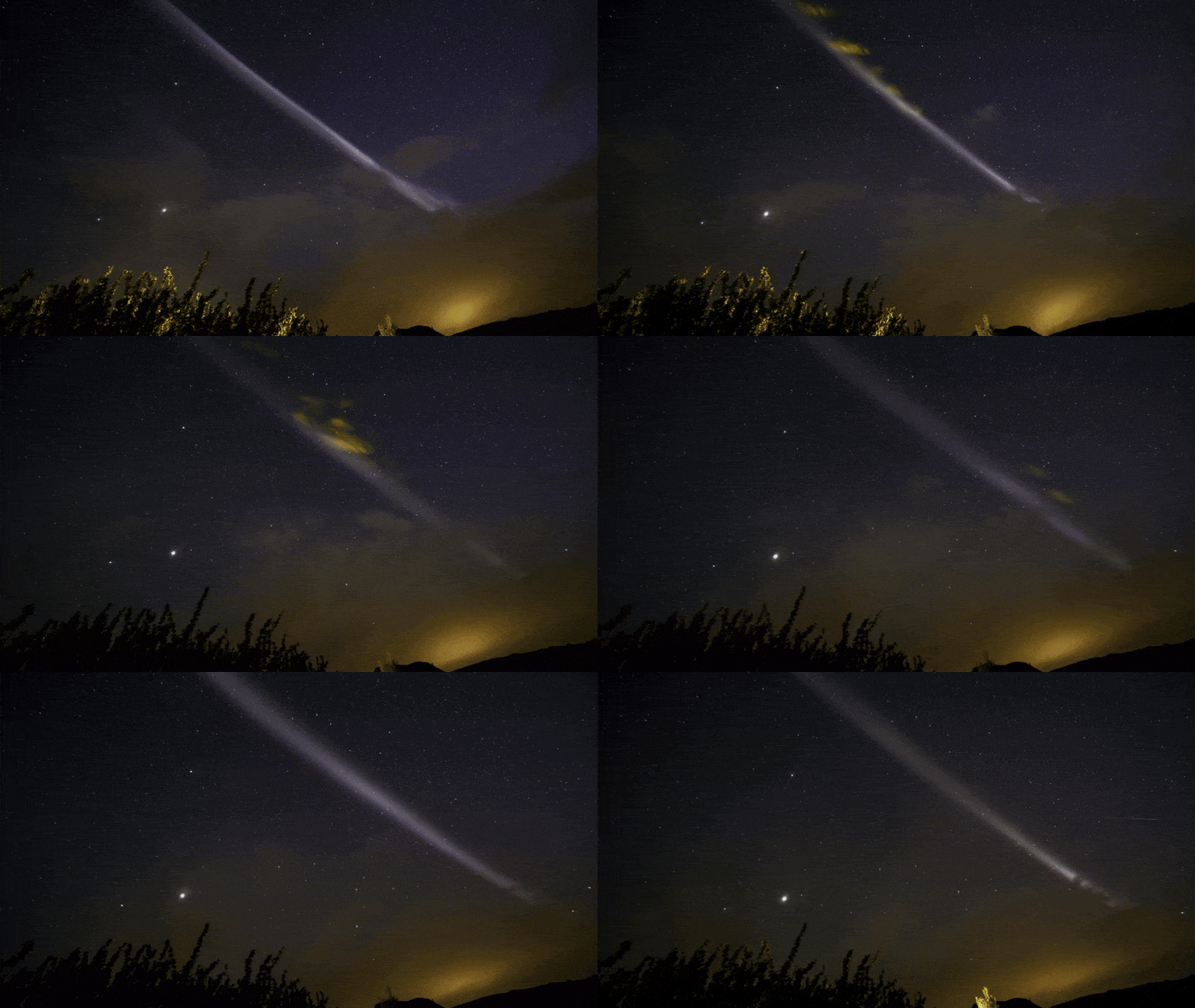
Neil Zeller (used with permission)
Aurora spotters can also help the Fram2 crew over the next few evenings. Specifically, the SolarMaX citizen-science initiative out of the University of Svalbard is looking for ground observations of aurora to alert the Fram2 crew on each pass. To be useful, observers need to submit images with the correct time and location to the Fram2 SolarMaX site.
Space-Track now has Fram2 listed as IDs 2025-066A/63427, and Heavens-Above has a link dedicated to tracking the mission on their front page. Spotting Fram2 in orbit will favor regions above 45 degrees latitude northward — think the northern U.S., Canada, Alaska, Scandinavia, etc.
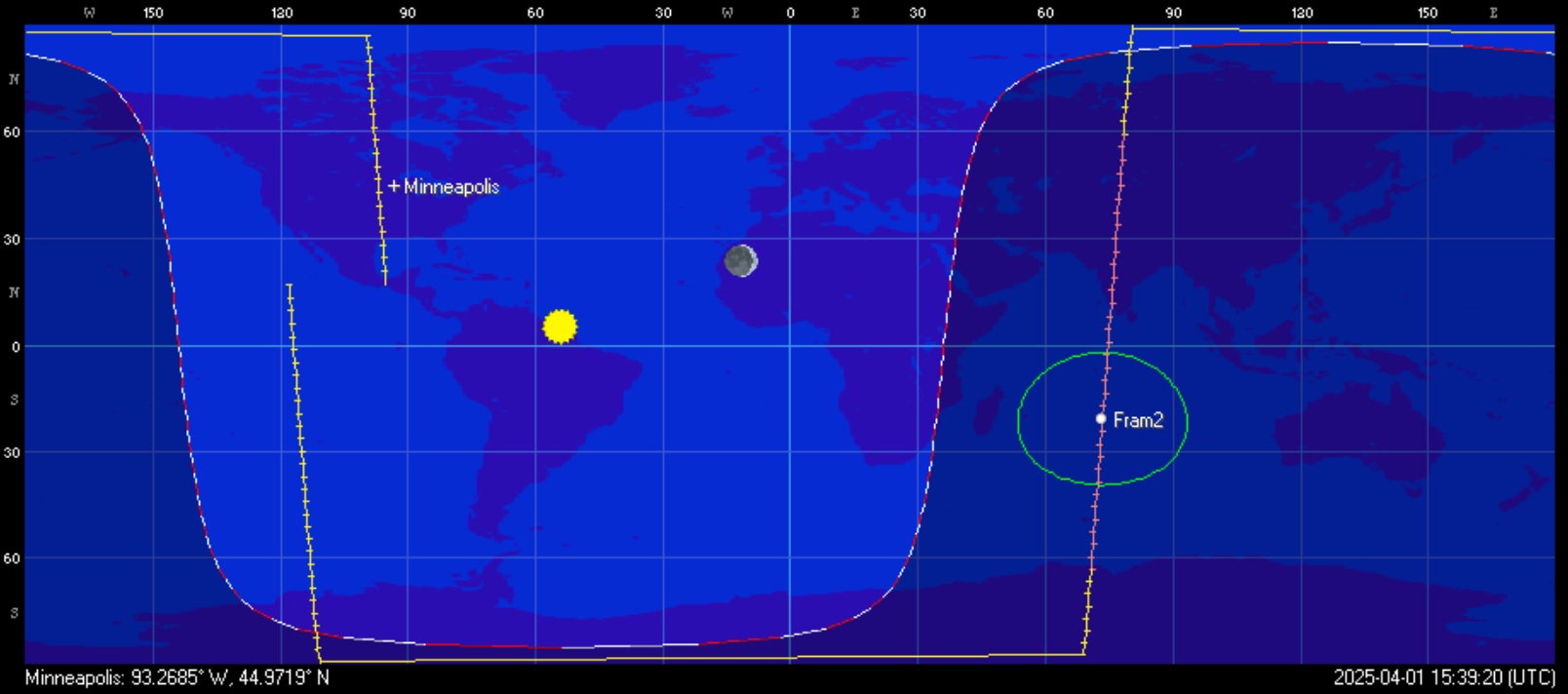
Dave Dickinson / Orbitron
The launch is the latest highlight in a fast-paced year for SpaceX. The company has already completed 37 launches this year. Most of those were Starlink deployments, but the company also sent Firefly Aerospace’s Blue Ghost lander to the Moon as well as the PUNCH and SPHEREx astronomy missions into low-Earth orbits.
It’ll be fun to follow the crew of Fram2 this week as they go on a whirlwind pole-to-pole trek in space.
About David Dickinson
David Dickinson is a freelance science writer, high school science teacher, retired enlisted U.S. Air Force veteran and avid stargazer. He currently resides with his wife Myscha in Bristol, Tennessee. David also writes science fiction in his spare time. He posts as @AstroDave on BlueSky about space news and sky-watching worldwide.


Comments
Enrico the Great
July 15, 2025 at 5:40 pm
Any follow up to this?
You must be logged in to post a comment.
You must be logged in to post a comment.