 SUNSET:

 0
0Images from a unique new space observatory are in, showcasing its potential for exploring the universe near and far.

NASA / JPL-Caltech
On March 11th, a brand-new NASA observatory launched into low-Earth orbit, promising to reveal a new view of the universe. The observatory’s name is a mouthful — Spectro-Photometer for the History of the Universe, Epoch of Reionization and Ices Explorer, or SPHEREx — and its mission is just as ambitious: SPHEREx will record the intensity of light at different wavelengths across the whole sky.
“At its core, it’s an enormously wide field of view, near-infrared survey telescope,” says Phil Korngut (Caltech). As SPHEREx’s instrument scientist, he presented the mission’s first observations during a press conference at the 246th American Astronomical Society meeting in Anchorage, Alaska.
Overall, the telescope will capture more than 450 million galaxies as far as 10 billion light-years away, more than 100 billion stars in the Milky Way, and more than 9 million measurements of interstellar clouds.
Incredibly, every single pixel on every image will have its own spectrum at near-infrared wavelengths ranging from 0.75 to 5 microns. Those spectra encode key information about the objects observed. The survey is planned to last two years, with each all-sky survey lasting around six months, together “producing an enormous spectroscopic dataset,” according to Korngut.
Three Science Goals
SPHEREx circles over Earth’s poles about 14½ times every day, capturing a circular strip of sky. The observatory relies on a series of reaction wheels to shift its position, so that it can take 600 exposures daily.
“We specifically tailored this survey to get at our top three science goals,” Korngut says. Their aims are lofty: determine the conditions for life outside the solar system, understand the history and evolution of galaxy formation, and investigate the earliest epochs of the universe.
SPHEREx will probe these science areas by measuring ice abundances, extragalactic background light, and large-scale structures outlined by galaxies and galaxy clusters. All of these goals require a large-scale spectroscopic survey in the near-infrared, in which astronomers can see through dust that obscures shorter wavelength or peer through time to observe earlier galaxies at longer wavelengths.
Spectral Data Cubes
The telescope uses spectroscopy to capture the intensity of emission at different wavelengths, like a prism splitting light into all colors of the rainbow. SPHEREx captures spectra using two methods stacked together.
First, it contains three filters sitting over its field of view, each of which capture emission at certain wavelength ranges.“SPHEREx also uses what we call a dichroic beam splitter,” Korngut says, “which is an optic that behaves like a mirror at certain wavelengths and a window at others.” By combining the two technologies, the telescope observes six different wavelength ranges in a single field of view, capturing more than 102 different colors in total.
Producing these “spectral data cubes,” as Korngut calls them, will enable unprecedented information on the entire night sky, and it also enables astronomers to identify targets for follow-up observations with the James Webb Space Telescope or other observatories.
Korngut addresses the professional astronomy community in the press conference: “No matter what object you’re interested in, as long as it’s above our detection threshold, we will deliver to you, the community, a spectrum across the near-infrared,” Korngut says.
A Wealth of Information
“As we progress with our operation of the observatory, we have now gotten to the point where we have pieced together full data cubes,” Korngut says. He shows off an image of a star-forming nebula on the outer coastline of the Large Magellanic Cloud
The new views are also useful for studying spread-out structures with faint emission, such as wisps of gas in the space between stars. The wavelengths covered capture emission from interstellar molecules such as carbon-based molecules known as polycyclic aromatic hydrocarbons. “You can just see all of these structures and the molecular and atomic emission just lighting up, and there’s a wealth of information in there,” Korngut says.
He also shares a video of a “swim through [a] data cube.” The region itself is five square degrees in the sky, making up only 2% of what will eventually be the all-sky survey. “There’s all sorts of [spectral] lines which light up at different wavelengths,” Korngut says. As he toggles through different frames, various structures appear and disappear. “We are marching along, filling up the sky with spectroscopy,” he adds.
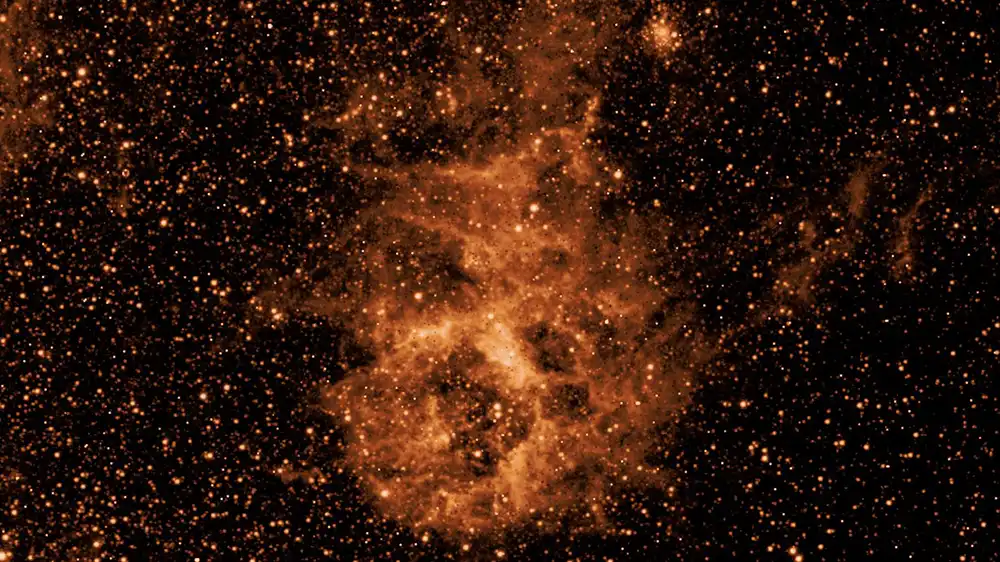
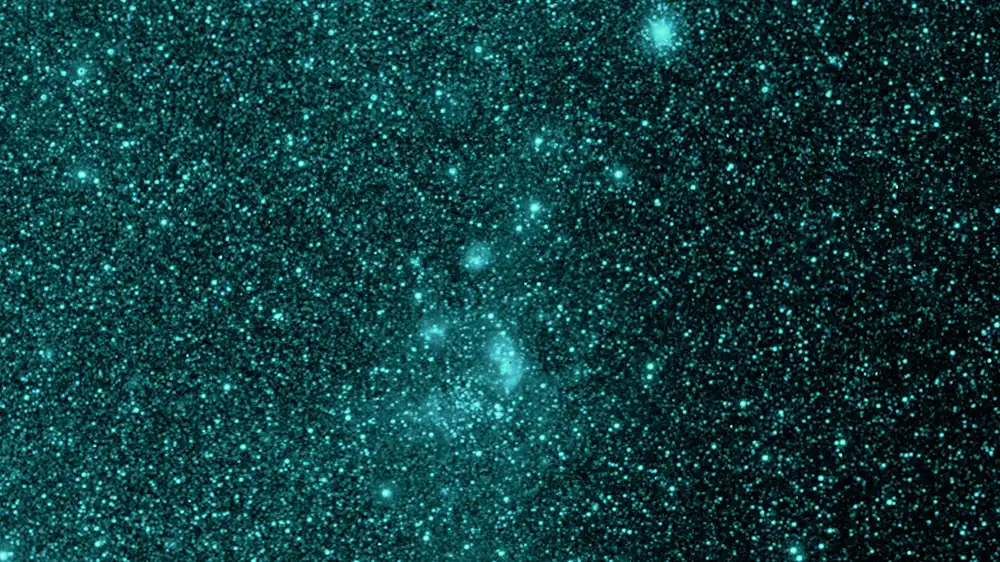
In these images of a planetary nebula, the orange-hued image at 3.29 microns captures emission from soot-like molecules known as polycyclic aromatic hydrocarbons. In the green-tinted image, taken at 0.98 microns, this emission isn't visible and the structure largely disappears.
NASA / JPL-Caltech
The team will begin releasing calibrated images on the NASA/IPAC Infrared Science Archive (IRSA) in early July. “The initial release will contain about a week and a half [of data],” Korngut says, “and then we just roll out the data on a conveyor belt.”
“The discovery space is wide open, so I’m looking to [you, the astronomy community] to go fishing for some amazing spectroscopic results,” Korngut says.
About Arielle Frommer
Arielle Frommer is a science writer for Sky & Telescope and astronomy PhD student at Yale, where she studies exoplanets. In her free time, she enjoys hiking, crocheting, drinking coffee, and reading and writing fiction.


Comments
You must be logged in to post a comment.