 SUNSET:

 0
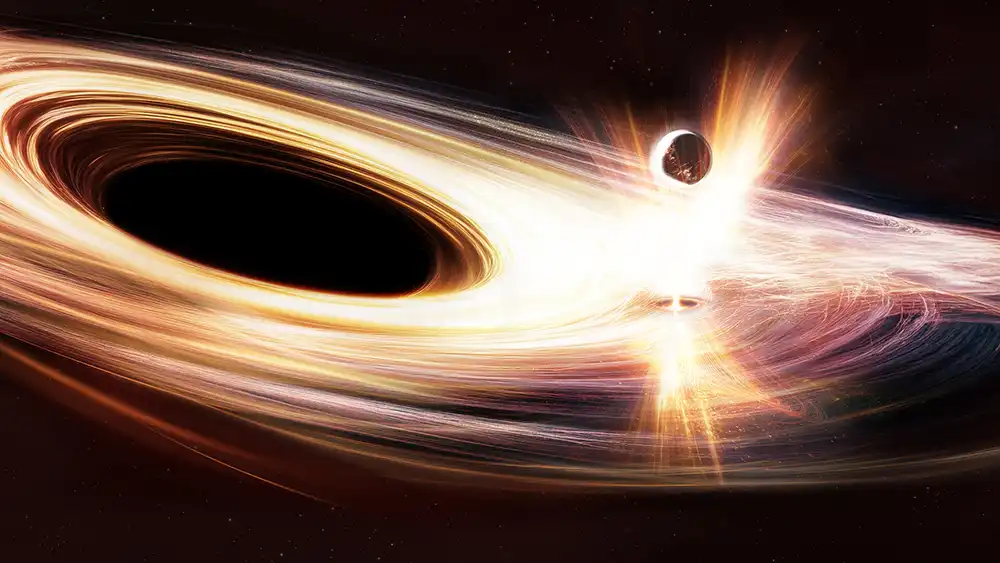
0Regular bursts of high-energy X-rays might herald the birth of active galactic nuclei, the supermassive black holes in galaxy cores.
ESA
A galaxy 330 million light-years away in the Virgo constellation hosts a supermassive black hole with the mass of about a million Suns, and for two decades that black hole has lain dormant. Then, literally overnight, the switch flipped. Astronomers around the world watched as a sudden flow of gas into the maw lit a flickering beacon of light, marking the awakening of an active galactic nucleus (AGN).
Known by the designation bestowed by the automated Zwicky Transient Facility that detected the source, ZTF19acnskyy (nicknamed “Ansky”) brightened at ultraviolet through infrared wavelengths over a few months after its discovery. The kicker came four years later, though, when the newly awakened AGN began to erupt in a regular pattern of extremely energetic X-ray bursts that recurred about every 4½ days. The observing team, led by Lorena Hernández-García (University of Valparaíso, Chile), now thinks that these quasi-periodic eruptions (QPEs) might often herald AGN wake-up calls. The results have been published in Nature Astronomy.
“Ansky is a newborn AGN and we are witnessing the awakening of its massive black hole in real time,” Hernández-García suggests. While other possibilities are plausible — such that the black hole shredded a nearby star — she notes that the initial flickering and brightening don’t match those scenarios as well.
Another key piece of evidence is the lack of broad emission lines in the visible-light spectrum. Broad emission lines form as gas orbiting near the black hole is ionized. If the galaxy’s core suddenly brightened because the black hole had pulled apart a star, and was in the process of swallowing its gas, the formation of broad lines is typical. But if the black hole instead has encountered a large, amorphous gas cloud, the ionized broad-line-emitting region may take longer to form.
“If the hypothesis of the newborn AGN is true, it might be that the broad-line region did not have enough time to form yet,” Hernández-García explains. “We are monitoring the source to search for new broad lines that we expect should appear.”
“But we don’t know how much time it takes to create a broad line region,” she adds. “So this is very exciting!”
Matt Nicholl (Queen’s University Belfast, UK), wasn’t involved in the current study but has previously studied QPE-emitting AGN, and he’s just as excited about this result. “What surprises me, though, is that we haven’t caught so many AGN in the act of turning on, and already we’ve found one with QPEs,” he says, “which either means a big stroke of luck — not uncommon in transient astronomy! — or that these systems quite often have QPEs.”
New flows of gas themselves do not create QPEs. That the eruptions recur semi-regularly on short timescales suggests that they’re coming from an object orbiting the black hole, such as a star or low-mass black hole. Sometimes, the supermassive black hole captures and pulls apart a star — the stellar core that remains is then the object that interacts with the inflowing gas.
In Ansky’s case, though, and perhaps more broadly in the case of newly activated AGN, new flows of inspiraling gas flatten into a disk wide enough that it’s more likely to cross the orbits of stars that were already there. This scenario explains both the slightly longer period of the QPEs in Ansky as well as their extreme energy.
Time will now tell whether Ansky develops swirling clouds of ionized gas that create the expected broad emission lines. Then it will have transitioned all the way from quiescence into a full-blown AGN.
About Monica Young
Monica Young, a professional astronomer by training, is News Editor of Sky & Telescope.


Comments
You must be logged in to post a comment.