 SUNSET:

 0
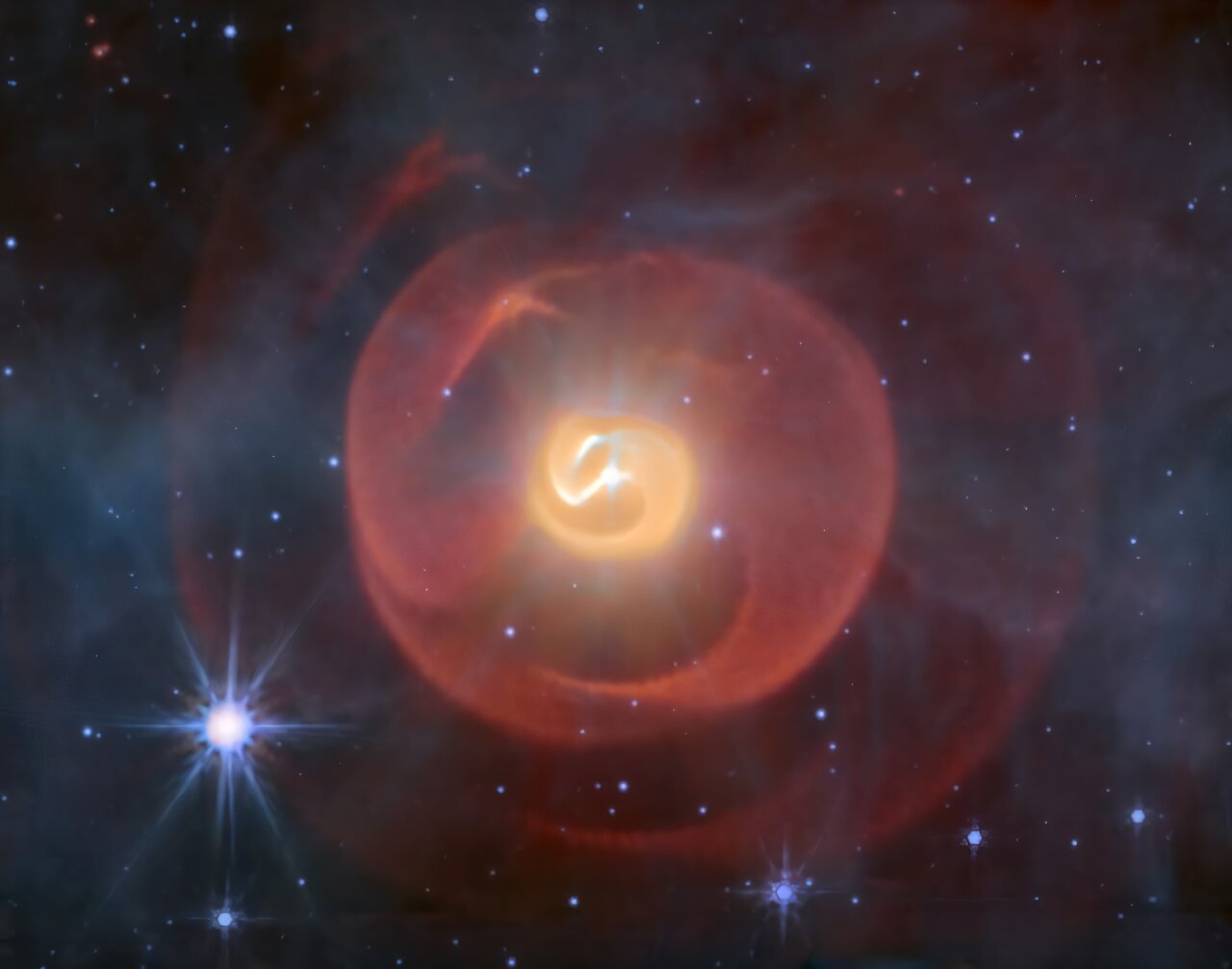
0The James Webb Space Telescope shows intriguing new details in the Apep Nebula, created by the colliding winds of two dying stars.
Han et al. / White et al. / Dholakia; NASA / ESA
The Egyptian serpent god of chaos, Apep, makes for a fitting name of the sinuous nebula shown anew in data from the James Webb Space Telescope. This image captures warm dust encircling two Wolf-Rayet stars, behemoths that are nearing the ends of their lives. For a brief period, about 1,000 years before their final collapse, these massive stars fling away their outer layers of hot gas. As those gaseous layers crash into other gas — such as the winds of a companion — they cool and compress, forming tiny grains of dust. (Though those grains are more like the smoke of a campfire than the dust in your living room corner.)
Just one Wolf-Rayet star, with a regular star for a companion, makes a pinwheel pattern on the sky — take a look at WR104 for an example. But when there are two such stars orbiting each other, their thrown-off gas collides to form the magnificent patterns of Apep, previously imaged by the Very Large Telescope.
Now, the new Webb images reveal that there's another player creating disorder: a third star — a main-sequence O star — in the system, with its own, weaker wind that bites into the larger veils of carbon-rich dust. The images also show that there are multiple shells of dust nested inside one another, spaced in a regular way that suggests a repeating mechanism that's forming the shells.
The inner pair of Wolf-Rayet stars orbit each other on a period of 190 years, the longest period of such a binary in the Milky Way. (The O star is farther out.) "This [orbital period], together with the confirmed classification as a hierarchical triple, cements Apep as a singular astrophysical laboratory for studying colliding winds and the terminal life stages of the most massive star systems," write Ryan White (Macquarie University, Australia) and colleagues.
The observations are discussed in two papers (paper 1, paper 2) and on The Conversation.
About Monica Young
Monica Young, a professional astronomer by training, is News Editor of Sky & Telescope.


Comments
You must be logged in to post a comment.