 SUNSET:

 0
0Two winter stars left their mark long ago on wispy gas clouds near the solar system. Their passage might even have influenced life on Earth.
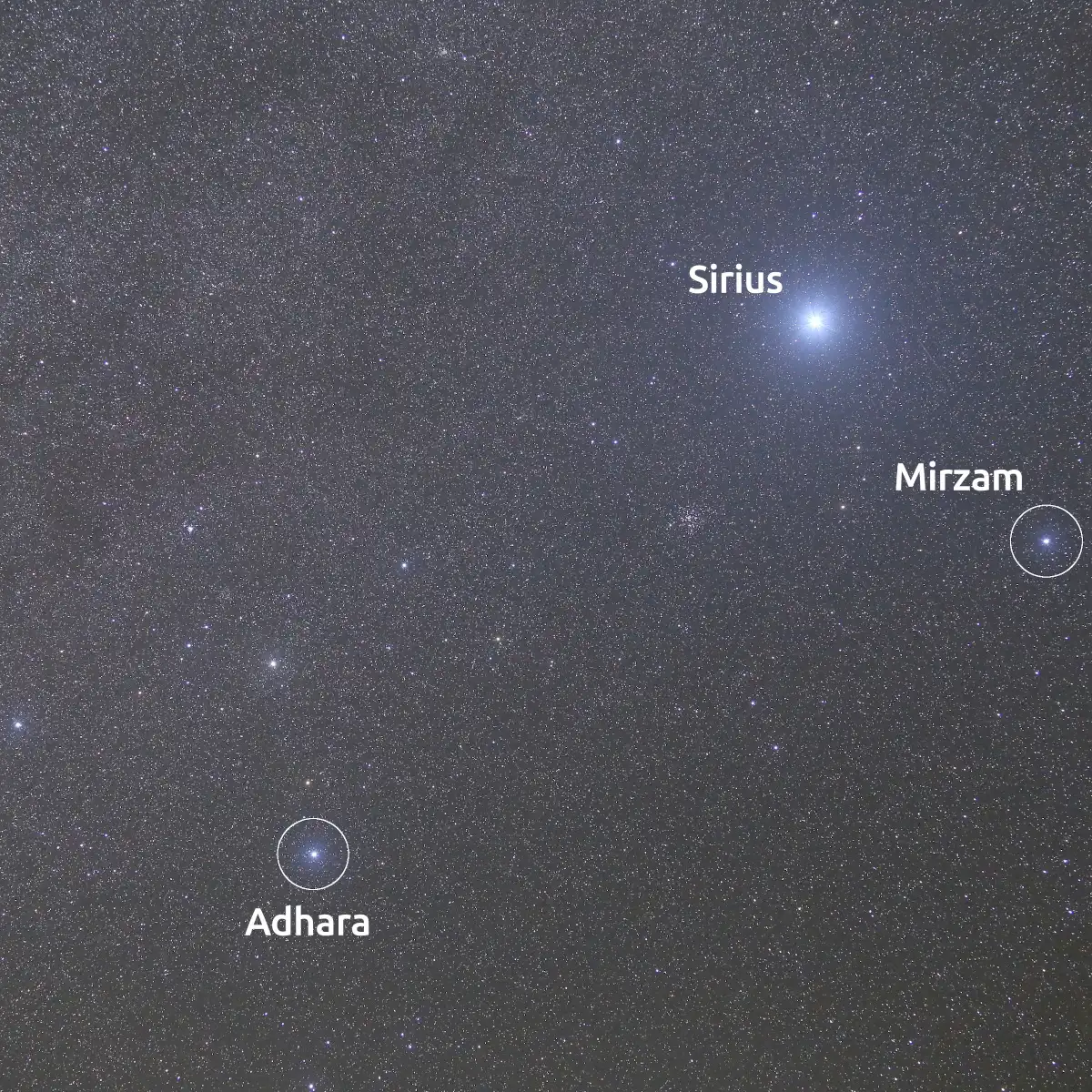
On early winter nights, β and ε Canis Majoris, also known as Mirzam and Adhara, shine as bright stars within the constellation Canis Major, the Great Dog. You’ll find them due south around midnight, local time, marking the front and back paws of the larger of Orion’s two hunting hounds. Wind back 4.5 million years, though, and they would have appeared quite different: Both stars were so close back then that they would easily have outshined Sirius. What’s more, they marked their territory, energizing the gases around the Sun, reports a team led by Michael Shull (University of Colorado) in the December Astrophysical Journal.

NASA / Adler / U. Chicago / Wesleyan
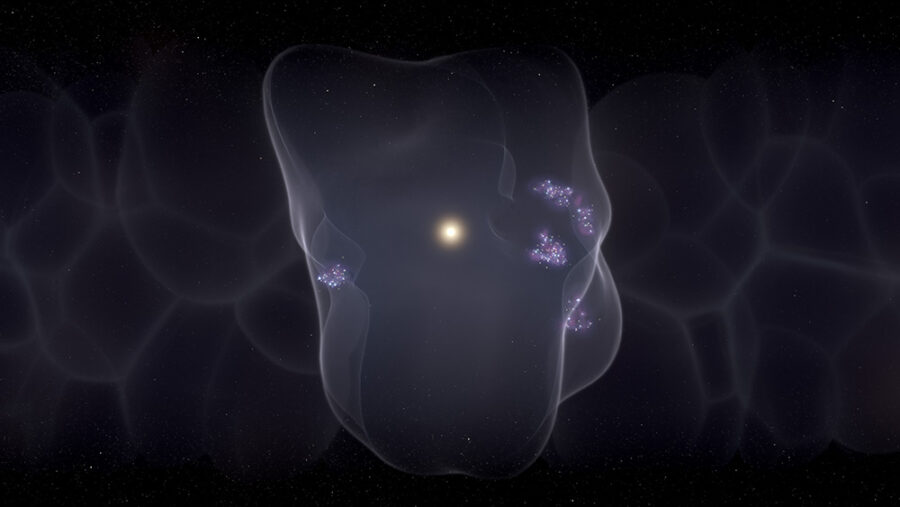
The astronomers looked at β and ε CMa while investigating interstellar clouds around the solar system, focusing on 15 diffuse wisps of mostly hydrogen and helium that extend out to about 30 light-years from the Sun. The clouds are incredibly thin; with only one atom per three cubic centimeters, they’ve roughly five times the density of the Milky Way’s interstellar space. Yet a significant fraction of those atoms are ionized, stripped of their electrons. That’s surprising, because the Sun doesn’t emit enough high-energy radiation to ionize gas that far away.
Already in the 1990s, astronomers identified three white dwarfs — G191-B2B, Feige 24, and HZ 43A — as likely sources of ionizing energy. White dwarfs are compact remnants of low-mass stars that radiate lots of ultraviolet radiation, carrying energy to strip some hydrogen and helium atoms of their electrons.
Center for Astrophysics / Leah Hustak (STScI)
And white dwarfs also aren’t the only sources of energizing radiation. Also in the 1990s, astronomers identified the Local Bubble, a supernova-blown bubble of hot gas that surrounds the local clouds out to a distance of 300 light-years, and which also emits copious ultraviolet photons. So do two giant stars in Canis Major, β and ε CMa.

Till Credner / Wikimedia Commons
Understanding the contributions from these different sources has been difficult: “It’s kind of a jigsaw puzzle, where all the different pieces are moving,” Shull says. “The Sun is moving. Stars are racing away from us. The clouds are drifting away.”
To obtain a clearer picture, Shull and his colleagues calculated the stars’ properties and UV emission using revised distances provided by the Hipparcos satellite (the newer, more precise data provided by Gaia was no help, because both stars are too bright for Gaia’s sensors). They also traced the paths β and ε CMa took over the past millions of years: Today, these stars are more than 400 light-years away; however, 4.5 million years ago, they both came within 30 light-years of the Sun.
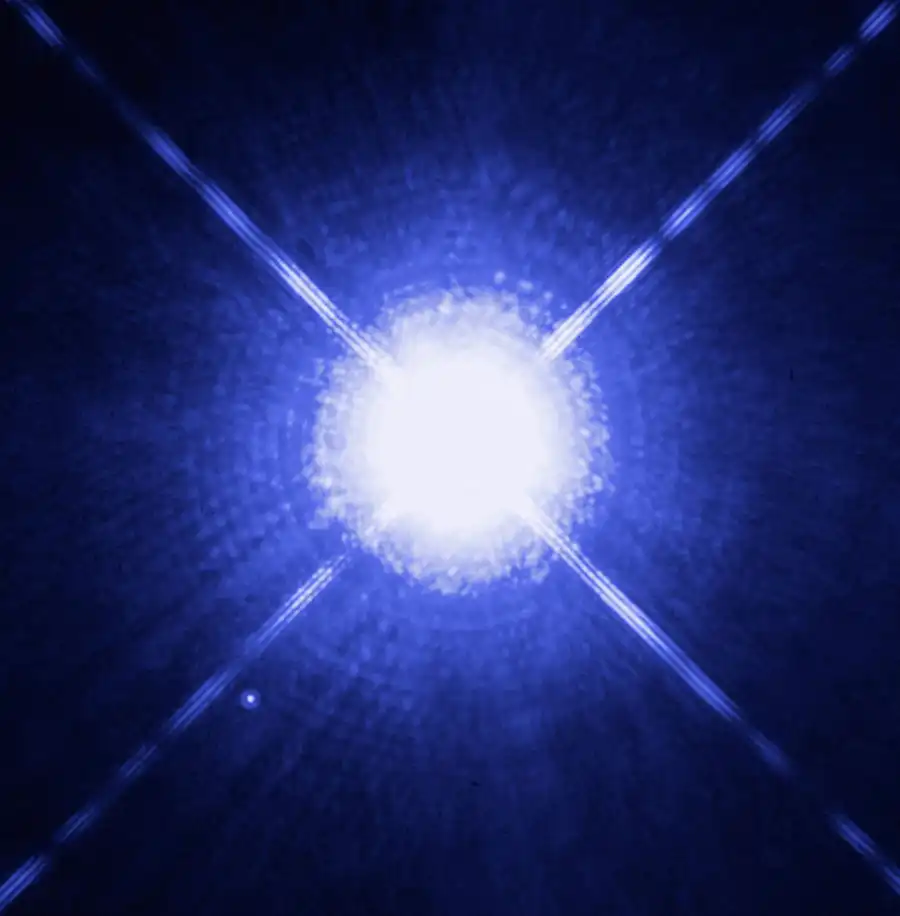
That’s still much farther than Sirius, which is 8 light-years away today. But as B-class stars, β and ε CMa currently churn out 22,000 to 25,000 times the Sun’s luminosity, respectively. For comparison, Sirius A is an A0-class star that shines with just 24 times the Sun’s luminosity. (Sirius B, Sirius A’s white dwarf companion, doesn’t contribute much ultraviolet radiation because it’s older and thus much cooler than the other white dwarfs.) Thus, a few million years ago, β and ε CMa would have shone at around magnitude –4.1, rivaling Venus in the night sky.
NASA / ESA / H. Bond (STScI) / M. Barstow (University of Leicester)
After calculating these two stars’ properties, Shull and his team concluded that during this time, they would have ionized the gas clouds around the Sun just as much as the Local Bubble. The stars thus help explain how that gas has maintained its high levels of ionization.
Jan Hattenbach
The ionization history around our Sun may have implications for our own planet. The local clouds shield Earth from harmful energetic particles zooming around in the larger galaxy — particles that would otherwise destroy ozone in Earth’s upper atmosphere. A weakened ozone layer would in turn let in less energetic, but equally harmful UV radiation from the Sun.
“The changing interstellar environment of the Sun may have an important effect on the evolution of life on Earth,” says Jeffrey Linsky (University of Colorado), who was not directly involved in this work: “The new paper [...] is an important new development in our understanding of the history of the local region of space with potentially important effects on Earth’s climate.”
“Even though this close passage occurred millions of years ago, it is interesting that we can see the implications of it in the properties of our local interstellar medium today,” adds Seth Redfield (Wesleyan University), who was also not involved in the study. “This leads me to wonder: What other interesting past encounters do we have evidence for in our surroundings, and what encounters are in store for our cosmic neighborhood in the future?”


Comments
You must be logged in to post a comment.