 SUNSET:

 0
0The two brightest planets in our sky will be less than 2 degrees apart on June 9th at sunset.
Contacts:
Meg Thacher, Associate Editor
(202) 328-2010 x22182, [email protected]
Edwin L. Aguirre, Associate Editor
(617) 500-6793 x131, [email protected]
Note to Editors/Producers: This release is accompanied by high-quality graphics; see the end of this release for the images and links to download.
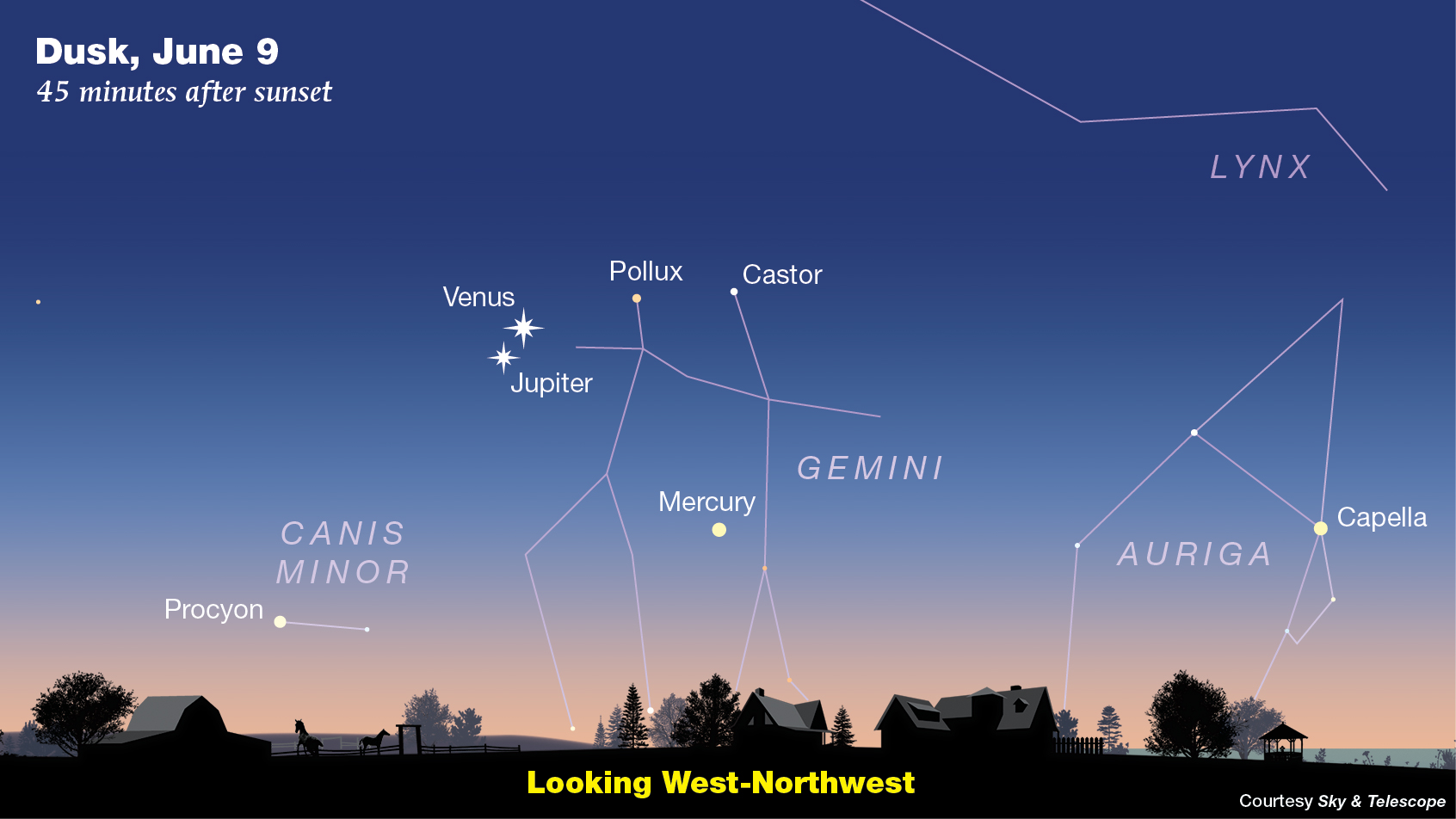
A glorious sunset sight awaits observers on June 9th. Jupiter and Venus, the brightest planets in our sky, will be only 1.6° apart — so close that you can completely cover them with your thumb held at arm’s length. Since the planets orbit the Sun on a common plane, these close approaches, known as conjunctions, occur fairly frequently. The planets and the Moon pass by each other as seen from Earth, in a celestial dance that repeats over time. This particular one on June 9th, though, is fairly special due to the closeness and brightness of its participants.
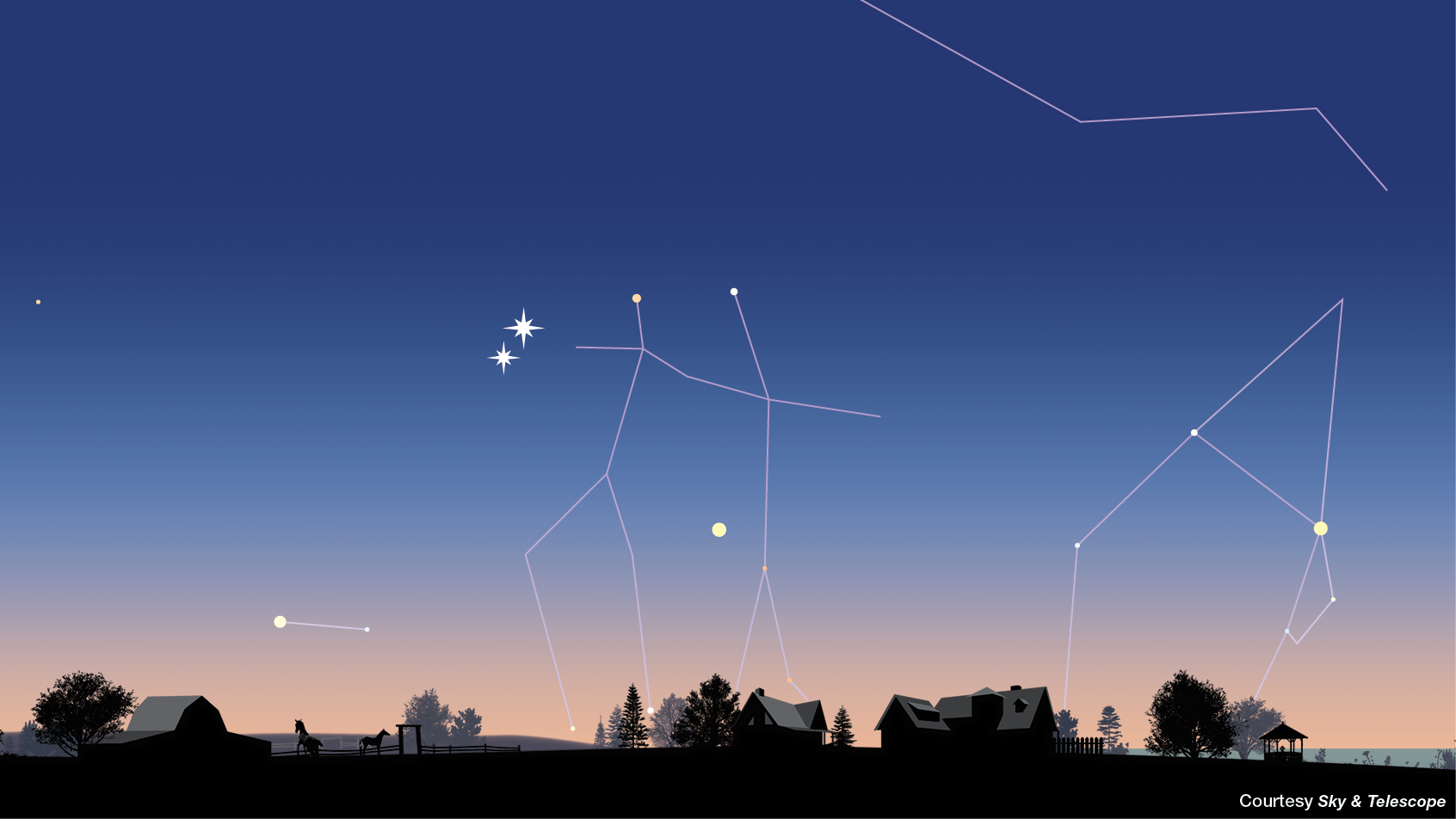
Look for the planetary duo in the western sky about 45 minutes after sunset, which occurs late at this time of year (around 8:30 p.m.) in the Northern Hemisphere. Alert observers will probably spot Venus shortly after the Sun sinks below the horizon. Jupiter and Venus are currently in Gemini to the left of the constellation’s brightest stars, Castor and Pollux. The notoriously hard-to-spot planet Mercury sits to their lower right, just 10° above the horizon; it will appear as the Sun sets and the sky darkens. If you have a clear, unobstructed view to the west-northwest, see if you can catch the tiny planet before it crosses the horizon at 10:17 p.m. local time. Jupiter and Venus set just before 11 p.m.
Zooming in
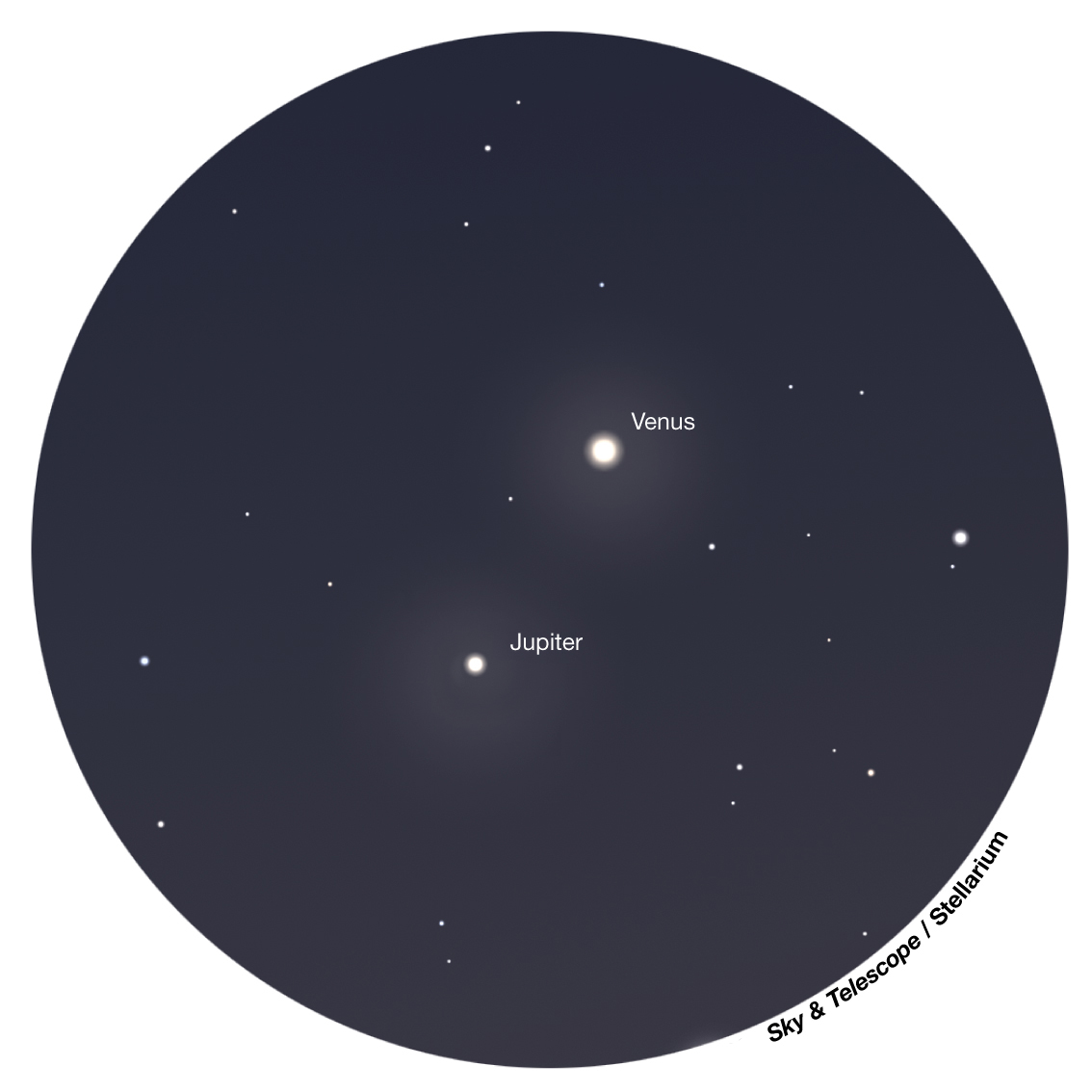
In a small telescope at low power, Jupiter will appear about twice as large as Venus, but that’s due to their relative sizes and distances. Venus, a bit smaller than Earth, is about 180 million km (110 million miles) from us — slightly greater than Earth’s distance from the Sun (called an astronomical unit, or au). Jupiter, 10 times the size of Earth, is about 6 au, or 900 million km, from us. Paradoxically, Venus will be about 1,000 times brighter than Jupiter due to its highly reflective cloud cover and proximity to the Sun. Jupiter appears at magnitude –1.9 and 33 arcseconds in diameter. Venus is a brilliant magnitude –4.0 and 14 arcseconds wide. (An arcsecond is 1/3600th of a degree.)
If your telescope’s aperture is 50 mm (2 inches) or larger, you may be able to spot three of Jupiter’s four brightest moons: Io on one side, Europa and Callisto on the other. (Ganymede will be hiding behind the giant planet at the time.) However, the planets’ brightness will prevent binocular observers from seeing Venus’s gibbous (oval-shaped) phase or the signature light and dark stripes of clouds in Jupiter’s upper atmosphere.
If the forecast calls for cloudy skies on the night of the 9th, don’t despair! This close approach is the culmination of a 10-day planetary do-si-do. Jupiter and Venus will remain within 5° of each other (half the size of a fist held at arm's length) from June 4th to June 14th. Look for the waxing crescent Moon joining the mix on June 16th and 17th. They'll line up beautifully and serve as a pointer to Mercury before it disappears from view. As a result of its orbital motion and ours, Jupiter sinks toward the horizon each day and will be hidden in the Sun's glare throughout July. Venus, on the other hand, has been ascending and brightening. It will dominate the western sky for most of the summer.
Graphics
Sky & Telescope is making the illustrations below available to editors and producers. Permission is granted for nonexclusive use in print and broadcast media, as long as appropriate credits (as noted) are included. Web publication must include a link to SkyandTelescope.org.
Credit: Sky & Telescope / Stellarium
Credit: Sky & Telescope

