 SUNSET:

 0
0September’s night sky features the iconic Summer Triangle, almost directly overhead at nightfall, and a newcomer to the evening sky: the planet Saturn, which will rise in the east not long after sunset. Get tips for viewing these and lots more stargazing info by downloading this month’s Sky Tour podcast!

Listen Here:
Podcast: Play in new window | Download
Subscribe: Apple Podcasts | Spotify | Email | RSS | More
Check out the illustrated version of this podcast on Sky & Telescope’s YouTube channel!
Summer might be ending astronomically, but most of summer’s stars can still be seen. Anyone heading outside some nice September evening will be greeted by an amazing array of stars overhead. Topping the list is the trio of bright stars collectively called the Summer Triangle. Finding them is easy, even if your backyard is hopelessly awash with light pollution.
Lift your gaze up, way up, to find a bright star that’s almost directly overhead. That’s Vega. The triangle’s second corner is to the south of Vega, by about three times the width of your clenched fist. That’s Altair, the main star is the constellation Aquila, the Eagle. The third star, Deneb, is about two fists from Vega toward east. It marks the tail of a graceful swan, the constellation Cygnus.
Modern astronomers have assigned Vega a magnitude of 0.0 — but did you know that there’s another star in the evening sky even brighter than Vega? To learn its location and identity, listen to this month’s Sky Tour episode!
Sky & Telescope
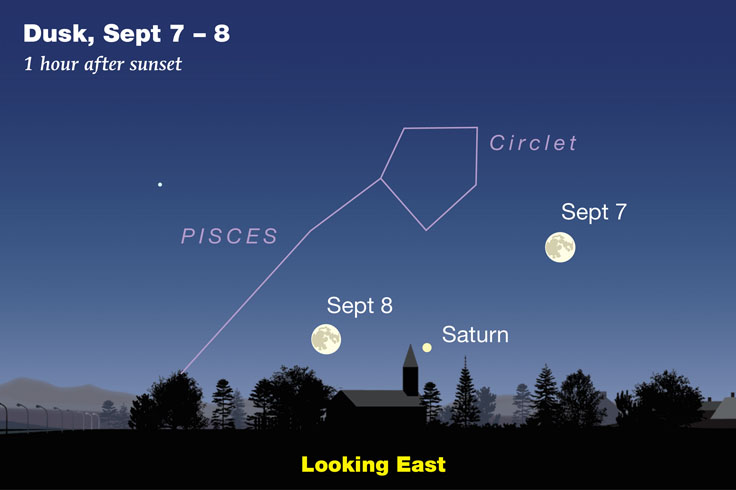
Planet-wise, most of the action is in the morning sky before dawn, with Venus and Jupiter continuing to dazzle over the eastern horizon. But another bright planet — Saturn — is about to make its debut in the evening sky. On the night of September 20–21, Saturn reaches opposition, appearing opposite the Sun in our sky. It rises not long after sunset and will be slowly cross the sky all night long. It will rise earlier week by week.
There’s lots more to see on September evenings. So to get a guided tour of “what’s up” in the next few weeks, check out our fun and informative Sky Tour podcast!
About J. Kelly Beatty
J. Kelly Beatty, S&T Senior Editor, joined the staff of Sky Publishing in 1974 and specializes in planetary science and space exploration. Learn more about him here.


Comments
You must be logged in to post a comment.