 SUNSET:

 0
0This month we’ll look for tiny bits of Halley’s Comet; track down four planets; take stock of bright stars in the late-spring sky; and use the constellation Leo to learn what astronomers call all the stars that don’t have names. So grab your curiosity, and come along on this month’s Sky Tour episode.

Listen Here:
Podcast: Play in new window | Download
Subscribe: Apple Podcasts | Spotify | Email | RSS | More
Listen to an illustrated version of this podcast on Sky & Telescope’s YouTube channel.
During early May, Earth crosses the orbit of Comet Halley (1P), and when that happens we run into rocky grit shed by the comet centuries ago. The bits that slam into our atmosphere are tiny, but they arrive at 150,000 miles per hour! All that kinetic energy gets dissipated high in the atmosphere as brief “shooting stars.” Astronomers call this annual cosmic light show the Eta Aquariid meteor shower, because these crumbs from Halley’s Comet appear to be plow into us from the direction of the constellation Aquarius. To enjoy this shower you’ll need to get up a couple of hours before dawn on the mornings of May 5th or 6th. With luck, you’ll see a meteor every 5 to 10 minutes.
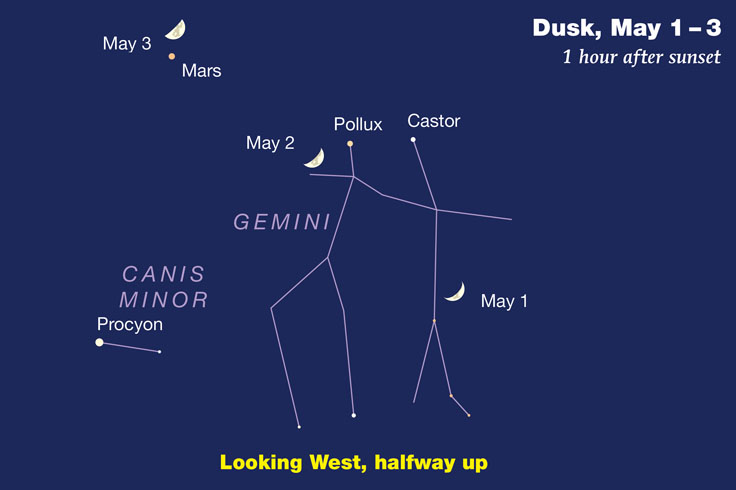
In the evening sky, Jupiter is moving lower in the west, and Mars is well to the upper left of Jupiter, about halfway to overhead and sitting in a somewhat isolated patch of sky without any other bright stars close by. A fat crescent Moon makes a dramatically close pass by Mars on the evening of May 3rd.
Sky & Telescope
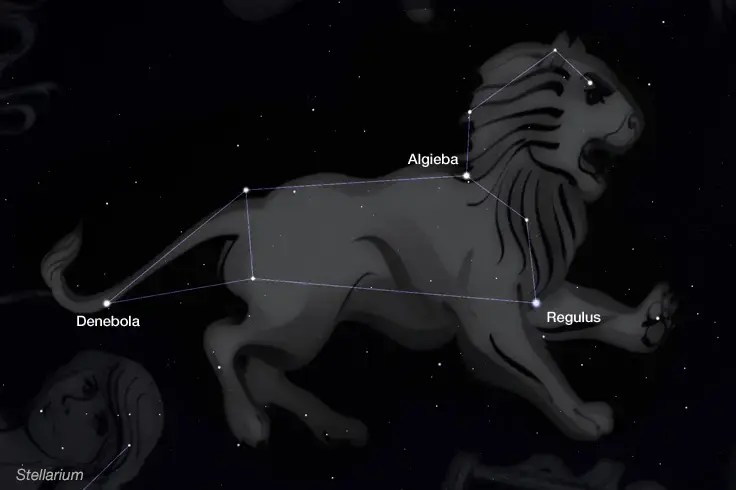
This month’s Sky Tour episode uses stars in the constellation Leo, the Lion (almost directly overhead each evening) to explore star names. The brightest stars in the sky have names that have evolved over the last two millennia. For example, Regulus, the anchor star in Leo, is Latin for “little king.” The star to its left, at the lion’s back end, is called Denebola, a short form of the Arabic words for “the lion’s tail.” Just above Regulus is Algeiba, Arabic for “the lion’s mane.” Well, that all makes sense!
But what about all the ones that don’t have common names? How do astronomers identify one from another? Due to its prominence, Regulus is also called the “Alpha” star in Leo. In the mid-1500s, German astronomer Johann Bayer assigned a Greek letter to every bright star in a given constellation. The brightest was Alpha, the next brightest Beta, and so forth. So Regulus is also known as Alpha Leonis (the constellation’s genitive form). Denebola is Beta Leonis, and Algeiba is Gamma Leonis.
Stellarium
There’s another widely used scheme for identifying stars that uses numbers. It’s used to identify 2,554 stars — and only for the ones visible from Great Britain! Why is that? You’ll have to listen to Sky Tour to find out!
Of course, this month’s Sky Tour podcast is chock full of entertaining celestial tidbits like this. And every episode helps thousands of loyal listeners enjoy “what’s up” in the starry sky. So why not give it a try? Grab this month’s episode, go out on a clear May evening, and get a guided tour of this month’s celestial highlights!
About J. Kelly Beatty
J. Kelly Beatty, S&T Senior Editor, joined the staff of Sky Publishing in 1974 and specializes in planetary science and space exploration. Learn more about him here.


Comments
You must be logged in to post a comment.