To celebrate New Horizons' successful launch, participating scientist Henry Throop decorated his freshly shaven head with a realistic Pluto map (artwork provided by deputy project scientist Leslie Young). Charon orbits to scale beside Throop's head. Dan Durda
Get Articles like this sent to your inbox
By submitting this form, you are consenting to receive marketing emails from: Sky & Telescope, 1667 K Street NW, Suite 800, Washington, DC, 20006, https://aas.org/. You can revoke your consent to receive emails at any time by using the SafeUnsubscribe® link, found at the bottom of every email. Emails are serviced by Constant Contact
Thanks to NASA's New Horizons spacecraft, we're about to see Pluto up close for the first time. Here are a few snapshots of the scientists and engineers who'll make it possible.
After a 9½-year, 4½-billion-mile journey, NASA's New Horizons spacecraft is on the threshold of its historic encounter with Pluto and its moons. The spacecraft will be its closest to Pluto, just 12,500 km (7,800 miles) away, at 11:49:58 Universal Time on July 14th.
Emily Lakdawalla's 8-page preview article in the July issue provides all the info you'll need to prepare for the flyby, and don't forget to read principal investigator Alan Stern's exclusive commentaries on the mission for SkyandTelescope.com.
Of course, it's taken hundreds of scientists and engineers to get New Horizons to its destination, and we thought you might enjoy seeing a few snapshots of them hard at work. If you want to see more images about the New Horizons mission, Pluto, and related topics, visit Pluto Picture of the Day.
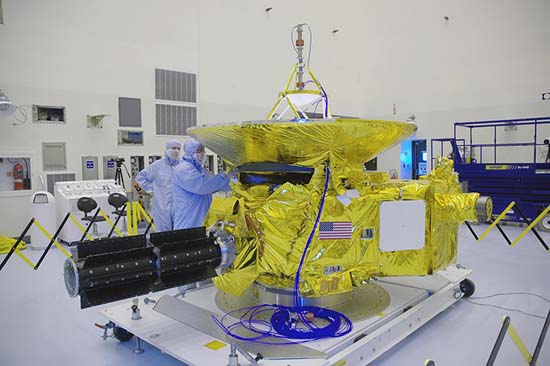
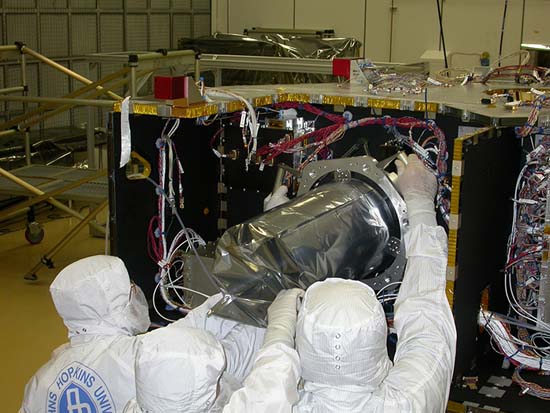
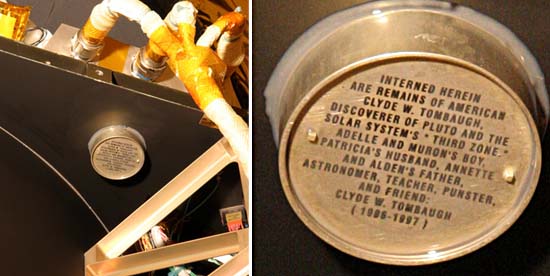
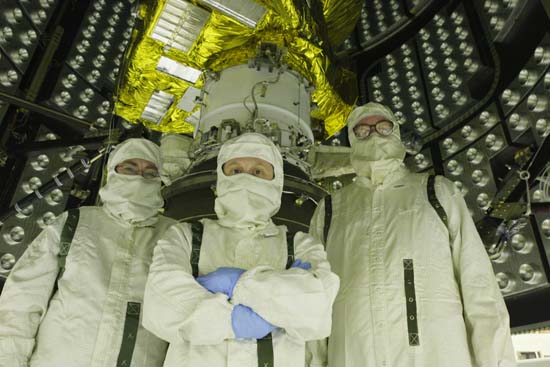
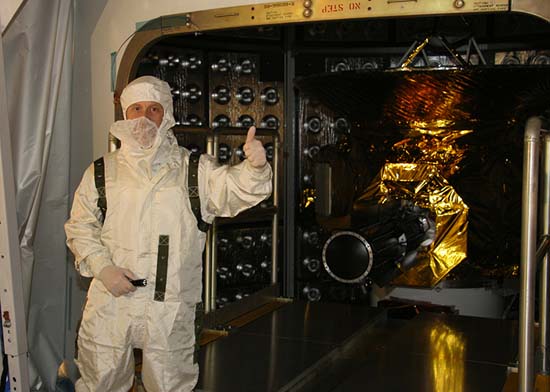
Technicians look over the New Horizons spacecraft in the clean room at Kennedy Space Center's Payload Hazardous Servicing Facility prior to its launch in January 2006. NASALORRI, short for Long Range Reconnaissance Image, provides the spacecraft with powerful telescopic eyesight. It consists of a telescope with an 8.2-inch (20.8-cm) aperture and a 2.63-m focal length. NASAA small container of ashes from Clyde Tombaugh, who discovered Pluto in 1930 and died in 1997, is affixed to the inside, upper deck of the spacecraft. Universe TodayFrom left: Assurance engineer Jim Kinnison, principal investigator Alan Stern and project manager Glen Fountain pose under the New Horizons spacecraft at Kennedy Space Center in late 2005, not long before it was enclosed in its protective fairing and moved to the launch site. Johns Hopkins University Applied Physics Laboratory
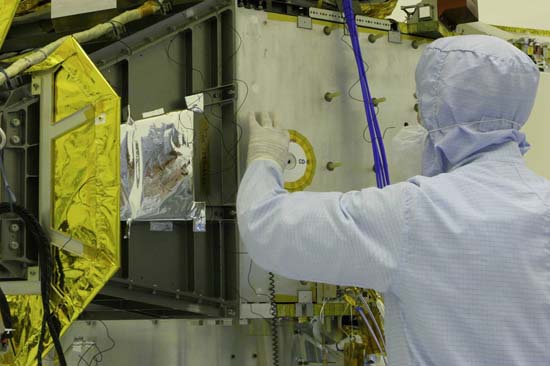
A technician installs a compact disc, containing the names of 434,738 people who signed up to send their names to Pluto, onto the exterior of the New Horizons spacecraft. NASA / JHU-APL / Southwest Research Inst.
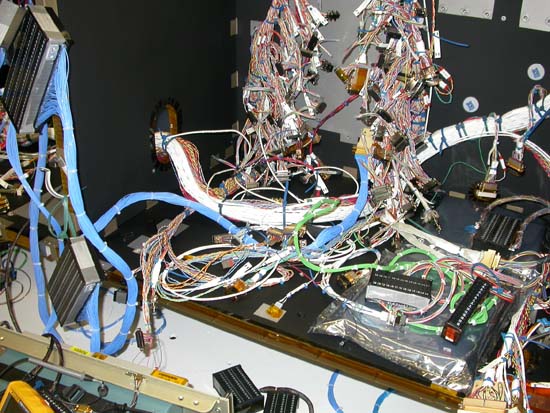
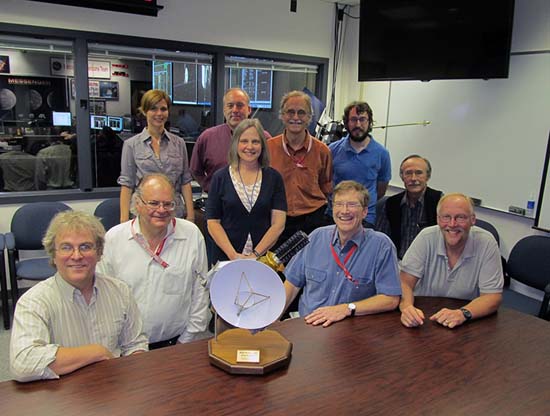
In the last photograph of New Horizons before it departed for Pluto, principal investigator Alan Stern gives a "thumbs up" signal just after spacecraft's radioisotope thermoelectric generator (RTG) was installed and armed while on the launch pad on January 13, 2006. NASA / JHU-APL / Southwest Research Inst.Patsy Tombaugh, the widow of Clyde Tombaugh, chats with Jane Spencer at a party before the spacecraft's launch in January 2006. (Patsy died in 2012 at the age of 99.) John SpencerThe New Horizons mission operations team cheers as the Pluto-bound spacecraft lifts off from Cape Canaveral Air Force Station, Florida, on January 19, 2006. Johns Hopkins University Applied Physics LaboratoryTo celebrate New Horizons' successful launch, participating scientist Henry Throop decorated his freshly shaven head with a realistic Pluto map (artwork provided by deputy project scientist Leslie Young). Charon orbits to scale beside Throop's head. Dan DurdaFollowing tradition, the contingency plans developed to deal with a possible rocket failure are ceremonially burned 6 hours after New Horizons' successful launch on January 19, 2006. John SpencerAll these wires connect different instruments and electronics aboard the New Horizons spacecraft, so that their results can be sent back to Earth via the main radio antenna. LASPNew Horizons mission scientists gathered for a team meeting on January 19, 2015. Rather than being assigned to specific instruments, these researchers belong to six groups that will tackle specific areas of study (such as surface composition or geology). NASA / JHU-APLAlice Bowman (center) is New Horizons' Mission Operations Manager (or "MOM"). Last September she posed for a picture with members of the missions hazard team, tasked with ensuring that the spacecraft survives its encounter with Pluto. Pictured, left to right, are: Doug Hamilton, Tod Lauer, Marina Brozovic, David Kaufmann, Alice Bowman, John Spencer, Hal Weaver, Simon Porter, Bob Jacobson, and Mark Showalter. John Spencer
Mark Showalter, New Horizons science team member and discoverer of Pluto's moons Styx and Kerberos, checks out some data in 2011. Project scientist Hal Weaver is in the background. John Spencer
Pluto's atmosphere is 97% nitrogen. But it's so cold there, with surface temperatures around 44 K (–229°C), that nitrogen (melting point: 63.15 K or –210°C) can exist as solid ice on its surface. www.periodictable.ruNew Horizons is not the first mission proposed to visit Pluto. Scientists have been pushing NASA to go there since 1990. NASA / JHU-APL / Southwest Research Inst.
To provide the best experiences, we use technologies like cookies to store and/or access device information. Consenting to these technologies will allow us to process data such as browsing behavior or unique IDs on this site. Not consenting or withdrawing consent, may adversely affect certain features and functions.
Functional
Always active
The technical storage or access is strictly necessary for the legitimate purpose of enabling the use of a specific service explicitly requested by the subscriber or user, or for the sole purpose of carrying out the transmission of a communication over an electronic communications network.
Preferences
The technical storage or access is necessary for the legitimate purpose of storing preferences that are not requested by the subscriber or user.
Statistics
The technical storage or access that is used exclusively for statistical purposes.The technical storage or access that is used exclusively for anonymous statistical purposes. Without a subpoena, voluntary compliance on the part of your Internet Service Provider, or additional records from a third party, information stored or retrieved for this purpose alone cannot usually be used to identify you.
Marketing
The technical storage or access is required to create user profiles to send advertising, or to track the user on a website or across several websites for similar marketing purposes.
To provide the best experiences, we and our partners use technologies like cookies to store and/or access device information. Consenting to these technologies will allow us and our partners to process personal data such as browsing behavior or unique IDs on this site and show (non-) personalized ads. Not consenting or withdrawing consent, may adversely affect certain features and functions.
Click below to consent to the above or make granular choices. Your choices will be applied to this site only. You can change your settings at any time, including withdrawing your consent, by using the toggles on the Cookie Policy, or by clicking on the manage consent button at the bottom of the screen.
Functional
Always active
The technical storage or access is strictly necessary for the legitimate purpose of enabling the use of a specific service explicitly requested by the subscriber or user, or for the sole purpose of carrying out the transmission of a communication over an electronic communications network.
Preferences
The technical storage or access is necessary for the legitimate purpose of storing preferences that are not requested by the subscriber or user.
Statistics
The technical storage or access that is used exclusively for statistical purposes.The technical storage or access that is used exclusively for anonymous statistical purposes. Without a subpoena, voluntary compliance on the part of your Internet Service Provider, or additional records from a third party, information stored or retrieved for this purpose alone cannot usually be used to identify you.
Marketing
The technical storage or access is required to create user profiles to send advertising, or to track the user on a website or across several websites for similar marketing purposes.
 SUNSET:

 0
0









Comments
You must be logged in to post a comment.