 SUNSET:

 0
0Due to the vast distances separating deep-sky objects from Earth, few show obvious changes on scales shorter than a human lifetime. But there are exceptions.
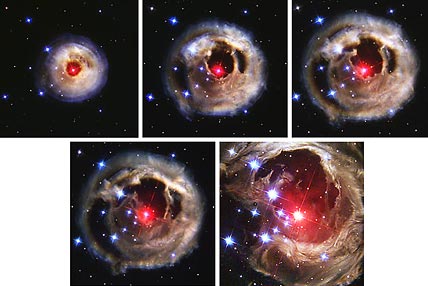
The Hubble Space Telescope”™s Advanced Camera for Surveys captured these images (approximately true color) of the expanding light echo around V838 Monoc-erotis. We see an expanding pulse of light from the early-2002 outburst reflecting off nearly motionless dust clouds and shells.
When stars explode or flair, their energy and/or cast-off material can create changes visible thousands of light-years away. For instance, the star V838 Monocerotis flared in 2002. The flash is lighting up a surrounding cloud of gas and dust, giving the appearance of a ring of material expanding at the speed of light. See a discussion of this "light-echo" effect here.
In the case of V838 Mon, it's just the light — the "flash front" — that's expanding; the lit-up material is actually standing still (more or less). Not so with supernovae, which are so energetic that they expel their outer layers at a good percentage of the speed of light.
The Crab Nebula, discussed on page 31 of SkyWatch 2012, is a good example. It's the cast-off material from a supernova seen in 1054. It has been photographed now for almost 10% of its entire life, and not surprisingly, it has expanded quite a bit over that period. See, for instance, this Astronomy Picture of the Day. The Chandra X-ray telescope has also produced some time-lapse videos of matter swirling furiously around the neutron star at the heart of the Crab.
Click here to find other videos and images for SkyWatch 2012.

Comments
You must be logged in to post a comment.