 SUNSET:

 0
0This month’s episode showcases the stars and planets visible on April evenings. We’ll explore full-Moon quirks; spot Venus and Jupiter after sunset; learn about Gemini, the celestial twins; and hunt for meteors toward month’s end. So grab your curiosity, and come along on this month’s Sky Tour.

Listen Here:
Podcast: Play in new window | Download
Subscribe: Apple Podcasts | Spotify | Email | RSS | More
Check out the illustrated version of this podcast on Sky & Telescope’s YouTube channel!
April is one of the better months for stargazing here in the Northern Hemisphere. Spring evenings are generally pleasant, and the bugs haven’t taken control — yet! Even with daylight time in effect, evening twilight comes fairly early. You’ll find that the Sun sets between 7:30 and 8:00 during most of this month, and by 9:00 p.m. it’s good and dark.
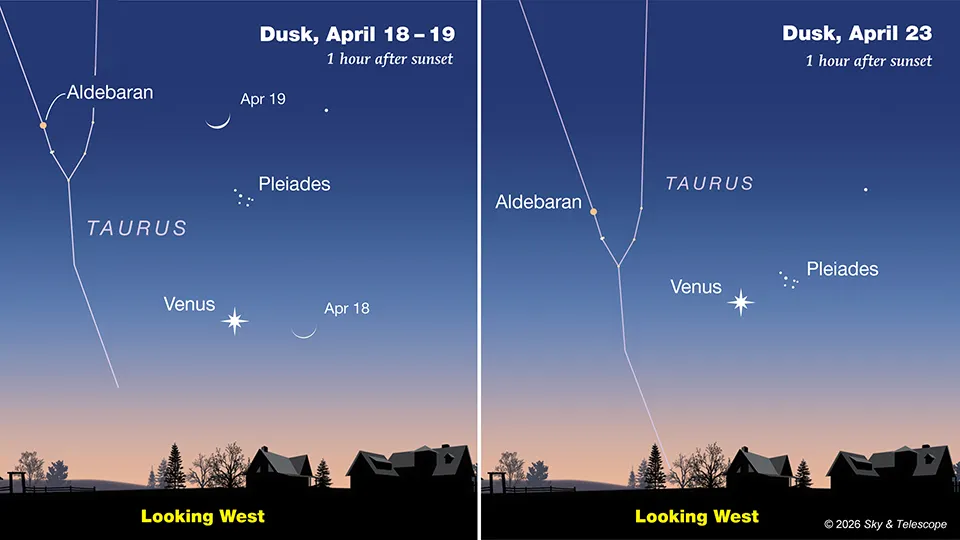
Planet-wise, this is definitely a month of transition. You’ll recall that last month Venus, Saturn, and Mercury were barely in view low in the west after sunset — all part of that over-hyped “planet parade.” Now Saturn and Mercury have left the evening stage, leaving brilliant Venus. It’s still low in the west at dusk but climbing higher week by week, setting about two hours after sunset.
Sky & Telescope
If you’ve got keen eyesight, then you might be able to spot the Pleiades star cluster low in the west above Venus. They’re separated by about twice the width of your clenched fist at arm’s length early in the month. But that gap narrows as the cluster slowly sinks and Venus rises. On the 18th and 19th, a beautiful thin crescent Moon joins the scene, and they’re just 3° apart (about the width of two fingers) on the 23rd.
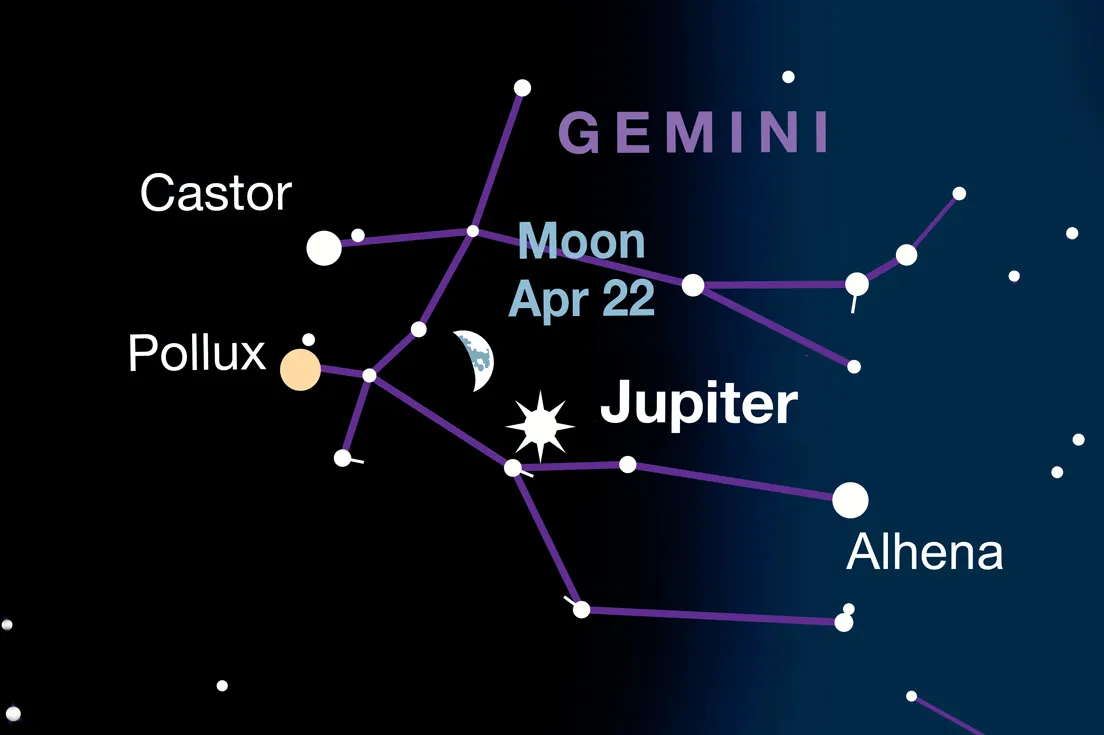
The other planet visible on April evenings is Jupiter. You’ll find it higher up in the west, glowing brightly about halfway from the horizon to overhead once it gets dark. The King of Planets gets a passing visit by the Moon on April 22nd, when they’ll be about two fingers apart.
Not far from Jupiter is a nice pair of equally bright stars. These are Pollux and Castor, the Twins of Gemini. Can you tell which is which? Just remember that Pollux, on the left, is closer to Procyon — and both names begin with “P.” Castor, on the right, is closer to Capella — and both begin with “C”.
Sky & Telescope
These bright stars mark the heads of mythology’s twin brothers (by different fathers, it seems), and at this time of year their heads are on top of their bodies, which hang side by side toward the horizon. Honestly, the mythology is pretty messy here. Their mother was Leda, and the usual story is that Castor was fathered by Tyndareus, the king of Sparta, while Pollux was the divine son of Zeus, who seduced Leda in the guise of a swan. Anyway, in time Pollux convinced his dad to make Castor immortal, so the twins could always be together, and Zeus transformed them into Gemini.
Look eastern from the Big Dipper’s handle to spot Arcturus, the fourth-brightest star in the night sky. Together with Sirius (#1) and Capella (#6), these three stars make an enormous triangle that nearly spans the entire evening sky.
This is just a sample of the fun and educational guided exploration of the night sky that awaits you with this month’s Sky Tour Astronomy Podcast. Click on the link above to listen!
About J. Kelly Beatty
J. Kelly Beatty, S&T Senior Editor, joined the staff of Sky Publishing in 1974 and specializes in planetary science and space exploration. Learn more about him here.


Comments
You must be logged in to post a comment.