 SUNSET:

 0
0This month’s episode showcases the Big and Little Dippers, now placed high in the northern evening sky. We’ll also ponder May’s “Blue Moon,” track down all five bright planets, and watch for meteors from Halley’s Comet. So grab your curiosity, and come along on this month’s Sky Tour.

Listen Here:
Podcast: Play in new window | Download
Subscribe: Apple Podcasts | Spotify | Email | RSS | More
Check out the illustrated version of this podcast on Sky & Telescope’s YouTube channel!
Let’s get started with where you’ll find the Moon this month. Its cycle of phases will be a snap to remember, kicked off by a full Moon on May 1st — and then a second full moon on May 31st.
Now, you’ve probably heard that the one on the 31st should be called a Blue Moon, signifying the second full Moon in a month. But did you know that definition is actually an error started by Sky & Telescope back in March 1946? Yep! That’s when James Hugh Pruett misread tables of lunar phases in the Maine Farmer’s Almanac and came up with the interpretation that’s so common today.
But Pruett was wrong. That old-timey almanac actually described how, in some years, four full Moons occur in a single three-month season, from June’s solstice to September’s equinox, for example. Anyway, this month you get to witness full Moons on both the 1st and the 31st.
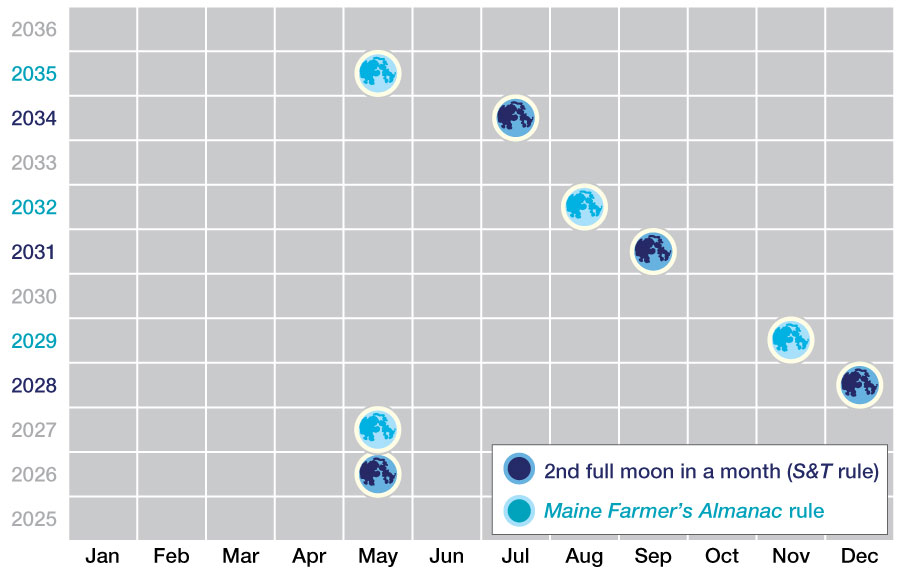
Sky & Telescope
Once it does get dark, look toward west to spot the two brightest planets. Brilliant Venus is hanging low, not far above the horizon. Higher up is Jupiter. Let’s test your powers of observation. Venus is clearly brighter than Jupiter, but by how much? Twice? Ten times? It’s actually about six times right now.
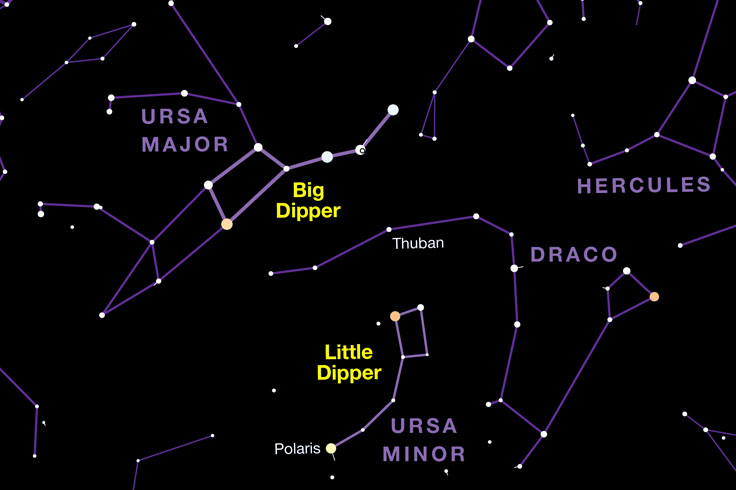
The evening skies of May feature one obvious star pattern that just about everyone knows: the Big Dipper. To find it, all you have to do is look up — way up. You should see the Big Dipper looming over you, with its curved handle bent upward and its four-sided bowl apparently overturned as if dumping soup into some imaginary pot.
Sky & Telescope
I think of the Big Dipper as the “Swiss Army Knife of the night sky,” because it helps me find so many other key springtime stars. For example, find the two stars at the dipper’s left end, forming one side of its bowl. Draw an imaginary line downward through these “pointer stars and follow that line by about three fists. You’ll come to Polaris, the North Star. It marks the end of the handle of the Little Dipper.
And there’s more! To learn about other stars you can find by using the Big Dipper, check out this month’s Sky Tour astronomy podcast.
About J. Kelly Beatty
J. Kelly Beatty, S&T Senior Editor, joined the staff of Sky Publishing in 1974 and specializes in planetary science and space exploration. Learn more about him here.


Comments
You must be logged in to post a comment.