 SUNSET:


Explore the Night with Bob King
See Southern Hemisphere Stars in This Journey to the Bottom of the Sky
How Low Can You Go? Journey to the Bottom of the Sky

Explore the Night with Bob King
Welcome Back, Milky Way!
Twilight's end brings the return of the summer Milky Way to the eastern sky. We unravel the anatomy of our home galaxy by teasing out the hidden structures within that glowing band.

Astronomy in Space with David Dickinson
Astronomers Might Have Found Apollo 10's "Snoopy" Module
A small near-Earth object might be a historic piece of space hardware: the Apollo 10 lunar module, dubbed "Snoopy."
Explore the Night with Bob King
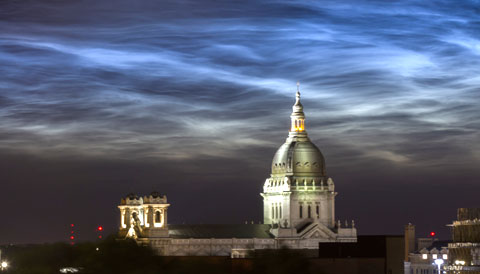
Freaky Noctilucent Clouds Break Out All Over
Night-shining clouds made of ice and meteor smoke are on the increase. We explore their origins and how to see them.

Imaging Foundations with Richard Wright
Satellites, Begone! Remove Trails from Your Astrophotography
While the growing number of satellites above our heads is a concern, there are ways to mitigate their appearances in deep-sky astrophotography.

Explore the Night with Bob King
Jupiter Is Outstanding at Opposition
Prime-time Jupiter viewing kicks off this month when the planet reaches opposition on June 10th.

Astronomy in Space with David Dickinson
NICER Maps the X-ray Sky
NASA's NICER instrument aboard the International Space Station is giving us a unique view of much of the X-ray sky.

Cosmic Relief with David Grinspoon
One Small Step for Plantkind
With a seed germinated on the lunar farside, Earth’s biosphere made its first tentative foray into the cosmos.

Explore the Night with Bob King
SpaceX Launches First Volley of Starlink Satellites
The 60 Starlink satellites parading across the sky make an incredible sight, but some skywatchers wonder at what cost to the night.

Astronomy in Space with David Dickinson
NASA’s Budget Gets a Boost for the Artemis Moon Initiative
As the White House requests an extra $1.6 billion for NASA’s Artemis project, the agency moves forward with commercial partnerships.

Explore the Night with Bob King
See Bright Nebulae Millions of Light-Years Away
We leave the Milky Way behind and venture out to explore giant star-bursting regions in the galaxies M101 and NGC 2366.

Explore the Night with Bob King
Watch International Space Station Flybys All Night Long
The annual International Space Station marathon viewing season begins later this week, when skywatchers in the Northern Hemisphere can watch up to five successive ISS passes in one night.

Imaging Foundations with Richard Wright
An Introduction to Lucky Imaging for Astrophotography
Despite its name, luck has nothing to do with "lucky imaging." The technique is a powerful tool for crisp, clear astrophotography. Here, we take on lucky imaging of the Moon.
Explore the Night with Bob King
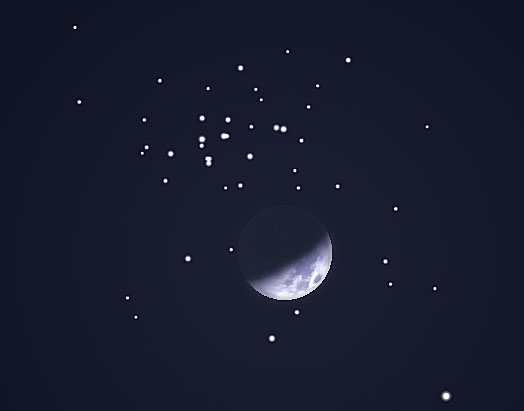
The Moon Bumbles Into the Beehive Friday
The thick crescent Moon occults oodles of stars in the Beehive star cluster Friday evening for much of the Americas.
Explore the Night with Bob King
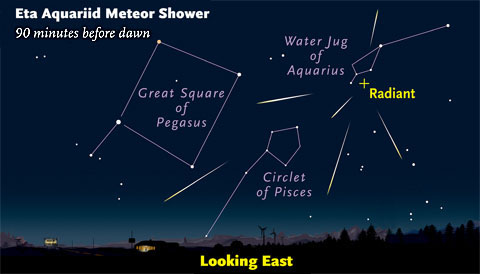
An Excellent Year for the Eta Aquariid Meteor Shower
With no Moon to muss, take a crack at seeing the Eta Aquariids, which could be one of the better meteor showers of the year.

Explore the Night with Bob King
Hunting Bright Variable Stars in M5 and M13
Globular clusters are packed with variable stars, some of which are easy to see and follow in amateur telescopes. We explore M5 and M13, two of the season's finest.

Astronomy in Space with David Dickinson
How Astronomers Used Asteroids to Measure Stars
Astronomers have used a unique method and an extraordinary telescope array to reveal the diameters of distant stars.

Explore the Night with Bob King
Double-Star Date with a Dragon
For your enjoyment, a diverse selection of double stars in Draco for small and medium telescopes.

Astronomy in Space with David Dickinson
Sounding Rockets Spark Dramatic Arctic "Aurora"
The spectacular AZURE experiment is the latest of several missions probing the interface of Earth and space over the Arctic.

Imaging Foundations with Richard Wright
Shoot for the Moon
After all these years, the Moon still hasn't lost its luster as an astrophotography target. Richard S. Wright Jr. provides the basics for a good Moon shot.
