By submitting this form, you are consenting to receive marketing emails from: Sky & Telescope, 1667 K Street NW, Suite 800, Washington, DC, 20006, https://aas.org/. You can revoke your consent to receive emails at any time by using the SafeUnsubscribe® link, found at the bottom of every email. Emails are serviced by Constant Contact
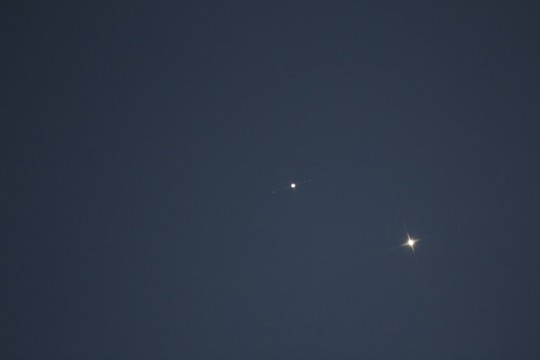
Rick Fienberg shot June 30th's epic planet pairing with an 80-mm f/6 Explore Scientific refractor and a Canon Rebel T3i camera at ISO 400. He combined a short exposure (1⁄160 s) that showed Venus and Jupiter well with a longer, 0.8-s exposure that brought out Jupiter’s moons (from left to right: Ganymede, Io and Europa merged, and Callisto). The field of view is 2⁄3° across.
For the last few weeks, countless numbers of the world’s 7 billion people watched the western evening sky as the two brightest planets, Venus and Jupiter, edged closer and closer to one another. Last night, June 30th, they reached their least separation: 0.3° apart (at the time of twilight for the Americas).
But this celestial dance is far from over. Tonight Venus and Jupiter will still be only about 0.6° apart, as seen from the Americas, and 1.0° tomorrow night. Then they start to say goodbye and will journey apart as they sink deeper into the afterglow of sunset throughout July.
We’ve been lavished with lovely photos from our readers and thought we’d share a few below. Check out our online Photo Gallery to see them all, and submit your own.
Enjoy the show, both here and by eye outside!
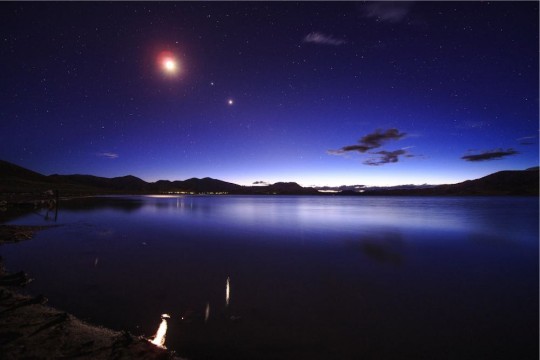
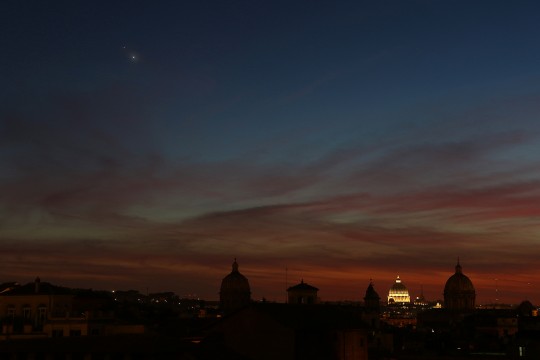
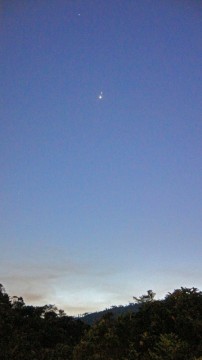
Jupiter, Venus, and the waxing crescent Moon on June 19th, taken by Mario_RSC in Toledo, Spain, with an Olympus SP520.Sunset celestial show by Jeff Dai, taken in Yamdrok Lake, Tibet, on June 21st with a Canon 6D camera and Nikkor 14-24mm lens.Venus and Jupiter close to conjunction shine above Saint Peter’s in Rome, by Gianluca Masi on June 29th. Taken with a Canon 7D Mark II and a 17-55mm lens.Venus and Jupiter Close Conjunction at Dusk by Adam Hazique Zakwan Luhat, taken in Belaga, Sarawak, Malaysia, on June 30th, the evening of the closest pairing. The photographer used a Sony NEX-5 camera with 18-50 mm zoom lens, and a Celestron 70-mm f/5.6 telescope for the close up.Venus and Jupiter at Twilight by Frankie Lucena, in Cabo Rojo, Puerto Rico, on June 30th. Taken with an Olympus 3000 mounted on a tripod.Venus-Jupiter by [email protected], taken from Urmia, Iran, on June 30th with a 150-mm Newtonian reflector and Canon 60D camera.
About Anne McGovern
Anne is the 2015 summer Editorial Intern at Sky & Telescope and a graduate student in Science and Medical Writing at Johns Hopkins University. She is sustained by science and literature, and loves to travel the world.
In looking at photographs of the conjunction from around the world taken on June 30th, I've noticed that the relative positions of Jupiter and Venus are different. From Los Angeles, Jupiter appeared in the One O'clock position vis a vis Venus; however in other photos from other locals it appears at the 11 O'clock position. What is the reason for the apparent difference in relative position? Considering the distances to Venus and Jupiter from Earth and the relatively small distances from the viewer's perspective on Earth, it is hard to explain this difference simply by parallax. I'd be very interested in the explanation of this phenomenon.
Garyt, I think the photo from sel3ulba is probably rotated 90 degrees. It's hard to tell since there isn't anything else in the photo to refer to but that is the simplest explanation.
Hi Gary,
Great question! Besides the possibility that the photo was just reversed, the relative position of Venus and Jupiter does depend on your latitude. Since we are all on a round Earth (and our 6 o'clock position is down towards the horizon) this would change the apparent orientation of the the pair. So at the same instance for us in the L. A. area (I'm in North County, San Diego) we get an orientation of 11 o'clock. Someone north of our location would see the pair move towards the 10 o'clock position and the the 9 o'clock position the farther north you go. Areas south of our 34 and 33 degree north latitude positions would see the pair move towards the 12 o'clock and then eventually to the 1 o'clock position. The photos from Malaysia and Iran are farther south than we are in So. Cal. This just happens because someone else's 6 o'clock position is different from ours -- even though everyone's "down" is towards the center of the Earth.) I've often looked at a setting full Moon, in which the "Man on the Moon" face is tilted over to about the 4 or 5 o'clock position, and then realizing that the rising full Moon for someone in Asia would see the "Man on the Moon" face oriented to roughly the 12 o'clock position at that same instant. Interesting huh? So parallax doesn't really play into it, it's just a question of Earthly orientation. I hope this helps! --Ed Marshall San Marcos, CA.
Gary Tenzer: Venus was moving so fast in comparison to Jupiter, that the relative position changed in a matter of hours. The difference between the images is due to the fact, that they are photographed at different times.
Jupiter uses 12 years to orbit around the Sun. It must therefore spend about one year in each of the Zodiacal constellations. Venus is always seen near the Sun, and as the Sun appears to move through all the Zodiacal constellations in one year - equivalent to about one month in each constellation - Venus is obviously moving similar quickly. Venus moves faster than Jupiter, because it orbits closer to the Sun (Kepler's Laws).
To provide the best experiences, we use technologies like cookies to store and/or access device information. Consenting to these technologies will allow us to process data such as browsing behavior or unique IDs on this site. Not consenting or withdrawing consent, may adversely affect certain features and functions.
Functional
Always active
The technical storage or access is strictly necessary for the legitimate purpose of enabling the use of a specific service explicitly requested by the subscriber or user, or for the sole purpose of carrying out the transmission of a communication over an electronic communications network.
Preferences
The technical storage or access is necessary for the legitimate purpose of storing preferences that are not requested by the subscriber or user.
Statistics
The technical storage or access that is used exclusively for statistical purposes.The technical storage or access that is used exclusively for anonymous statistical purposes. Without a subpoena, voluntary compliance on the part of your Internet Service Provider, or additional records from a third party, information stored or retrieved for this purpose alone cannot usually be used to identify you.
Marketing
The technical storage or access is required to create user profiles to send advertising, or to track the user on a website or across several websites for similar marketing purposes.
To provide the best experiences, we and our partners use technologies like cookies to store and/or access device information. Consenting to these technologies will allow us and our partners to process personal data such as browsing behavior or unique IDs on this site and show (non-) personalized ads. Not consenting or withdrawing consent, may adversely affect certain features and functions.
Click below to consent to the above or make granular choices. Your choices will be applied to this site only. You can change your settings at any time, including withdrawing your consent, by using the toggles on the Cookie Policy, or by clicking on the manage consent button at the bottom of the screen.
Functional
Always active
The technical storage or access is strictly necessary for the legitimate purpose of enabling the use of a specific service explicitly requested by the subscriber or user, or for the sole purpose of carrying out the transmission of a communication over an electronic communications network.
Preferences
The technical storage or access is necessary for the legitimate purpose of storing preferences that are not requested by the subscriber or user.
Statistics
The technical storage or access that is used exclusively for statistical purposes.The technical storage or access that is used exclusively for anonymous statistical purposes. Without a subpoena, voluntary compliance on the part of your Internet Service Provider, or additional records from a third party, information stored or retrieved for this purpose alone cannot usually be used to identify you.
Marketing
The technical storage or access is required to create user profiles to send advertising, or to track the user on a website or across several websites for similar marketing purposes.
 SUNSET:

 10
10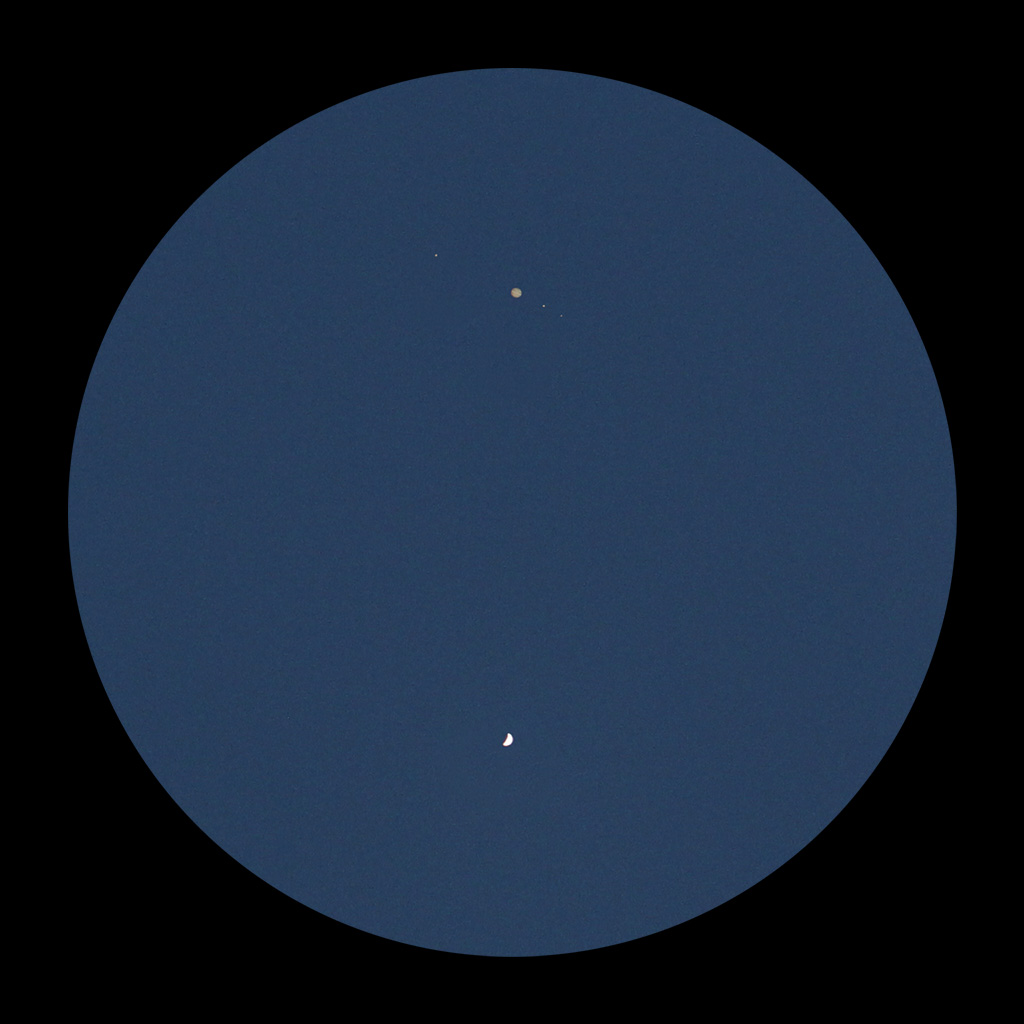




Comments
July 1, 2015 at 9:29 pm
https://m.flickr.com/#/photos/cwchin/19108875969/
You must be logged in to post a comment.
July 2, 2015 at 11:06 am
In looking at photographs of the conjunction from around the world taken on June 30th, I've noticed that the relative positions of Jupiter and Venus are different. From Los Angeles, Jupiter appeared in the One O'clock position vis a vis Venus; however in other photos from other locals it appears at the 11 O'clock position. What is the reason for the apparent difference in relative position? Considering the distances to Venus and Jupiter from Earth and the relatively small distances from the viewer's perspective on Earth, it is hard to explain this difference simply by parallax. I'd be very interested in the explanation of this phenomenon.
You must be logged in to post a comment.
July 6, 2015 at 1:30 am
They are taken on different days.
You must be logged in to post a comment.
Richard-Peterson
July 3, 2015 at 10:54 pm
Garyt, I think the photo from sel3ulba is probably rotated 90 degrees. It's hard to tell since there isn't anything else in the photo to refer to but that is the simplest explanation.
You must be logged in to post a comment.
Ed-Marshall
July 3, 2015 at 11:19 pm
Hi Gary,
Great question! Besides the possibility that the photo was just reversed, the relative position of Venus and Jupiter does depend on your latitude. Since we are all on a round Earth (and our 6 o'clock position is down towards the horizon) this would change the apparent orientation of the the pair. So at the same instance for us in the L. A. area (I'm in North County, San Diego) we get an orientation of 11 o'clock. Someone north of our location would see the pair move towards the 10 o'clock position and the the 9 o'clock position the farther north you go. Areas south of our 34 and 33 degree north latitude positions would see the pair move towards the 12 o'clock and then eventually to the 1 o'clock position. The photos from Malaysia and Iran are farther south than we are in So. Cal. This just happens because someone else's 6 o'clock position is different from ours -- even though everyone's "down" is towards the center of the Earth.) I've often looked at a setting full Moon, in which the "Man on the Moon" face is tilted over to about the 4 or 5 o'clock position, and then realizing that the rising full Moon for someone in Asia would see the "Man on the Moon" face oriented to roughly the 12 o'clock position at that same instant. Interesting huh? So parallax doesn't really play into it, it's just a question of Earthly orientation. I hope this helps! --Ed Marshall San Marcos, CA.
You must be logged in to post a comment.
Karsten Bomholt
July 4, 2015 at 3:20 am
Gary Tenzer: Venus was moving so fast in comparison to Jupiter, that the relative position changed in a matter of hours. The difference between the images is due to the fact, that they are photographed at different times.
You must be logged in to post a comment.
July 4, 2015 at 11:04 pm
Karsten, Jupiter moves through our sky faster than Venus.
You must be logged in to post a comment.
Karsten Bomholt
July 6, 2015 at 1:09 am
Jupiter uses 12 years to orbit around the Sun. It must therefore spend about one year in each of the Zodiacal constellations. Venus is always seen near the Sun, and as the Sun appears to move through all the Zodiacal constellations in one year - equivalent to about one month in each constellation - Venus is obviously moving similar quickly. Venus moves faster than Jupiter, because it orbits closer to the Sun (Kepler's Laws).
You must be logged in to post a comment.
andy
July 4, 2015 at 5:35 am
My photo of the pairing taken in the UK consists of 3 combined short exposures.
https://onedrive.live.com/redir?resid=950831DD56DCEB87!1026&authkey=!ALCFdyiCu7T6PAA&v=3&ithint=photo%2cjpg
You must be logged in to post a comment.
July 8, 2015 at 10:33 pm
Photos of the Venus-Jupiter Conjunction very good. It is very amazing. Thanks to photographer
You must be logged in to post a comment.
You must be logged in to post a comment.