 SUNSET:

 1
1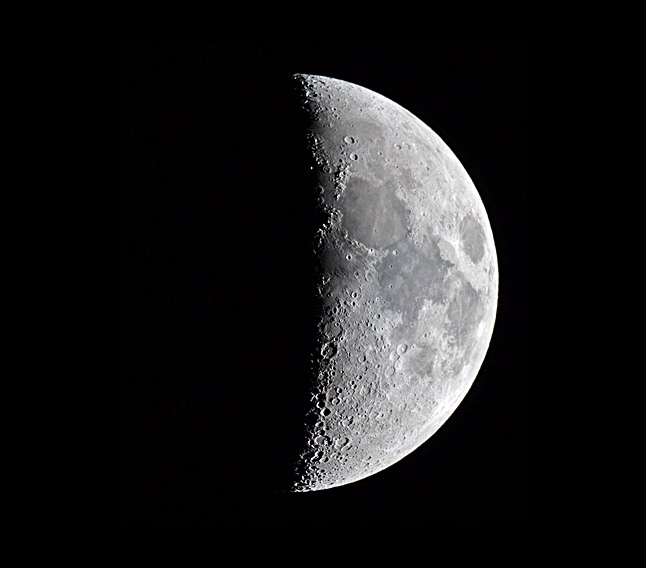
When the Moon is waxing, like now, it shines in the evening and grows wider each night — as the terminator (the line dividing night and day on the Moon's surface) moves to unveil more and more of the blasted, alien landscape.
Gary Seronik
Maybe you just got a shiny new telescope to call your own. Congratulations — you could be on your way to making lifelong friends with stupendous, faraway cosmic immensities floating high over your roof every night, things you never knew were right up there waiting all along for you to find them.
However, most of them are so far and faint that just locating and identifying them is the challenge — and the accomplishment! Whether your new scope is a long, sleek tube or a compact marvel of computerized wizardry, surely you're itching to try it out.
Before You Observe
Here are three essential tips for starting on the right foot, to avoid frustrations and dead ends and to move quickly up the learning curve.
First, get your scope all set up indoors. Read the instructions, and get to know how everything works — how the telescope moves and if it can be locked from moving, how to change eyepieces, how to align or “collimate” the optical parts if necessary, and so on — in warmth and comfort. That way you won’t have to figure out unfamiliar knobs, settings, and adjustments outside in the cold dark.
Second, take the scope outside in the daytime and familiarize yourself with how it works on distant scenes — treetops, buildings — to get a good feel for what it actually does, and for how wide (or rather, how narrow! ) its views are.
Don’t be surprised if the view is upside down. Allowing this in an astronomical telescope keeps the optical parts simpler, meaning clearer and less trouble-prone. And it doesn’t matter because there’s no up or down in space!
You'll quickly find that the telescope’s lowest magnification (meaning the eyepiece with the longest focal length; the one with the widest lenses and the highest “mm” number on it) gives the brightest, sharpest, and widest views. And also, the view that wiggles the least with each touch to the telescope. The lowest power also makes it easiest to find what you’re trying to aim at, thanks to its less-narrow field of view.
So you’ll always want to start off with the lowest power. Switch to a higher-magnification eyepiece only after you’ve found your target, got it centered, and had a good, careful first look.
If the telescope has a little finderscope or a red-dot pointing device attached to its side, daytime is the easiest time to align the finder with the main scope. You really need to do this! Aim the telescope at a distant treetop or other landmark and center it in the main view. Lock the mount’s motions if the mount allows this. Recheck that the treetop is still centered, get it back there if necessary, then look through the finderscope. Use the finder’s adjustment screws to center its crosshairs (or red dot) on the same treetop. Then recheck again that the treetop is still in the center of the main scope’s view, in case you bumped it off in this touchy process.
Third: Psych yourself to be patient. If you hit a frustration point, breathe, relax, and start again. Spend time with each sky object you are able to locate, and really get to know it. Too many first-time telescope users unconsciously expect Hubble-like brightness and color in the eyepiece — when in fact most astronomical objects are very dim to the human eye. Moreover, our night vision sees dim things mostly in shades of gray, not in color. Much of what the universe has to offer is subtle and, again, extremely far away!
But the longer and more carefully you examine something faint and difficult, the more of it you’ll gradually discern. Astronomy teaches patience. Learn it.
And take to heart Jennifer Willis's personal astronomy story, Modest Expectations Give Rise to Delight.
On the other hand, the Moon and the naked-eye planets are bright and easy to find. They make excellent first targets for new telescopic observers. Sky & Telescope’s This Week’s Sky at a Glance has daily suggestions for both telescopic and naked-eye viewing of the brightest stars and planets.
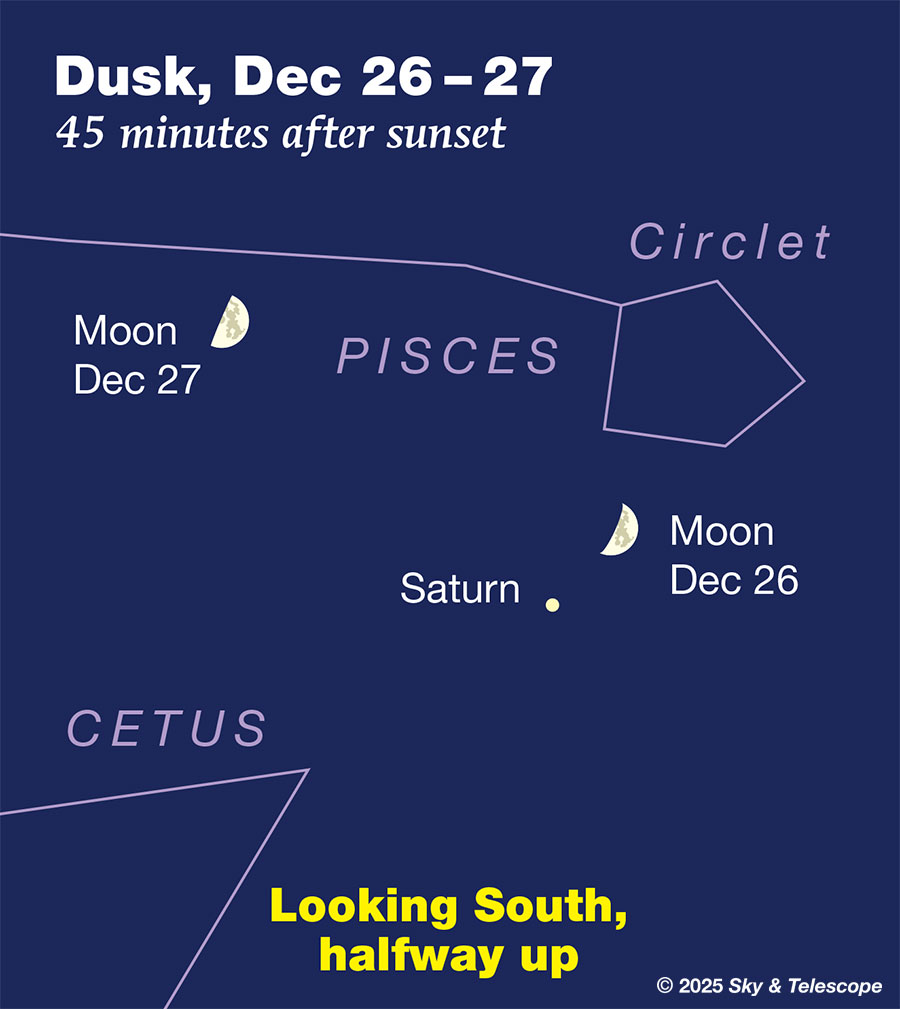
For instance, here's looking high in the south as the stars come out on December 26 and 27, 2025. The waxing Moon will guide your way to Saturn. Their background constellations are dim Pisces and Cetus, with no stars bright enough to be plotted here.
New-Telescope Delight: The Moon
The Moon is one celestial object that never fails to impress in even the most humble scope. It’s our nearest neighbor in space — big, bright, starkly bleak, and a mere quarter million miles away. That’s a hundred times closer than the nearest planet ever gets. An amateur telescope and a detailed Moon map can keep you busy forever.
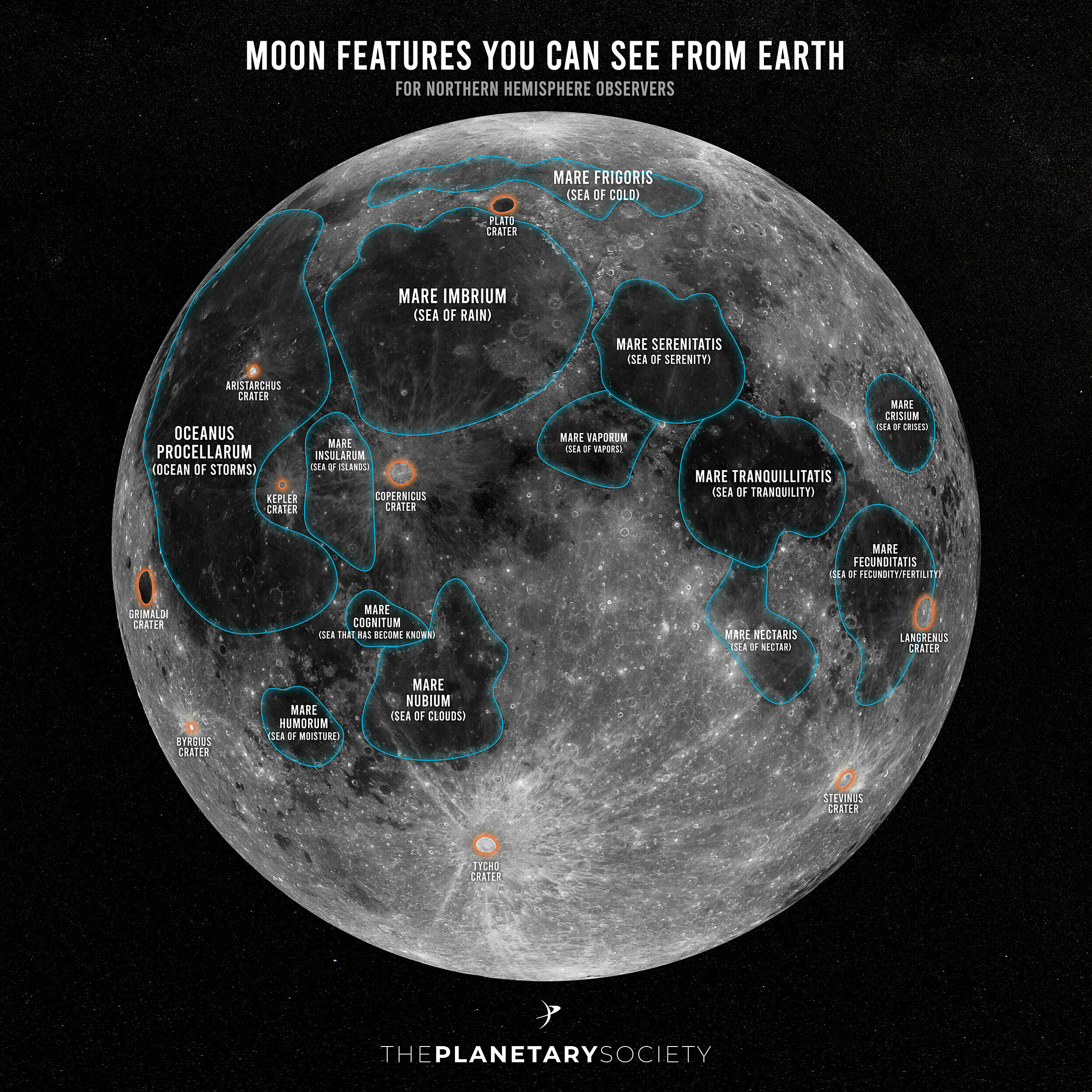
Tonight (December 25, 2025) the Moon shines high in the evening sky. As the photo at the top of this page shows, lunar surface features stand out best when they are near the Moon’s terminator: the lunar sunrise or sunset line. There, the low Sun in the Moon’s sky makes even low landforms cast long, stark black shadows and stand out dramatically. The advancing terminator unveils new landscapes day by day when the Moon is waxing before full, then hides them in darkness day by day when the Moon is waning after full.
In between at full Moon, the terminator lies all around the Moon’s edge essentially out of sight. So full phase (which next comes January 2nd) is actually the worst time to see detail on the Moon. That’s because its whole face is brightly sunlit by the Sun directly behind us, so the lunar mountains, hills, craters and cliffs cast no shadows to reveal them as other than flat. Everything will just be shades of brilliant gray-white. Still, don't ignore the full Moon. Now you get a complete look at the flat, gray lunar lava plains or “seas” (maria in Latin). Learn their names. Brighter areas are more mountainous, and many craters large and small will reveal themselves at full Moon by their bright white rims and spreading white "rays" of splashed debris.
Bright Planets
Two bright planets await you now in the evening sky: Saturn and, later in the evening, Jupiter.
Saturn currently shines high in the south after dark, and lower toward the southwest as the evening grows late. It's the brightest point in its area, so you'll have no trouble finding it.
And this evening the 25th, it's that obvious bright point about a fist-width at arm's length upper left of the Moon.
A telescope will reveal that this season, we see Saturn's iconic rings very close to edge on. So they look like a toothpick stuck through a cheeseball. We get such a view of Saturn only every 15 years. Watch carefully to see if you can make out the thin black line of the rings' shadow on Saturn's globe. And can you see hints of cloud banding?

Damian Peach
Saturn has many moons. The biggest, Titan, is detectable in a 3-inch or larger telescope as a tiny pinpoint in Saturn's vicinity. Tonight (December 25th) it’s off to one side of Saturn by a little less than twice the full length of the rings, in line with them. Can you detect Titan’s slightly orange tint? You are seeing its smoggy methane atmosphere.
And on the other side of Saturn tonight are fainter Dione just off the rings' tip, then faint Tethys, then brighter Rhea much farther out. Identify the moons you see, or to look for, at any date and time with Sky & Telescope's online Saturn's Moons tool.
Jupiter is the brilliant white dot shining low in the east as night arrives. But don't get your hopes up for a fine telescopic view of it just yet. When an object is fairly low in the sky, high magnification shows it shimmering and blurring more than when it's high up. This is because you're looking through thick low layers of Earth's atmosphere, where the fuzzing and image degradation caused by our unstable atmosphere is at its worst. This blurring and shimmering is called the atmospheric seeing. The seeing changes quite a bit from night to night and sometimes even moment to moment. Astronomers are always trying to catch spells of good seeing. This was much of the motivation for putting telescopes in space above the atmosphere entirely.
By 9 or 10 p.m. Jupiter rises high into much better view.
Even the smallest telescope at low power will show Jupiter's four pointlike moons on either side of it. They change configuration endlessly from night to night as they orbit the planet. This evening, December 25th, you'll find Europa, Callisto and Ganymede off on one side of Jupiter and Io closer in on the other side. Tomorrow their configuration will be quite different, and on and on while Jupiter is in view all this winter and early spring. (Use S&T's online Jupiter's moons tool.) They've been at it up there every night for 4.6 billion years, ever since the solar system formed.
Now switch to fairly high power. Jupiter itself spins so fast (once every 10 hours) that it's not quite round, which a small scope will reveal.
And can you make out any of Jupiter’s parallel tan cloud belts? They can darken or brighten, broaden or narrow, over a matter of months or years. They won't exactly leap out at you. Keep looking, and looking. Carefully. You may (or may not) catch that occasional moment of steady air when a planet sharpens right up.

The Great Red Spot? It was on the other side of Jupiter at the time of this photo.
There’s another reason to keep looking. When you’re working near the limit of your vision, as you usually will be in astronomy, it takes time and continued attention to see all that you can see. Things that were at first invisible may start to occasionally flicker into view, then become definite enough to hold almost steadily. Did we say astronomy teaches patience?
Jupiter’s famous Great Red Spot, in the edge of the South Equatorial Belt, is a harder catch. It may need at least a 4- or 6-inch scope and a night of especially steady seeing. The Red Spot is currently pale orange (this too changes), and it has been gradually shrinking for decades. And, of course, it needs to be on the side of Jupiter facing Earth at the time you look!
The other bright planets are currently out of good sight:
Venus is the brightest one of all, but it's currently hiding behind the glare of the Sun. It will emerge this spring and summer to shine as the bright "Evening Star" in the western twilight.
Venus is covered in white clouds that are brilliantly lit by sunlight twice as bright as sunlight on Earth. In a telescope Venus shows phases like the Moon, but they change much more slowly. This spring Venus will appear gibbous. Then, as it enlarges month to month drawing nearer to us, it become half-lit, then a crescent, then a dramatic thin crescent in late summer and early fall as it settles lower into the twilight.

J. Kelly Beatty
Mars too is out of sight now behind the Sun. Not until summer will it emerge into good view, and even then you'll have to be out before dawn. But later in 2026 it will move into the evening sky, to become largest, brightest, and closest to Earth in early 2027.

Little Mercury, the last bright planet, is also hidden now in the glare of the Sun. Its best evening showings in 2026 will come in late February and early June. Because Mercury orbits close to the Sun, we only see it fairly near the Sun in our sky: low in the west after sunset or low in the east before sunrise.
Deeper Telescopic Sights
Of course there’s much more to the night sky than the Moon and planets! Winter nights often bring crisp, transparent skies with a grand canopy of stars. But with so many inviting targets overhead, where to point first?
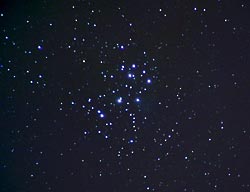
Well, face east these evenings and look very high. See a speckly little misty patch, about the size of your fingertip at arm’s length? You've just found the Pleiades, the finest star cluster visible to the naked eye. Most people can make out the six brightest Pleiades stars with the unaided eye (and distance glasses if necessary). They form a tiny dipper shape. But a telescope will show a whole swarm, including a few double stars, and the dipper pattern will look huge and bright — overspilling your eyepiece view at any but the very lowest magnifications.
Astronomers have determined that the Pleiades include more than 500 stars in all, most very faint. Like other star clusters, the Pleiades are held together by their mutual gravity. They swarm like bees on a timescale of millions of years. This one is classed as an open cluster for the stars’ relatively uncrowded arrangement. It’s nearby as star clusters go, traveling through space as a swarm about 440 light-years away.
The Pleiades stars, astronomers have determined, began to shine only about 80 million years ago. This makes them mere toddlers compared to our Sun and solar system, age 4.6 billion years. These youthful suns are astonishingly energetic. Alcyone (al-SIGH-oh-nee), the brightest, is at least 350 times as luminous as our Sun. Like the other bright Pleiads it gleams with an intense bluish-white light — a sign that it’s unusually hot and massive.
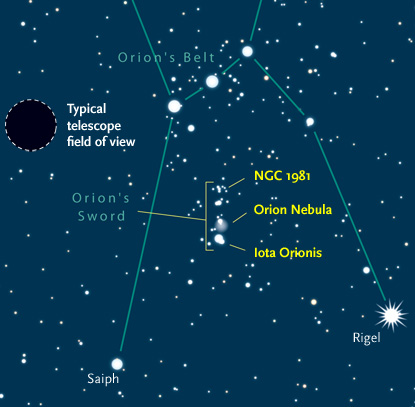
Next, here’s a deeper suggestion. The familiar constellation Orion climbs the southeastern sky after dinnertime at this time of year, way down below the Pleiades. In its middle, look for the three-star line of Orion’s Belt. The Belt is now almost vertical in early evening. It turns diagonal (as shown below) when Orion is higher in finer view later at night.
Sky & Telescope diagram
Just a few degrees south of the Belt (in other words a few finger-widths at arm’s length) runs a smaller, dimmer line of stars: Orion’s Sword. Within it lies the Orion Nebula, a luminous cloud of gas and dust where new stars are forming by the hundreds. It shows pink in many photographs, but to the human eye it’s dim gray with a hint of green. The nebula is evident in any telescope once you get pointed at it, and so is the tight quartet of young stars near its center, known as the Trapezium. Astronomers refer to the Orion Nebula as Messier 42 (M42), and you’ll see it labeled that way on star charts. Located about 1,400 light-years away, it's the closest massive star-forming nebula to Earth.
Dim objects like nebulae are best seen when the sky is moonless and really dark. The farther you can get out from under the skyglow of city light pollution, the better. But don't let moonlight or light pollution dissuade you from finding what you can see from your own backyard or apartment balcony or roof garden or fire escape! Choose reasonably bright targets to hunt, and develop the skills to find them and observe them carefully so you’ll be ready to make the most of better conditions when the chance arises. For instance, the sky may be especially clean and dark the night after a storm passes through.
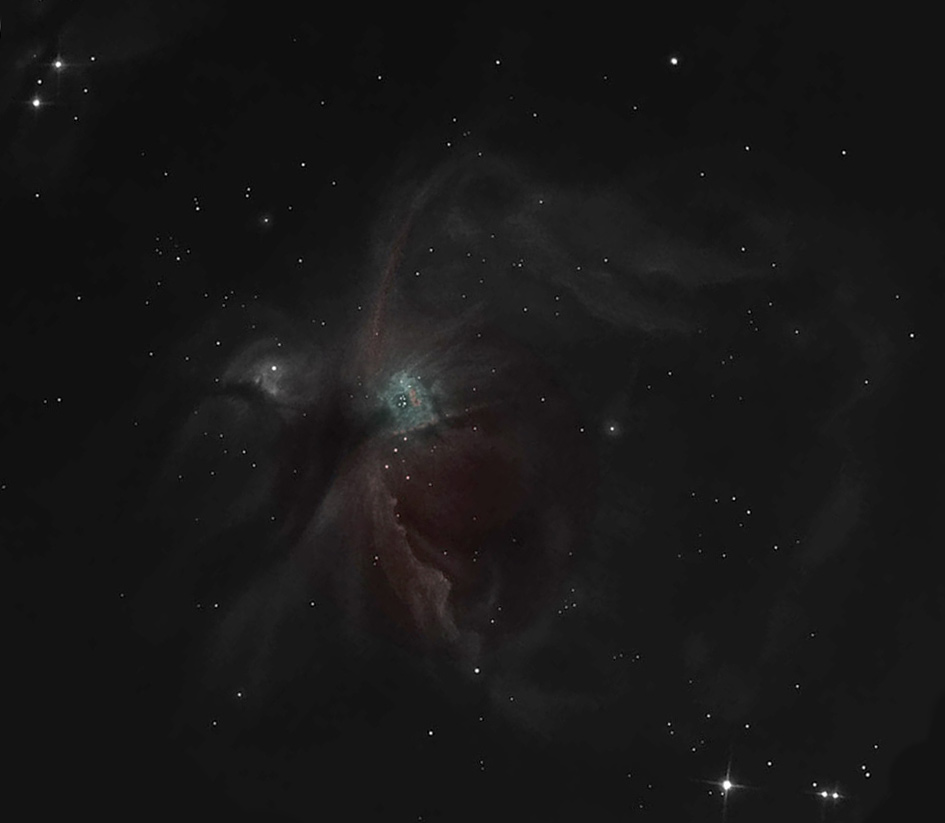
Howard Banich / S&T Online Gallery
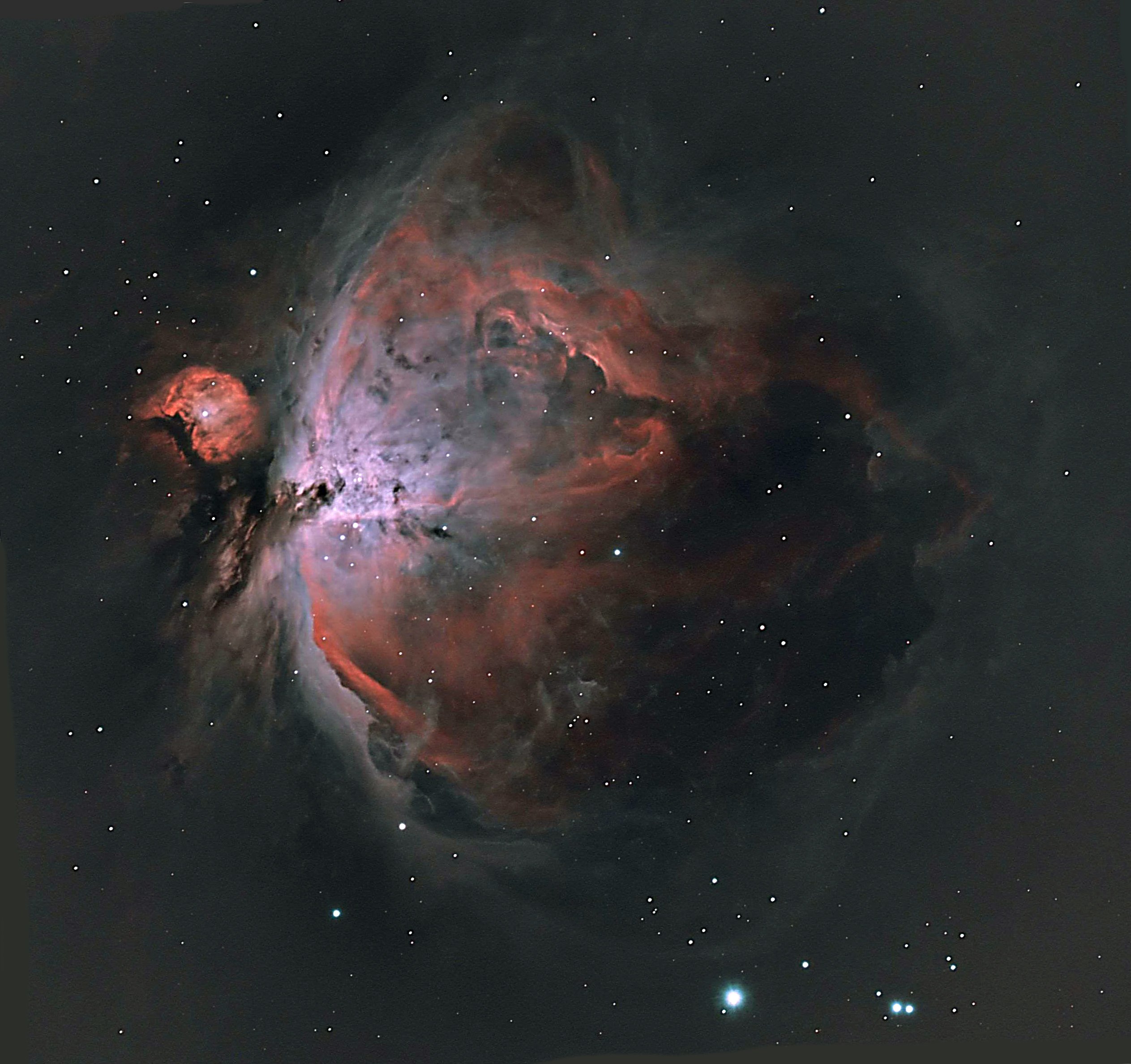
Modern digital astrophotography has made fine, well-mounted amateur telescopes far more capable than we once thought they could be. But despite ongoing technical advances and simplifications, imaging this good is an art for the finicky and dedicated who can buy serious gear and have the time and patience to master it. However, the technology is getting better and simpler to use all the time! A major obsession could be in your future. . . .
Ravzan Orbu / S&T Online Gallery
Next Steps in Astronomy
To find much else in the night sky, start learning the constellations. They’re the key to locating everything fainter and deeper to hunt with binoculars or a telescope — the same way that on a globe of Earth, you need to know the continents and countries before you can pinpoint, say, Milan or Dnipro or Jakarta.
For an easy-to-use constellation guide covering the whole evening sky, you can use the big monthly map in the center of each issue of Sky & Telescope, the essential magazine of astronomy (ahem).
You’ll also want a good, detailed star atlas (set of more detailed maps), such as the widely used Pocket Sky Atlas; a good deep-sky guidebook; and some practice in how to use your maps — whether they're on paper or on the screen of a phone or tablet — to pinpoint the aim of your telescope onto something too faint to see with your eyes alone. So be sure to read our article How To Use a Star Chart with a Telescope.
For more tips on skywatching and how to get the most out of your scope, see this website’s Observing section and Getting Started section.
Whatever else, stick with it. Nobody is born knowing this stuff. Get to know the astronomy shelf at your local library. Good books are clearer and much better organized for getting the big picture than the random jumble of the internet. Work your way into the hobby at your own pace, finding things to know and do and understand without worrying about everything else you haven’t got to yet. That’s kinda the way life is in a big universe, right?
P.S.: To discover the attitude-alignment that every successful, lasting amateur astronomer develops, do read Jennifer Willis's Modest Expectations Give Rise to Delight.
About Alan MacRobert
Alan M. MacRobert became an avid Sky & Telescope subscriber in 1966 at age 14, joined the editorial staff in 1982, and is now a senior contributing editor, semi-retired. He played a role in practically every part of the magazine and the company's other products for more than a generation, both on the amateur-observing side and the science-reporting side. In 1994 a book collection of his observing how-tos and telescopic sky tours was published as Star Hopping for Backyard Astronomers. He has produced This Week's Sky at a Glance online every week since 1989.


Comments
JohnofYork
December 26, 2025 at 4:57 pm
I think this is one of the most attractive and friendly articles for newbies as I have ever read. I feel that Mr Macrobert is at my elbow. I recommend that all those new to this fascinating hobby read his wonderful guide.
Well done, Sir.
You must be logged in to post a comment.
You must be logged in to post a comment.